
Choose Your Language / 言語を選択:
Introduction
From Science “Observing” Weather to Story of Girl “Praying” for Weather
Every year February 16 is Weather Chart Day.
February 16, 1883 (Meiji 16), Japan’s first weather chart created. Under German meteorologist Erwin Knipping (1844-1922) guidance, Tokyo Meteorological Observatory (current Meteorological Agency) created 7-color printed weather chart using meteorological data collected from 11 weather stations nationwide. From March 1 onward printed and issued once daily, from August 23 onward displayed at Shinbashi and Yokohama stations. This marked beginning of Japan’s modern meteorology, first step of scientific weather forecasting.
Weather chart analyzes present and future weather by drawing meteorological data like atmospheric pressure, temperature, wind on maps. Isobars and symbols allow seeing low pressure, high pressure, front positions at glance. Reading weather charts enables us grasping weather as massive natural phenomenon, preparing.
Perfect film for this Weather Chart Day is Makoto Shinkai’s 2019 animated film Weathering With You.
This film complete opposite approach from science “observing,” “analyzing,” “expressing” weather (weather charts)—story of girl possessing power manipulating weather by “praying.” Protagonist Hina Amano “100% sunshine girl” possesses mysterious power clearing cloudy skies merely by praying. However, this power has cost, Hina bears destiny becoming human sacrifice as “weather maiden.”
Completely opposite approach film yet depicts universal theme how we should face weather in climate change and abnormal weather era.
Over 5 years since 2019 release, abnormal weather and climate change threats depicted in film became even more urgent reality for us today.
Through this film, consider science trying understanding weather (weather charts), power trying manipulating weather (sunshine girl), ultimately how we should coexist with weather as massive nature.
Basic Information & Synopsis
→ For synopsis and production information, see our Database Article
Director: Makoto Shinkai
Year: 2019
Runtime: 114 minutes
Production: CoMix Wave Films, Story Inc.
Commemorative Day: Weather Chart Day (February 16)
Background Knowledge
Makoto Shinkai Director: Weather Depiction Genius
Makoto Shinkai born February 9, 1973, Koumi Town, Minamisaku District, Nagano Prefecture. He Japan’s representative animation director known for beautiful imagery and bittersweet romance stories like 5 Centimeters per Second, The Garden of Words, Your Name.
Love for Weather: Shinkai director stated loving watching sky and clouds since childhood. Koumi Town, Nagano surrounded by Yatsugatake and Mt. Asama with complex air currents, staring at sky clouds constantly changing shape, sky colors changing like gradation, never getting tired watching. “As child played with sky like ‘that cloud shape looks like monster,’ but entering adolescence clearly felt sky’s beauty ‘how beautiful’” (Shinkai director).
Weather Expression Evolution: In Shinkai works, weather not mere background but crucial element expressing character emotions. 5 Centimeters per Second (2007) depicted snow’s warmth, The Garden of Words (2013) depicted rain as red thread. The Garden of Words especially famous as “rain film,” rain falling patterns, raindrops bouncing in puddles, raindrops running down windows—all poetically beautifully depicted. Critics evaluated “rain third character.”
Weathering With You second “rain film” 6 years after The Garden of Words. However, while The Garden of Words depicted quiet emotional rain, Weathering With You depicts fierce, overwhelming, sometimes threatening rain.
Production Background: Climate Change Crisis Awareness
Shinkai director states Weathering With You production motivation:
“Making film, first consider what current audiences want seeing. Considering what Japanese people concerned about now, weather I thought. Climate change issues exist, but before that weather incredibly intimately connected to us, major factor influencing mood.”
“From around hot summer 2016 when previous work Your Name screened, remember realizing anxiety and fear ‘from now weather won’t be just enjoyment thing.’”
“We adults undoubtedly share responsibility creating such world. But young generation living future lives need not bear adults’ depression. Want generation living in world where abnormal weather normalized to lightly overcome and go beyond.”
Weather Prayer Folk Traditions and “Weather Maiden” Origins
“Sunshine Girl” “Rain Man” Traditions:
- Folk traditions existing throughout Japan
- Legends specific persons’ event participation brings clear weather (or rain)
- Actually “sunshine girls” invited to weddings, sports events
Weather Prayer Rituals:
- Teru teru bozu: Dolls wishing for clear weather
- Rain-making ceremonies: Events praying for rain during drought
- Regional distinctive weather prayers (e.g., Kyoto Gion Festival, Aomori Nebuta Festival)
“Weather Maiden” Shrine Background:
Film’s “weather maiden” concept deeply related to actual shrine beliefs. Particularly notable shrines:
- Koenji Hikawa Shrine Weather Shrine: Japan’s only shrine enshrining weather deity, said granting weather wishes
- Kifune Shrine (Kyoto): Enshrines water deity, famous for rain prayers since ancient times
- Seimei Shrine (Kyoto): Enshrines onmyoji Abe no Seimei, weather divination and prayer history
- Regional water deity and thunder deity shrines: Scattered nationwide, community weather prayer centers
These shrines actually conduct “weather prayers,” film’s “weather maiden” setting likely inspired by such traditional Japanese belief systems. Particularly Shinto concept where miko serves as intermediary between gods and humans strongly reflected in Hina’s character setting.
What Makes It Exceptional
Rain and Light’s Overwhelming Visual Beauty
Weathering With You‘s finest point is rain and light depiction. Makoto Shinkai director sublimated rain from “mere weather” to “art.”
Rain Depiction: Most film features rain scenes. However, Shinkai director’s rain not monotonous. Light rain, heavy rain, drizzle, downpour—rain has various expressions. Raindrops running down windows, rain bouncing in puddles, Tokyo shrouded in rain viewed from building rooftop—all poetic and beautiful.
Particularly impressive: Tokyo aerial shots covered by rain clouds. Heavy gray clouds covering city, occasional light leaking through has overwhelming power. Shinkai director evaluated “can fantastically beautifully show super annoying rainy Tokyo situation from aerial view.”
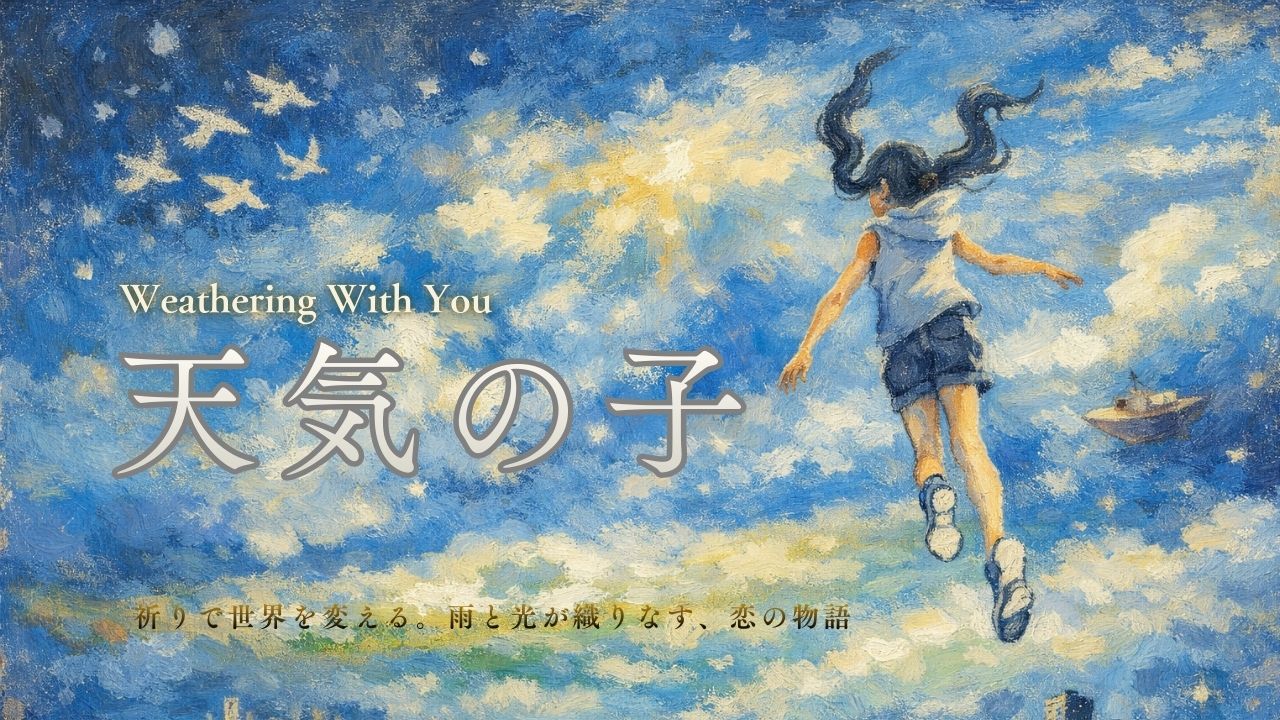
Light Depiction: Scene where Hina prays, rain clouds split, blue sky and sunlight pour through is film highlight. Light radiates through cloud gaps, entire city shines golden. This “light explosion” gives audience intense emotion.
Shinkai director’s light expression ability world’s highest level. Light reflection, shadows, reflections—all calculated, beauty surpassing live-action.
World Above Clouds: “otherworld above clouds” Hodaka visits saving Hina is film’s most fantastical scene. White cloud sea, blue sky, sunlight, fish swimming in sky—this otherworld reminiscent of Hayao Miyazaki’s Studio Ghibli works yet depicted with Makoto Shinkai’s unique aesthetics.
Weather and Emotion Synchronization
Shinkai works’ characteristic is weather closely linked to character emotions. Weathering With You pushes this technique to extreme.
Hina’s Emotions and Weather: Hina’s power linked to her emotions. When Hina happy, sky clears. When Hina anxious, snow falls (August snow). When Hina angry, lightning strikes.
This “emotion = weather” setting functions as metaphor. Our hearts precisely change like weather. Sunny days and rainy days exist.
Storytelling-wise, excellently fuses fantasy elements with social issues. While using supernatural “sunshine girl” setting, weaves realistic themes like running away from home, poverty, loneliness, environmental problems. Particularly life’s harshness Hodaka faces in Tokyo and complex circumstances of adults surrounding him depicted as modern society microcosm.
RADWIMPS Music
Following Your Name, RADWIMPS handled all songs. Theme songs “Is There Still Anything That Love Can Do?”, “Grand Escape”, “We’ll Be Alright” perfectly express film’s emotions.
Particularly “Grand Escape” flows during climax scene where Hodaka saves Hina, drawing audience into excitement and emotion whirlpool. Toko Miura’s vocals fragile and beautiful, speaking Hina’s feelings.
Related Articles
- Weathering With You Database – Synopsis & Production Details
- Makoto Shinkai – Filmmaker Profile
- RADWIMPS – Music Profile
はじめに
天気を「観る」科学から、天気を「祈る」少女の物語へ
毎年2月16日は天気図記念日です。
1883年(明治16年)2月16日、日本で初めて天気図が作成されました。ドイツ人の気象学者エルウィン・クニッピング(Erwin Knipping、1844〜1922年)の指導のもと、東京気象台(現在の気象庁)が全国11箇所の測候所から集めた気象データを元に、7色刷りの天気図を作成したのです。3月1日以降は印刷して1日1回発行されることになり、8月23日以降は新橋と横浜の停車場に掲示されました。これが日本の近代気象学の始まりであり、科学的な天気予報の第一歩でした。
天気図は、気圧や気温、風などの気象データを地図上に描いて現在や未来の天気を分析する図です。等圧線や記号によって、低気圧や高気圧、前線の位置などが一目でわかるようになります。天気図を読むことで、私たちは天気という巨大な自然現象を把握し、備えることができます。
この天気図記念日に観るのに最適な映画が、新海誠監督による2019年のアニメーション映画『天気の子』です。
この映画は、天気を「観る」「分析」「表す」科学(天気図)とは正反対のアプローチ——天気を「祈る」ことで操る力を持った少女の物語です。主人公・天野陽菜は「100%の晴れ女」として、祈るだけで曇天を晴れにする不思議な力を持っています。しかし、この力には代償があり、陽菜は「天気の巫女」として人柱になる運命を背負います。
全く正反対のアプローチの映画ではありますが、気候変動と異常気象の時代に、私たちが天気とどう向き合うべきかという普遍的なテーマを描いています。
2019年の公開から5年以上が経過しましたが、映画が描いた異常気象と気候変動の脅威は、今日の私たちにとってさらに切実な現実となっています。
この映画を通じて、天気を理解しようとする科学(天気図)と、天気を操ろうとする力(晴れ女)、そして最終的には天気という巨大な自然とどう共生していくべきかについて考えてみませんか。
基本情報・あらすじ
→ あらすじや製作情報はデータベース記事へ
監督: 新海誠
製作年: 2019年
上映時間: 114分
制作: コミックス・ウェーブ・フィルム、ストーリー
記念日: 天気図記念日(2月16日)
予備知識
新海誠監督:気象描写の天才
新海誠は1973年2月9日、長野県南佐久郡小海町生まれです。彼は、『秒速5センチメートル』『言の葉の庭』『君の名は。』など、美しい映像と切ない恋愛物語で知られる日本を代表するアニメーション監督です。
気象への愛: 新海監督は幼少期から空や雲を見るのが大好きだったと語っています。長野県の小海町は、八ヶ岳や浅間山に囲まれた気流が複雑な土地で、空を見上げていると時々刻々と雲が形を変え、空の色がグラデーションのように変化していくのをずっと飽きずに眺めていたそうです。「幼い頃は『あの雲の形は怪獣みたい』などと空で遊んでいましたが、思春期を迎える頃には『なんてきれいなんだ』と空の美しさをハッキリと感じるようになっていました」(新海監督)。
気象表現の進化: 新海作品において、気象は単なる背景ではなく、登場人物の感情を表現する重要な要素です。『秒速5センチメートル』(2007)では雪の温かさを、『言の葉の庭』(2013)では雨を赤い糸として描きました。『言の葉の庭』は「雨の映画」として特に有名で、雨の降り方、水たまりに跳ねる雨粒、窓を伝う雨滴——すべてが詩的で美しく描写されています。批評家たちは「雨が3人目の登場人物」と評しました。
『天気の子』は、『言の葉の庭』から6年後の「雨の映画」第2弾です。しかし、『言の葉の庭』が静かで情緒的な雨を描いたのに対し、『天気の子』は激しく、圧倒的で、時に脅威的な雨を描いています。
制作背景:気候変動への危機感
新海監督は、『天気の子』の制作動機について次のように語っています。
「映画を作るにあたって、今の観客が何を見たいかをまず考えます。そして今、日本人が気にしているのは何かと考えたときに、天気かな、と。気候変動のこともあるけれど、それ以前に天気は僕たちにものすごく密接に関わっていて、気分を左右する大きな要因ですよね」
「前作『君の名は。』が上映された2016年の暑かった夏あたりから、『これからは、天気は楽しむだけのものではなくなってしまうだろう』と、不安や怖さを実感したのを覚えています」
「そんな世界をつくってしまった僕たち大人には間違いなく責任の一端がある。でも、これからの人生を生きていく若い世代の人たちまで、大人の抱える憂鬱を引き受ける必要はないと思うんです。異常気象が常態化している世界で生きていく世代には、それを軽やかに乗り越えて向こう側に行ってほしい」
天候祈願にまつわる民間伝承と「天気の巫女」の元ネタ
「晴れ女」「雨男」の伝承:
- 日本各地に存在する民間伝承
- 特定の人物が行事に参加すると晴れる(または雨になる)という言い伝え
- 実際、結婚式やスポーツイベントなどで「晴れ女」が招かれることもある
天候祈願の儀式:
- 「てるてる坊主」:晴天を願う人形
- 「雨乞い」:旱魃の際に雨を祈願する行事
- 地域による特色ある天候祈願(例:京都の祇園祭、青森のねぶた祭りなど)
「天気の巫女」の神社的背景:
映画に登場する「天気の巫女」の概念は、実在する神社の信仰と深い関係があります。特に注目すべき神社:
- 気象神社(高円寺氷川神社境内):日本唯一の気象の神様を祀る神社、天候に関する願いを聞いてくれるとされる
- 貴船神社(京都):水の神様を祀り、古来より雨乞いや雨止めの祈願で有名
- 晴明神社(京都):陰陽師・安倍晴明を祀り、天候占いや祈祷の歴史がある
- 各地の水神社・雷神社:全国に点在し、地域の天候祈願の中心となってきた
これらの神社では実際に「天候祈願」が行われており、映画の「天気の巫女」という設定は、こうした日本の伝統的な信仰体系から着想を得ていると考えられます。特に巫女が神様と人間の仲介役を務めるという神道の概念が、陽菜のキャラクター設定に色濃く反映されています。
優れている点
雨と光の圧倒的な映像美
『天気の子』の最も優れた点は、雨と光の描写です。新海誠監督は、雨を「単なる天候」から「芸術」に昇華させました。
雨の描写: 映画の大部分は雨のシーンです。しかし、新海監督が描く雨は、単調ではありません。小雨、豪雨、霧雨、土砂降り——雨にも様々な表情があります。雨粒が窓を伝う様子、水たまりに跳ねる雨、ビルの屋上から見下ろす雨に煙る東京——すべてが詩的で美しいです。
特に印象的なのは、雨雲に覆われた東京の俯瞰ショットです。どんよりとした灰色の雲が都市を覆い、その間から時折光が漏れる様子は、圧倒的な迫力です。新海監督は「東京の雨という超絶ウザったいシチュエーションを、俯瞰してあそこまで幻想的に美しく魅せることができる」と評されました。
光の描写: 陽菜が祈って雨雲が割れ、青空と太陽の光が差し込むシーンは、映画のハイライトです。光が雲の隙間から放射状に降り注ぎ、都市全体が黄金色に輝きます。この「光の爆発」は、観客に強烈な感動を与えます。
新海監督の光の表現力は世界最高峰です。光の反射、陰影、写り込み——すべてが計算され、実写を凌駕する美しさです。
雲の上の世界: 帆高が陽菜を救うために訪れる「雲の上の異空間」は、映画の最も幻想的なシーンです。白い雲の海、青い空、太陽の光、そして空を泳ぐ魚——この異世界は、宮崎駿のスタジオジブリ作品を彷彿とさせながらも、新海誠独自の美学で描かれています。
天気と感情のシンクロ
新海作品の特徴は、天気が登場人物の感情と密接にリンクしていることです。『天気の子』では、この手法が極限まで推し進められています。
陽菜の感情と天気: 陽菜の力は、彼女の感情と連動しています。陽菜が幸せな時、空は晴れます。陽菜が不安な時、雪が降ります(8月の雪)。陽菜が怒った時、雷が落ちます。
この「感情=天気」という設定は、メタファーとして機能しています。私たちの心も、まさに天気のように変わりやすいものです。晴れの日もあれば、雨の日もあります。
また、ストーリーテリングの面では、ファンタジー要素と社会問題を巧みに融合させている点が秀逸です。「晴れ女」という超自然的な設定を用いながらも、家出、貧困、孤独、環境問題といった現実的なテーマを織り込んでいます。特に帆高が東京で直面する生活の厳しさや、彼を取り巻く大人たちの複雑な事情は、現代社会の縮図として描かれています。
RADWIMPSの音楽
『君の名は。』に続き、RADWIMPSが全楽曲を担当しました。主題歌「愛にできることはまだあるかい」「グランドエスケープ」「大丈夫」は、映画の感情を完璧に表現しています。
特に「グランドエスケープ」は、帆高が陽菜を救うクライマックスシーンで流れ、観客を興奮と感動の渦に巻き込みます。三浦透子のボーカルは、儚く美しく、陽菜の心情を代弁しています。
関連記事
- 天気の子 データベース – あらすじ・製作情報
- 新海誠 – 監督プロフィール
- RADWIMPS – 音楽プロフィール