
Choose Your Language / 言語を選択:
Introduction
A Film That Embodies the Spirit of Women Taking Back Their Freedom
April is Sexual Assault Awareness Month, and throughout the month, Take Back the Night campaigns are held across the world.
The movement traces its origins to 1976 in Belgium, where women marched through the streets by candlelight. It has since grown into an international movement with hundreds of events in more than 30 countries. Take Back the Night is not simply a protest against danger on the streets after dark. It addresses the full range of violence against women: assault and stalking, sexual violence at bars and social gatherings, drug-facilitated assault, date rape, and domestic violence. Its core demand is simple — women have the right to live without fear, at any hour, in any place.
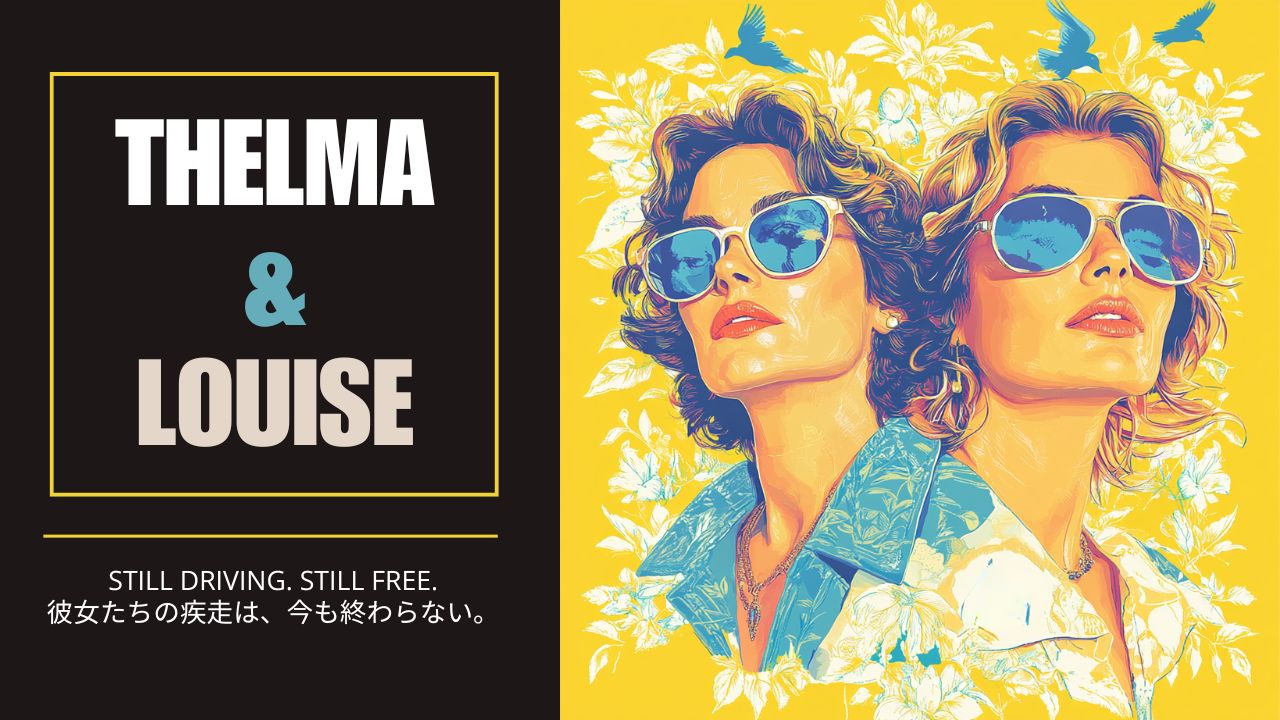
For this month, the film to watch is Thelma & Louise (1991), directed by Ridley Scott from a screenplay by Callie Khouri.
Thelma (Geena Davis) and Louise (Susan Sarandon) set out on a weekend road trip and find themselves on the run. What begins as an escape from the ordinary becomes a journey toward something neither of them could have planned — a reckoning with a world that has never been safe for them, and the discovery of a freedom they have never been allowed to want. The film is a revolutionary road movie, a landmark of feminist cinema, and one of the most visually accomplished American films of its decade.
Callie Khouri won the Academy Award for Best Original Screenplay. Susan Sarandon and Geena Davis were both nominated for Best Actress. The film was added to the United States National Film Registry by the Library of Congress in 2016.
Basic Information & Synopsis
→ For synopsis and production information, see our Database Article
Director: Ridley Scott
Year: 1991
Runtime: 130 minutes
Production: Pathé Entertainment, MGM
Commemorative Month: Sexual Assault Awareness Month / Take Back the Night (April)
Background Knowledge
Take Back the Night and Its Direct Connection to This Film
The Take Back the Night movement addresses violence against women in all its forms: assault on night streets, sexual violence at bars and social gatherings, drug-facilitated assault, date rape, and domestic violence by intimate partners.
The assault at the center of Thelma & Louise — Harlan’s attack on Thelma in a bar parking lot — is precisely the kind of violence this campaign exists to name and oppose. Thelma had been having a good time at the bar. She was targeted for it. The film’s premise is built on the same recognition that drives Take Back the Night: that “she was asking for it” is not a fact but an excuse, and that women have the right to be safe wherever they are.
Callie Khouri — The Screenplay’s Origin
Callie Khouri is a screenwriter, director, and producer. When she wrote Thelma & Louise, she was working at a music video production company in Los Angeles, having come up through waitressing and acting work in Nashville. The screenplay was her first.
The idea came to her in early 1988, driving home from work to her apartment in Santa Monica — two women committing crimes together. She spent the next six months completing the script, drawing on her own experience and her friendship with country singer Pam Tillis.
Khouri had intended to direct it herself as a low-budget independent film. The screenplay’s quality took it elsewhere. Ridley Scott, whose previous work included Alien and Blade Runner, took on the project — and the combination of Khouri’s writing and Scott’s visual intelligence produced something neither might have made alone.
Ridley Scott’s Visual Approach
Ridley Scott (b. 1937) was known before this film primarily as a maker of visually immersive genre cinema. Thelma & Louise showed a different range.
The film uses space as emotional language throughout. The cramped house, the dim diner, the enclosed interiors of the first act embody the compression of the women’s lives. As they move west, the frame opens: the desert, the horizon, the sky. The emotional progression and the geographical progression are the same movement.
The 1966 Ford Thunderbird convertible — top down, wind in their hair, against the American Southwest — is not just a car. It is what freedom looks like when you have never been allowed to have it.
The Cast
Geena Davis and Susan Sarandon’s pairing is among the great screen partnerships of American cinema. Davis plays Thelma’s transformation — from compliant housewife to someone who discovers she has a self — with complete conviction. Sarandon plays Louise’s containment: a woman who knows more than she says, and has reasons.
Brad Pitt appeared as J.D., a small-time drifter who becomes Thelma’s lover for a night. The role was among his earliest significant screen appearances and established him as a presence worth watching. Harvey Keitel plays FBI agent Hal — notably, not as an antagonist but as a man who understands what the women are running from and wishes the outcome could be different. His presence is the film’s acknowledgment that male understanding and solidarity matter.
What Makes It Exceptional
Ridley Scott’s Visual Aesthetics and Direction
The film’s greatness begins with the precision of Scott’s spatial storytelling. Compression and release, enclosure and open sky, the grid of the suburbs and the formlessness of the desert — these oppositions carry the film’s meaning as directly as the dialogue does.
The road movie has always been about freedom, but the freedom of the American road has typically been a male story. Thelma & Louise takes the form and fills it with women — and in doing so shows how much the form had been excluding. The Ford Thunderbird, the open highway, the sense of forward motion without destination: these feel different when the women driving have never been permitted this kind of movement before.
The Performances
Geena Davis and Susan Sarandon’s combination is one of the finest acting partnerships in American film history. The arc Davis traces — from someone who cannot order breakfast without asking her husband’s permission to someone capable of armed robbery — is played with such specificity that each step feels inevitable rather than sudden. Sarandon’s Louise is harder to read and harder to forget: a woman who has been managing what she knows for a long time, and who finally runs out of road to manage it on.
Brad Pitt’s J.D. is precisely calibrated — charming, unreliable, and gone. Harvey Keitel’s Hal is the moral witness the film needs: a figure who sees the women clearly enough to grieve the outcome, and whose sympathy the audience can hold onto as the ending approaches.
Screenwriter Callie Khouri’s Achievement
Khouri’s screenplay is the structural and moral foundation of the film. Its central insight is that Thelma and Louise are not exceptional — they are ordinary women whose situation has become extraordinary because the ordinary protections failed them. The film does not ask the audience to approve of everything the women do. It asks the audience to understand why they do it. That distinction — between judgment and understanding — is what keeps the film honest.
The Academy Award for Best Original Screenplay was recognition of a script that rewrote what a road movie could be about.
Related Articles
- Thelma & Louise Database – Synopsis & Production Details
- Ridley Scott – Filmmaker Profile
- Susan Sarandon – Actor Profile
はじめに
女性の解放と連帯を描いた不朽のフェミニスト映画
4月は、世界各地でTake Back the Nightキャンペーンが開催される特別な月です。このキャンペーンは、性暴力啓発月間(Sexual Assault Awareness Month)の一環として、性暴力、パートナー暴力、家庭内暴力に対する抗議と直接行動の場として機能しています。1976年にベルギーで女性たちがキャンドルを持って月夜の街を行進したのが起源となり、現在では世界30カ国以上で数百のイベントが開催される国際的な運動に発展しています。
このキャンペーンは単なる抗議活動を超えて、女性の安全と尊厳、そして真の解放を求める現代的な社会運動として、世界中の活動家や支援者に愛されています。各地域の大学や団体が独自に開催する行進、集会、追悼式を通じて、女性が夜間でも安全に街を歩く権利を取り戻すという象徴的な意味を持っています。
この運動の精神を最も力強く体現した映画として、1991年公開の**『テルマ&ルイーズ』**(Thelma & Louise)以上に相応しい作品はありません。リドリー・スコット監督、カリー・クーリ脚本によるこの傑作は、女性の解放と自己決定権を描いた革命的なロードムービーです。
ジーナ・デイヴィス演じるテルマとスーザン・サランドン演じるルイーズが、週末旅行から始まる逃亡劇で体験する自由への渇望と女性同士の絆の物語は、家父長制社会における女性の抑圧からの解放を痛烈に描いています。性暴力への立ち向かいと、それに続く社会からの追及を通じて描かれる女性の連帯は、Take Back the Nightキャンペーンの「女性が恐れることなく生きる権利を取り戻す」という精神の真の意味を考えさせてくれる、現代の観客にとって必見の作品といえるでしょう。
基本情報・あらすじ
→ あらすじや製作情報はデータベース記事へ
監督: リドリー・スコット
製作年: 1991年
上映時間: 130分
制作: パテ・エンターテインメント、MGM
記念月: 性暴力啓発月間 / Take Back the Night(4月)
予備知識
Take Back the Nightキャンペーンとフェミニスト映画の文化的意義
Take Back the Nightキャンペーンは、1970年代後半からアメリカで始まった草の根運動であり、女性が暴力の恐怖なしに生活する権利を主張する象徴的な行動として発展してきました。このキャンペーンが対象とする「夜の危険」は多岐にわたります。
この運動は単なる夜道の安全だけでなく、より広範囲な女性への暴力に対抗しています。具体的には、路上での襲撃やストーキング、バーやクラブでの性暴力、ドリンクに薬物を混入する犯罪、酔った状態につけ込む性的暴行、デートレイプ、そして夜間の家庭内暴力やパートナーからの暴力まで含んでいます。
『テルマ&ルイーズ』との直接的関連として——映画におけるハーランの事件は、まさに「酒場での性暴力」であり、Take Back the Nightキャンペーンが対象とする典型的な暴力の一例です。テルマがバーで楽しく過ごしていたところを狙われた状況は、「夜に外出する女性は襲われても仕方ない」という社会的偏見に対して、「女性はいつでもどこでも安全に過ごす権利がある」と主張するこの運動の本質的なメッセージと完全に合致しています。
脚本家カリー・クーリの創作背景
カリー・クーリは脚本家、監督、プロデューサーとして多彩な活動を展開していますが、『テルマ&ルイーズ』執筆当時は映像業界での実務経験を積み重ねていた時期でした。ナッシュビルでの女優活動やウェイター経験を経て、1980年代にはコマーシャルやミュージックビデオの制作会社で働いていました。
この脚本の構想は、1988年初頭の偶然の瞬間から生まれました。ミュージックビデオのプロデューサーとして働いていたクーリが、仕事を終えてサンタモニカのアパートへ車で帰る途中、「二人の女性が犯罪を繰り返す」というアイデアが突如として浮かんだのです。その後6ヶ月間をかけて、自身の人生経験とカントリーミュージック歌手パム・ティリスとの友情からインスピレーションを得ながら、初の本格的脚本を完成させました。
当初クーリは低予算のインディペンデント映画として自ら監督することを想定していましたが、脚本の質の高さが評価され、最終的に『エイリアン』『ブレードランナー』で知られるリドリー・スコット監督が演出を担当することとなりました。この運命的な出会いが、映画史に残る傑作の誕生に繋がったのです。
優れている点
リドリー・スコット監督の映像美学と演出技法
リドリー・スコット監督(1937年生まれ)は、『エイリアン』『ブレードランナー』などの視覚的傑作で知られていましたが、『テルマ&ルイーズ』では社会派ロードムービーという新境地に挑戦し、その卓越した映像センスを存分に発揮しています。
本作では、地理的な移動と心理的な変化が完璧に同調しており、アーカンソー州の閉塞的な日常からメキシコ国境への開放的な逃避行が、二人の女性の内面的覚醒の過程と見事に重なり合っています。
スコット監督の映像表現の真骨頂は、空間の対比による感情の可視化にあります。物語序盤の狭苦しい住宅、薄暗いダイナー、閉ざされた室内といった息詰まるような空間設計が「抑圧」を象徴する一方で、旅の進行とともに画面に登場する広大な砂漠、果てしなく続く地平線、開けた青空といった雄大な自然が「解放」を視覚的に体現しています。
特筆すべきは、1966年型フォード・サンダーバード・コンバーチブルの演出的活用です。この象徴的な車両は単なる交通手段を超越し、アメリカンドリームそのものの具現化として機能しています。屋根を開け放った開放的な車体で風を切って疾走する姿は、束縛からの完全な解放を雄弁に物語り、アメリカ南西部の荒涼とした美しさを背景に展開される映像は、ロードムービー史上屈指の美的達成として評価されています。
キャスティングと演技の評価
ジーナ・デイヴィス(テルマ役)とスーザン・サランドン(ルイーズ役)のコンビネーションは映画史上屈指とされています。デイヴィスは、従順な主婦から大胆な女性への変貌を説得力豊かに演じ、サランドンは経験豊富な女性の複雑な心理を深く表現しました。
特筆すべきは、若き日のブラッド・ピットがJ.D.役で出演していることです。映画の脇役やテレビへの頻繁なゲスト出演を経て、ピットはこの『テルマ&ルイーズ』での脇役でより広く認知されるようになりました。彼は、テルマ(ジーナ・デイヴィス)と友達になる小物の犯罪者J.D.を演じ、デイヴィスとのラブシーンは、ピットがセックスシンボルとして定着したきっかけと言われています。この作品が彼の映画界での大ブレイクのきっかけとなりました。
FBI捜査官ハル役のハーヴェイ・カイテルは、単純な「悪役」ではなく、二人の女性に同情的な理解ある男性として描かれており、男性の理解と支援の重要性も示しています。女性の権利向上は、女性だけでなく、理解ある男性の協力も必要であることを映画は示唆しています。
関連記事
- テルマ&ルイーズ データベース – あらすじ・製作情報
- リドリー・スコット – 監督プロフィール
- スーザン・サランドン – 俳優プロフィール