
Choose Your Language / 言語を選択:
Introduction
The Real Battle Begins the Day You Walk Out
April 17 is International Corrections Volunteers Day.
On April 17, 2024, at the Second World Congress of Probation held in The Hague, Netherlands, a declaration was adopted designating that date as International Corrections Volunteers Day — a day to raise global awareness of the community volunteers, including probation officers, who support the rehabilitation of people who have committed offenses, and to encourage international cooperation in this work.
Japan’s probation officer system is unique in the world. Civilian volunteers commissioned by the Minister of Justice counsel people on parole or probation regarding employment and housing, and support their reintegration into society. They are unpaid — receiving only minimal expense reimbursement — and yet approximately 46,000 people currently serve in this role across Japan, with an average age exceeding 65. The declining number of people willing to take on this work is a serious and growing problem.
What does rehabilitation mean? Does a society that believes people can turn their lives around actually provide the conditions in which they can do so? These are the questions this day raises — and one film answers them quietly, but with complete honesty.
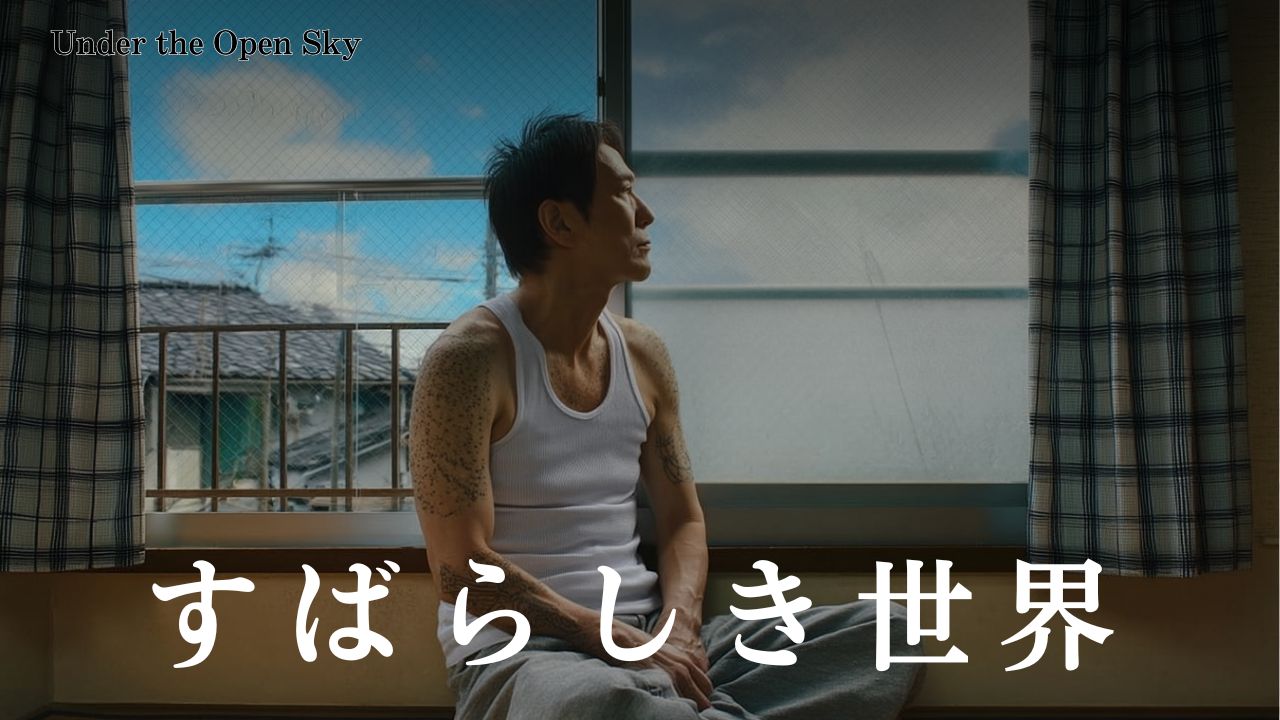
For this day, the film to watch is Under the Open Sky (すばらしき世界, Subarashiki Sekai), directed by Miwa Nishikawa in 2021.
The film follows Masao Mikami (Kōji Yakusho), a former yakuza member who has served 13 years for manslaughter, as he is released and attempts to recover something resembling an ordinary life. The film is based on Mibuncho, a 1990 novel by crime writer Ryūzō Saki, transposed to the present day. Kōji Yakusho won the Best Performance Award and the Audience Award at the 56th Chicago International Film Festival. The film also screened in official selection at the 45th Toronto International Film Festival and won the Audience Award at the Seattle International Film Festival.
Basic Information & Synopsis
→ For synopsis and production information, see our Database Article
Director: Miwa Nishikawa
Year: 2021
Runtime: 126 minutes
Production: Bunbuku, Warner Bros. Japan
Commemorative Day: International Corrections Volunteers Day (April 17)
Background Knowledge
The Source Novel and How Nishikawa Found It
Miwa Nishikawa came to the source material through an obituary. On October 31, 2015, she read the death notice for crime writer Ryūzō Saki, which mentioned Mibuncho. “If Saki had still been alive, I might never have read it,” she later said — the circumstances of discovery felt accidental, almost fated.
By 2015, Mibuncho had been out of print for nearly thirty years. No one in Nishikawa’s publishing circle had read it. Like its subject, the novel existed in a kind of forgotten isolation.
The Real Man: Tamura Akiyoshi and Ryūzō Saki
The novel’s model was a man named Akiyoshi Tamura, who had read Saki’s crime literature during his thirteen years in prison and, at forty-five, having been released, contacted Saki and asked him to write a novel based on his life.
Criminals approaching writers with their stories was not unusual, and Saki was initially inclined to decline. What changed his mind was seeing Tamura’s family register — a document so empty it shocked him. Ten prior convictions, twenty-three years in prison in total, and since reaching adulthood, never more than two consecutive years spent outside. The register contained almost nothing but the record of his offenses.
As Saki’s research continued, a sense of responsibility grew. He became Tamura’s guarantor for an apartment. After the novel was published, Tamura died, and Saki served as chief mourner at his funeral.
The Screenplay — Finding Tamura’s Voice
Working on the screenplay, Nishikawa found one detail in Saki’s follow-up writing: at Tamura’s forty-ninth-day memorial, a female editor from a Tokyo literary magazine had been present. Nishikawa tracked her down — she was still at the same publisher — and found her speaking warmly of the period. “This work was born loved,” Nishikawa came to feel.
Then Nishikawa discovered a 1988 radio documentary: A Man Without a Family Register, broadcast on Bunka Broadcasting, built around an interview with the then 46-year-old Tamura. The recording had survived. Nishikawa was able to hear Tamura’s actual voice — and that encounter expanded the screenplay considerably. The final script takes its first half largely from the source novel and its second half from Nishikawa’s original material. Three years of research preceded completion, including interviews with formerly incarcerated people, former members of organized crime, and a visit to Asahikawa Prison with Yakusho.
Miwa Nishikawa and Kōji Yakusho — A Twenty-Seven-Year Wait
Nishikawa (b. 1974), known for films including Sway and Dear Doctor, had written all her previous scripts from scratch. This was the first time she had worked from existing source material.
Her connection to Yakusho reaches back to 1991, when she was in her second year of high school. She watched him play serial killer Nishiguchi Akira in a Fuji Television drama and, by her own account, was so affected that she decided she wanted to work in a field where she could make things. Yakusho went on to become one of the most important actors in Japanese cinema, a figure Nishikawa considered “too eminent to approach for a role.”
When she read Mibuncho in 2015 and began thinking about casting, a clear line appeared: Yakusho — the drama — Saki — Mibuncho. She was now forty-four; he was sixty-two. She told herself: perhaps this is the moment. She made the approach — and told him, for the first time, that it was watching him in that 1991 drama that had set her on the path to directing. That disclosure was what moved him to say he would consider the offer seriously.
The Casting of Masami Nagasawa and Kazuko Yoshiyuki
The television producer Yoshizawa Haruka is an original character — she does not appear in the novel. When Nishikawa thought about who could deliver the role’s necessary arguments with maximum force, only one name came to mind: Masami Nagasawa.
A second significant casting story concerns Kazuko Yoshiyuki (1931–2019). The script included an original scene — absent from the novel — in which Mikami meets a woman and thinks: if only she were my mother. Nishikawa had Yoshiyuki in mind from her work on Dear Doctor (2009), and extended an offer in early summer 2019. Yoshiyuki was unwell but read the script and expressed her desire to try.
In late September, a message came: she could no longer guarantee she would not inconvenience the crew. Word also came that her wish was to end her career with a film role. Nishikawa responded that she would wait as long as needed and would find a way to make a same-day decision work. A backup was found: Sumiko Koike, an 87-year-old senior model with almost no acting experience, who accepted the role fully aware of the circumstances.
Yoshiyuki did not recover. She died shortly after the crew visited her — in the same university hospital where Dear Doctor‘s ward scenes had been shot. Koike completed the role.
The Title
The original title of the source novel, Mibuncho (roughly: “the register of a person’s status”), was rejected by the distributor as sounding like a period drama and failing to communicate anything to a contemporary audience. Nishikawa’s replacement was Subarashiki Sekai — “A Wonderful World.” The phrase can be read as irony or as sincerity. The ambiguity is the point.
Whether the world Mikami fought through, from release to death, was a wonderful world — that question is left to the audience.
What Makes It Exceptional
Kōji Yakusho’s Full-Body Performance
Masao Mikami is a contradictory person: someone who shouts at full volume while being, at his core, a person of goodwill; someone who carries the possibility of violence while being unable to look away when others are hurt. Yakusho plays these contradictions not through dialogue but through his body.
How Mikami stands, how he walks, the silence after he has shouted, the way his hands receive a bunch of cosmos flowers — his body tells the audience more about his interior than his words do. The Best Performance Award at the Chicago International Film Festival was a recognition of exactly this.
The Shōjis and Matsumoto — The Limits of Ordinary Goodwill
The people who support Mikami in the film are not professionals acting in a professional capacity — they are people who have decided, by their own choice, to be present. The Shōji couple, lawyers who serve as his guarantors, have gone well beyond legal obligation. Matsumoto, the supermarket manager, is hit with Mikami’s anger through a misunderstanding, and when he understands the truth, he apologizes and fronts the money Mikami needs.
The film holds both things simultaneously: the warmth of these ordinary people, and the hard limit of what ordinary goodwill can accomplish. Even the most sincere individual care cannot always breach institutional barriers. By showing both the warmth and the ceiling, the film makes a quiet structural argument about what rehabilitation support requires beyond personal kindness.
The Problem of “Consuming Goodness”
When Tsuda first encounters Mikami, he is looking for material. The producer Yoshizawa sees in Mikami’s story content that will perform. The film’s treatment of documentary-style media that turns vulnerable people into compelling viewing is a sharp piece of social criticism, delivered through character rather than argument.
The contrast that develops — between Yoshizawa, who continues to see Mikami as a subject, and Tsuda, who over time begins to see him as a person — sharpens in the film’s second half. Tsuda’s final declaration that he will write Mikami’s story marks the shift from consumption to responsibility.
This arc mirrors what many rehabilitation volunteers describe: the experience of being changed themselves by the relationship, rather than simply changing others.
Related Articles
- Under the Open Sky Database – Synopsis & Production Details
- Miwa Nishikawa – Filmmaker Profile
- Kōji Yakusho – Actor Profile
はじめに
出所した日から、本当の戦いが始まる
4月17日は、「国際更生保護ボランティアの日(International Corrections Volunteers Day)」です。
2024年4月17日、オランダ・ハーグで開催された第2回世界保護司会議において、その開催日である4月17日を「国際更生保護ボランティアの日」とする宣言が採択されました。罪を犯した人の立ち直りを支える保護司をはじめとする地域ボランティアの取組に対する国際的な認知度を高め、世界各国が協力して取り組むことを促す日です。
日本の保護司制度は世界に類を見ない独自のシステムです。法務大臣から委嘱を受けた民間のボランティアが、仮釈放中や保護観察中の人の仕事・住居の相談に乗り、更生を支援します。実費しか支給されない無報酬のボランティアでありながら、現在全国に約4万6千人が活動しています——その平均年齢は65歳を超え、担い手の減少が深刻な課題となっています。
更生とは何か。社会が「やり直せる」と思っている人に、社会はやり直す場所を本当に用意しているか——この記念日が問う問いに、一本の映画が静かに、しかし誠実に答えています。
この特別な日に観る作品として、西川美和監督による2021年の映画**『すばらしき世界』**をお薦めします。
本作は、殺人罪で13年服役した元ヤクザの三上正夫(役所広司)が出所し、「普通の生活」を取り戻そうとする姿を描いた作品です。直木賞作家・佐木隆三の小説『身分帳』(1990年)を原案とし、舞台を現代に移して映画化されました。
第56回シカゴ国際映画祭で役所広司が最優秀演技賞(ベストパフォーマンス賞)と観客賞を受賞。第45回トロント国際映画祭正式出品、シアトル国際映画祭観客賞など、国際的に高い評価を受けた作品です。
基本情報・あらすじ
→ あらすじや製作情報はデータベース記事へ
監督: 西川美和
製作年: 2021年
上映時間: 126分
制作: 文楽、ワーナー・ブラザース映画
記念日: 国際更生保護ボランティアの日(4月17日)
予備知識
原案『身分帳』との出会い
西川美和監督が原作の存在を知ったのは、2015年10月31日に届いた佐木隆三の訃報記事がきっかけでした。その記事に『身分帳』が紹介されており、興味を持ちました。「佐木が健在ならば未読のままだったと思う」と本人が語るほど、偶然の出会いでした。
当時『身分帳』は初版から30年近く経ち、絶版状態。出版関係の知人の中にも読んだ者はおらず、モデルとなった田村同様「孤児状態の忘れられた存在」でした。
原案モデル・田村明義と佐木隆三
モデルとなった田村明義は、13年間の服役中に佐木の犯罪文学を読み、45歳で出所したのち「自分をモデルに小説を書いてくれ」と佐木に連絡してきました。
犯罪者が過去を武勇伝化して売り込みをかけてくることは珍しくなく、佐木は「厄介な人物からのよくある売り込み」として一度は流そうとしました。しかし見せられた田村の戸籍謄本があまりに真っ白だったことに驚き、申し出を受けることにしました——前科10犯で延べ23年間を刑務所で過ごし、成人してから娑婆で2年以上続けて暮らしたことがない田村の戸籍には、前科以外に何も記載されていなかったのです。
取材を続けるうちに「この人の期待に応えなくてはならない」という責任感が芽生えた佐木は、田村のアパート入居の保証人にもなっています。小説の出版後、田村は亡くなり、佐木が喪主を務めました。
脚本——田村の肉声を求めて
脚本執筆にあたり、西川監督は佐木の残した後日譚から一つの手がかりを見つけました。田村の四十九日に、東京の文芸誌の女性編集者が参列していたという記述です。当時も同じ出版社に勤めていることが判明したその編集者は、当時のことを楽しそうに語り、「この作品は人に愛されて生まれた」という認識を西川に与えました。
さらに西川は取材中、1988年4月に文化放送で放送されたドキュメンタリー番組「戸籍のない男〜バラ24本の幸せ〜」の存在を知ります。当時46歳の田村へのインタビューをもとに制作されたこの番組の音源が奇跡的に残っており、西川は田村の肉声を実際に聞くことができました。この肉声との出会いが、脚本を大きく膨らませていきました。最終的に脚本の前半は原作からの引用が多く、後半は西川のオリジナルとなっています。
脚本の完成までに3年を要し、服役経験者や元反社会的勢力への取材、刑務所見学など徹底した調査を積み重ねました。役所広司は三上役の準備としてミシンの練習を行い、西川監督とともに旭川刑務所を見学しています。
西川美和監督と役所広司——27年越しの夢
西川監督(1974年〜)は『蛇イチゴ』『ゆれる』『ディア・ドクター』などで知られる映画監督で、デビュー以来すべての作品でオリジナル脚本を書いてきました。本作は彼女にとって初の原案小説を基にした作品です。
役所広司との縁は、1991年——西川が高校2年のとき——にさかのぼります。役所広司が連続殺人犯・西口彰を演じたフジテレビのテレビドラマを見て「ひどくショックを受け、それがきっかけでものを書く仕事につきたいと思うようになった」と、後に語っています。
役所はその後、日本映画界の最高峰へと登りつめ、西川にとって「キャスティングをお願いするには恐れ多い存在」になっていきました。しかし2015年に『身分帳』を読んでキャスティングを考えたとき、西川の頭の中に【役所広司=西口彰=佐木隆三=身分帳】というラインがはっきりと見えました。あのドラマを観てから27年、17歳だった西川も44歳。役所は62歳。「今なのかもしれない、ついに『時』が来た」と自らに言い聞かせ、オファーを出しました。
西川が役所本人に初めて「あのドラマを観て映画監督を目指した」と打ち明けたこの告白が、役所を「前向きに考えます」と動かした言葉でもありました。
キャスティング——長澤まさみと八千草薫
やり手のテレビプロデューサー・吉澤遥役は、原作には登場しないオリジナルキャラクターです。「ヒール役らしい正論を、誰に喋ってもらえればパワフルで印象的なインパクトを残せるか」を考えたとき、西川監督の頭に浮かんだのは長澤まさみただ一人でした。
もう一つの重要なキャスティングにまつわる話が、八千草薫(1931〜2019年)です。本作には原作にない場面として「三上が『この人が、母ならいいのに』と思う女性と出会う」シーンが設けられており、西川は2009年の『ディア・ドクター』に出演した八千草をイメージして2019年初夏にオファーを出しました。八千草は当時体調を崩していましたが、脚本を読んで「やってみたい」と意欲を示しました。
しかし同年9月末に「スタッフの皆さんに迷惑をかけずにお芝居できますという約束が今、できない」と連絡が入ります。「本人も最後の仕事は映画にしたい」という言葉も伝えられ、西川は「ギリギリまで待ちます。当日判断でもいい態勢を工夫します」と応じました。万が一の場合に備えてピンチヒッターを探した結果、演技経験のほとんどない87歳のシニアモデル・小池澄子がその事情を了承のうえで引き受け、この役を演じています。
八千草はそのまま快復することなく、西川たちがお見舞いに行って間もなく亡くなりました——奇しくも、かつて『ディア・ドクター』の病室ロケで使った同じ大学病院に入院していたのです。小池澄子は演出に苦戦しながらも、役を完遂しました。
タイトルの由来
当初、配給会社から原作通りの『身分帳』というタイトルに「時代劇のようで意味がわからない、客を呼べない」という変更要請がありました。西川監督がつけたタイトルが『すばらしき世界』——皮肉としても、賛美としても読める、その両義性を持つ言葉です。
三上が出所してから死ぬまで格闘し続けた「この世界」は、すばらしき世界だったのか。その問いは観客に委ねられています。
優れている点
役所広司の全身演技
三上正夫という人物は、矛盾を抱えています——激しく怒鳴りながらも、本質的には善意の人間。暴力の気配を持ちながら、誰かが傷つくのを見過ごせない。その矛盾を、役所広司はセリフではなく「体」で演じています。
立ち方、歩き方、怒鳴った後の沈黙、コスモスを受け取る手の動作——三上の身体は、言葉よりも正直に彼の内側を語っています。シカゴ国際映画祭の最優秀演技賞は、その「全身の演技」への評価でした。
庄司夫妻と松本——「普通の人」の支援
映画の中で三上を支えるのは、専門家ではなく「普通の人」たちです。身元引受人の庄司夫妻は弁護士ですが、三上との関係は法律的な義務を超えています。スーパーの店長・松本は、怒鳴られた相手に誤解だとわかれば謝り、費用を立て替えてくれます。
この「普通の人」の温かさと、彼らが支えられる範囲の限界が、同時に映画の中に存在しています——どんなに善意があっても、制度の壁は越えられないこともある。その両方を映すことで、映画は個人の善意だけに頼る更生支援の構造的な問題も静かに指摘しています。
「善意の消費」という問題
当初、津乃田は三上を「素材」として見ています。「面白いネタ」を探しています。吉澤が三上をドキュメンタリーの素材として扱う場面は、現代の「弱者を見世物にするメディア」への批評とも受け取れます。「前科者の社会復帰」という「いい話」を消費しようとする吉澤と、三上と時間を過ごすうちに、三上を一人の人間として見始める津乃田の対比が、映画の後半にかけて鮮明になっていきます。
「三上さんを小説に書く」という宣言は、「消費する対象」から「伝える責任を持つ人物」への転換を示しています。
この変容は、更生保護に関わるボランティアたちの多くが経験することでもあります——関わる中で、自分が変えられていく、という逆説的な経験です。
関連記事
- すばらしき世界 データベース – あらすじ・製作情報
- 西川美和 – 監督プロフィール
- 役所広司 – 俳優プロフィール