
Choose Your Language / 言語を選択:
Introduction
The Day Profit Outweighed Safety — The True Story of America’s Worst Oil Disaster
April 20 is the anniversary of the Deepwater Horizon oil spill.
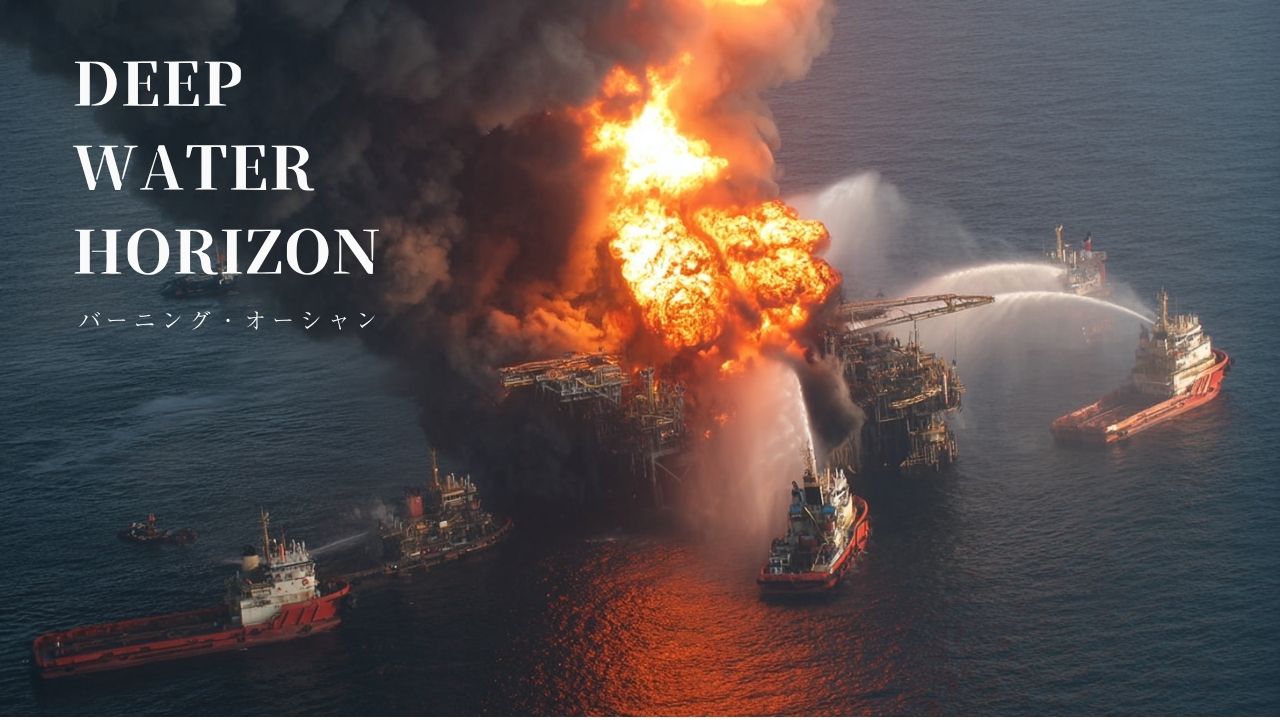
At 9:56 p.m. Central Daylight Time on April 20, 2010 — approximately 66 kilometers off the Louisiana coast in the Gulf of Mexico — the semi-submersible drilling rig Deepwater Horizon was engulfed in fire following a catastrophic explosion. The rig sank two days later. For the next 87 days, an estimated 210 million gallons of crude oil poured into the Gulf of Mexico, making it the worst oil disaster in American history. Eleven people were killed. Seventeen were injured.
For this anniversary, the film to watch is Deepwater Horizon (2016), directed by Peter Berg.
The film reconstructs what happened on the rig on April 20, 2010, based on the testimony of the actual crew members and official investigation reports. Centering on chief electronics technician Mike Williams (Mark Wahlberg) and offshore installation manager Jimmy Harrell (Kurt Russell), it follows the accumulation of cost pressures and overridden safety warnings that led to the explosion — rendered with a grip that does not let up.
The film received Academy Award nominations for Best Sound Editing and Best Visual Effects at the 89th Academy Awards, and a BAFTA nomination for Best Sound. It received a standing ovation after its world premiere at the Toronto International Film Festival. Rotten Tomatoes critic score: 82%, described as “seriously crafted and sufficiently gripping.”
Basic Information & Synopsis
→ For synopsis and production information, see our Database Article
Director: Peter Berg
Year: 2016
Runtime: 107 minutes
Production: Lionsgate, Summit Entertainment
Commemorative Day: Deepwater Horizon Oil Spill Anniversary (April 20)
Background Knowledge
What Caused the Explosion
To understand this film, it helps to understand what a “rig” is. The Deepwater Horizon was a semi-submersible drilling unit, 121 meters long and 78 meters wide, capable of operating at depths up to 2,400 meters. Its construction cost $560 million. Hundreds of workers lived and worked on it in rotation — a city on the water.
The accident also involved a complex corporate contracting structure. The rig was owned by Transocean and leased to BP; cementing work on the well was contracted to Halliburton. With three companies holding different roles and authorities, the question of who bore final responsibility for safety decisions was never clearly resolved.
Investigation and subsequent litigation revealed that the explosion was not a simple equipment failure. Under cost pressure from a 43-day schedule overrun, BP had made a sequence of decisions to skip safety procedures: skipping the cement bond log, disregarding anomalous negative pressure test readings, removing drilling mud prematurely. Each decision may have appeared defensible in isolation. Taken together, they eliminated every barrier that would have contained what was building below.
The 2014 federal court ruling found that BP had committed “gross negligence and willful misconduct,” assigning 67% of responsibility to BP, 30% to Transocean, and 3% to Halliburton. BP’s total costs ultimately exceeded $54 billion; in 2015, it reached an $18.7 billion settlement with the federal government, individual states, and 400 local governments.
Two BP employees, Donald Vidrine and Robert Kaluza, were charged with 11 counts of manslaughter, but the most serious charges were dismissed. Vidrine ultimately pleaded guilty to a single misdemeanor violation of the Clean Water Act and received probation. No one was held to meaningful criminal account.
Peter Berg and Mark Wahlberg — The True Story Partnership
Director Peter Berg (b. 1964) and Wahlberg had previously worked together on Lone Survivor (2013), also based on a real event. Together with Patriots Day (2016), the three films form a trilogy of what Berg has called “testimony films” — works built on extensive interviews with survivors and exhaustive review of documentary evidence.
For Deepwater Horizon, production designer Chris Seagers constructed an 85%-scale rig set, 21 meters tall, in the parking lot of the abandoned Six Flags New Orleans amusement park, with a 200-million-gallon water tank beneath it. Many of the fire sequences used real flame. The physical reality of the production is directly responsible for the film’s visual credibility — and for its Academy Award nominations.
The Gap Between Box Office and Critical Reception
The film cost approximately $110 million to produce and grossed around $121.8 million worldwide — a commercial disappointment by Hollywood standards, listed by The Hollywood Reporter as one of 2016’s major box office underperformers. One analyst suggested it should have been made for $60 million. That observation points not to a failure of the film but to the cost of its commitment to physical realism: the scale set, the water tank, the practical fire. The film’s visual authority is the direct product of that investment.
Critical reception was strong — 82% on Rotten Tomatoes, two Academy Award nominations — and the audience who saw it understood what they were watching.
Kurt Russell and Kate Hudson
Kurt Russell, who plays Jimmy Harrell, and Kate Hudson, who plays Mike’s wife Felicia, are in real life stepfather and stepdaughter. In the film they share no dialogue — only a hug. For viewers who know this, the moment carries a weight the script did not need to add.
What Makes It Exceptional
A Testimony Film, Not a Hero Film
The film’s greatest strength is its refusal to turn the disaster into a story about individual heroism. Mike Williams acts with courage — but the film’s moral weight rests not on his courage but on the question of why the explosion was not prevented.
The character of Vidrine is not written as a villain. He is written as an organization man responding to cost pressure — and the film makes clear that condemning him alone would be insufficient. The explosion did not come from individual malice. It came from a chain of institutional decisions. That is the colder and more disturbing truth, and the film does not look away from it.
The Architecture of Tension
The film spends more than forty minutes before the explosion building the conditions that make it inevitable. Nothing catastrophic is happening — but something is wrong. The negative pressure test returns numbers that do not add up. Harrell’s objections are brushed aside. The small decisions compound.
The audience knows what is coming. The tension is not suspense about the outcome but something more uncomfortable: the watching of a preventable disaster as it fails to be prevented. The film earns the explosion by making the audience feel every step toward it.
Sound Design and Visual Effects
The Academy Award nominations for sound editing and visual effects were recognition of specific technical achievements. The sound design — beginning with low, distant vibrations and building to the engulfing roar of the explosion — produces a physical experience of what it sounds like when a structure of that scale begins to come apart. The fire sequences, shot largely with practical effects, carry an authenticity that digital fire cannot replicate. These are not spectacle. They are documentation.
Related Articles
- Deepwater Horizon Database – Synopsis & Production Details
- Peter Berg – Filmmaker Profile
- Mark Wahlberg – Actor Profile
はじめに
利益が安全を上回った日——アメリカ史上最悪の石油災害を招いた人災の実話
4月20日は、「ディープウォーター・ホライズン原油流出事故記念日」です。
2010年4月20日午後9時56分(中部夏時間)——メキシコ湾、ルイジアナ州沿岸から約66キロ沖合。半潜水式海洋掘削装置「ディープウォーター・ホライズン」が、激しい爆発とともに炎に包まれました。2日後に沈没したこのリグからは、87日間にわたり推定2億1000万ガロンの原油がメキシコ湾に流出し続け、アメリカ史上最悪の石油災害となりました。爆発で11人が死亡し、17人が負傷しました。
この事故の記念日に観る作品として、ピーター・バーグ監督による2016年のアメリカ映画『バーニング・オーシャン』(原題:Deepwater Horizon)をお薦めします。
本作は、爆発の当日——2010年4月20日のリグの上で何が起きたか——を、実在の乗組員たちの証言と調査報告書をもとに再現した災害映画です。主任電子技術者マイク・ウィリアムズ(マーク・ウォールバーグ)と施設管理者ジミー・ハレル(カート・ラッセル)を中心に、圧力と安全軽視の積み重ねがいかにして爆発へと至ったかを、息もつかせぬ緊張感で描きます。
第89回アカデミー賞で音響編集賞と視覚効果賞の2部門にノミネート。第70回英国アカデミー賞では音響賞にノミネート。トロント国際映画祭でのワールドプレミア上映後には観客からスタンディングオベーションを受けました。Rotten Tomatoesの批評家スコアは82%、「非常にシリアスでありながら十分に引き込まれるアクションスリラー」と評されています。
基本情報・あらすじ
→ あらすじや製作情報はデータベース記事へ
監督: ピーター・バーグ
製作年: 2016年
上映時間: 107分
制作: ライオンズゲート、サミット・エンターテインメント
記念日: ディープウォーター・ホライズン原油流出事故記念日(4月20日)
予備知識
事故の背景——何が爆発を引き起こしたか
まず「リグ」とは何かを理解しておくと、本作の見え方が変わります。リグ(Rig)とは海上石油掘削装置のことで、洋上に浮かぶ巨大な作業基地です。ディープウォーター・ホライズンは全長121メートル・幅78メートルの半潜水式掘削装置で、水深最大2400メートルまで対応できる当時最高水準の設備でした。建造費は5億6000万ドル。数百人の作業員が交代で生活・作業する、文字通り「海の上の町」です。
事故には、複雑な企業の請負構造も深く関わっていました。ディープウォーター・ホライズンはトランスオーシャン社が所有しBPにリースしていたリグで、井戸のセメント作業はハリバートン社が請け負っていました。三社がそれぞれ異なる立場と権限を持つこの構造が責任の所在を曖昧にし、「誰が最終的な安全判断を下すのか」という問いを宙に浮かせていました。
調査委員会と裁判が明らかにした事故の構造は、単純な「機器故障」ではありませんでした。BPは工程の43日遅延によるコスト圧力のもと、複数の安全手順を省略する判断を重ねていました。セメント結合ログのスキップ、負圧試験の異常値の無視、掘削泥の早期撤去——それぞれは単独では「許容範囲」に見えたかもしれませんが、積み重なったとき、坑井を密閉するすべての壁が同時に失われる状況が生まれました。
2014年の連邦地裁判決は、BPが「重大な過失と故意の不正行為」を犯したと認定し、責任の67%をBP、30%をトランスオーシャン、3%をハリバートンに割り当てました。BPの総費用は最終的に540億ドルを超え、2015年には米国・各州・400の地方自治体と187億ドルの和解を結んでいます。
なおドナルド・ヴィドリンとロバート・カルーザは11件の過失致死罪で起訴されましたが、重大な容疑は棄却されています。ヴィドリンは最終的に水質浄化法(クリーンウォーター法)違反という軽罪一点について有罪を認め、保護観察処分となりました。重大な刑事責任を問われた者は実質的にいなかったということです。
ピーター・バーグとマーク・ウォールバーグの「実話コンビ」
監督のピーター・バーグ(1964年〜)と主演マーク・ウォールバーグは、本作の前年に同じく実話を基にした『ローン・サバイバー』(2013年)でタッグを組んでいます。本作と本作の翌年公開の『パトリオット・デイ』(2016年)を加えた三作品は、いずれも実際の事件・事故の当事者への取材と資料調査を徹底した「証言映画」として評価されています。
バーグは本作でマイク・ウィリアムズの実物とともに事故を再現しました。プロダクションデザイナーのクリス・シーガーズは、廃墟となったシックスフラッグス・ニューオーリンズ遊園地の駐車場に、高さ21メートル・縮尺85%の実物大リグのセットを建設。その下には200万ガロンの水で満たされたタンクも設置されています。炎のシーンの多くは実際に火をつけて撮影されており、その映像の迫力がアカデミー賞視覚効果賞ノミネートに結びつきました。
興行的失敗と批評的評価の乖離
本作は製作費約1億1000万ドルに対し、全世界興収が約1億2180万ドルにとどまり、ハリウッド・リポーターに「2016年の14大興行失敗作」の一つと評されました。
ただし予算の大半は、リグの縮尺85%セットの建設、200万ガロンの水を満たしたタンク、実際に炎を使った撮影など、徹底したリアリズムの追求に費やされています。あるアナリストが「6000万ドルの映画であるべきだった」と指摘したのは、内容の問題ではなく、このリアリズムへの投資が興行規模に見合わなかったという意味です。本作の映像的な説得力は、まさにその「過剰投資」の産物でもあります。
批評家の評価は82%と高く、アカデミー賞2部門ノミネートもその質を裏付けています。「掘削リグの専門的な話」という印象が若年層や一般層を遠ざけたマーケティングの問題も、興行不振の一因として指摘されています。
カート・ラッセルとケイト・ハドソンについて
ジミー・ハレル役のカート・ラッセルと、マイクの妻フェリシア役のケイト・ハドソンは、実生活でも継父と義娘の関係です。映画の中ではセリフのある交流がなく「ハグだけ」という状況も、二人の関係を知る観客には独特の感慨を与えます。
優れている点
「英雄映画」ではなく「証言映画」としての誠実さ
本作の最大の強みは、事故を「英雄の物語」に仕立てることを拒んでいる点です。マイクは確かに勇敢に行動しますが、映画の重心は個人の英雄性よりも、「なぜこの爆発は防げなかったのか」という問いに置かれています。
ヴィドリンというキャラクターが典型的な悪役として描かれていない点も重要です。彼は「コスト圧力に従う組織人」として描かれており、彼だけを断罪すれば済む話ではないことを映画は示唆しています。爆発は「個人の悪意」ではなく「組織の意思決定の連鎖」から生まれた——この冷静な視点が、本作を単純な勧善懲悪映画と区別しています。
前半の「緊張の積み上げ」
映画の前半は爆発が起きるまでの40分以上を、リグ上の日常と小さな不和の積み重ねに費やします。この「何も起きていないが何かがおかしい」という緊張の構築が、後半の爆発シーンの破滅的な重さを決定的なものにしています。
観客はすでに何が起きるかを知っています。それでも「止められなかったのか」という焦りが生まれるのは、この前半の設計のおかげです。
音響と視覚効果の完成度
本作がアカデミー賞で評価されたのは音響編集と視覚効果でした。爆発の音、炎の広がり方、油に覆われた海面——これらは「映画的な演出」ではなく、できる限り実際の状況に近づけるために設計されています。特に音響は、遠くで鳴り始める振動音から、全体を呑み込む爆発音への変容が、極めてリアルな恐怖を生み出しています。