
Choose Your Language / 言語を選択:
Introduction
Does DNA Determine Destiny? What Scientific Progress Asks of Human Dignity
April 25 is International DNA Day.
The date was designated in 2003 by the U.S. National Human Genome Research Institute (NHGRI) and the U.S. Congress to mark two milestones: April 25, 1953, when James Watson and Francis Crick published their description of DNA’s double helix structure in Nature, and April 25, 2003, when the completion of the Human Genome Project was announced. The day celebrates these achievements in the life sciences — and, implicitly, asks what we intend to do with them.
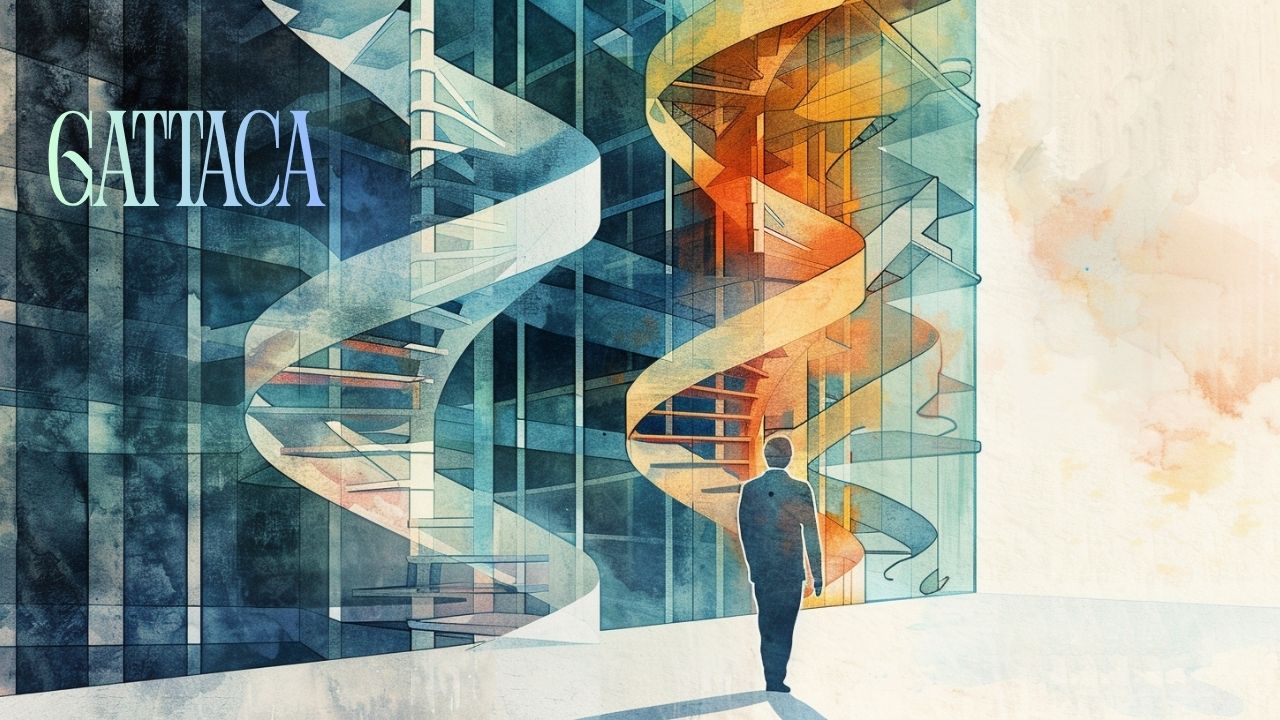
For this day, the film to watch is Gattaca (1997), directed by Andrew Niccol.
The film is set in a near future where genetic engineering is routine and a person’s DNA profile determines their access to education, employment, and ambition. Vincent Freeman (Ethan Hawke) is born without genetic modification — a “God-child,” conceived by chance rather than design — and is classified as “In-Valid.” He wants to be an astronaut. The film follows how he pursues that dream in a world that has already decided he cannot.
Gattaca was released while the Human Genome Project was still in progress. Its foresight has only become more apparent since. In 2011, NASA scientists named it the greatest science fiction film ever made. Nature Genetics published a review in which molecular biologist Lee M. Silver wrote: “Every geneticist should see Gattaca — if only to understand how the public perceives what we do.”
And today, the distance between Gattaca’s world and our own has narrowed further: direct-to-consumer genetic testing kits now sell for a few thousand yen, offering anyone a probability map of their disease risks, traits, and ancestry. The film’s central question — who decides what a life is worth — is no longer hypothetical.
Basic Information & Synopsis
→ For synopsis and production information, see our Database Article
Director: Andrew Niccol
Year: 1997
Runtime: 112 minutes
Production: Columbia Pictures, Jersey Films
Commemorative Day: International DNA Day (April 25)
Background Knowledge
Andrew Niccol’s Prescience and Creative Origins
Gattaca was Andrew Niccol’s feature directorial debut and his first produced screenplay. The New Zealand-born director had built a career directing television commercials in London before moving to Los Angeles to make “films longer than sixty seconds.”
His first completed script was The Truman Show. Jim Carrey’s attachment pushed the budget to $60 million, and the studio refused to hand that film to a first-time director; Peter Weir directed it instead. A studio executive told Niccol: “We can’t give you $80 million for a debut. But we can give you $20 million.” Niccol wrote Gattaca — deliberately designed to be made for that amount. The final production cost came to approximately $36 million as the scope expanded, against worldwide gross of $12.5 million. By Hollywood standards, a commercial failure; by almost any other measure, a film that has continued to accrue relevance for nearly three decades.
Niccol has said: “It’s hard to avoid interest in eugenics, forensics, and social engineering right now” — a comment made in 1997, before the genome was sequenced, before CRISPR existed. His intention was to explore what he called “the humanity in the technology”: to make a film about the moral implications of genetic knowledge that would reach audiences with no scientific background, in a world with no clear villains.
The film received the Best Film award at the Sitges Catalonian International Film Festival and the Jury Prize and Fan Trophy at the Gérardmer Film Festival. It received Academy Award nominations for Best Art Direction and a Golden Globe nomination for Best Original Score.
A sequel series was in development at Showtime in 2023 but was cancelled. Gattaca remains a single, complete film.
The Title and the Opening Sequence
“GATTACA” is composed entirely of four letters: G, A, T, and C — the abbreviations for the four nucleotide bases of DNA (guanine, adenine, thymine, cytosine). The title is the film’s thesis stated in its name.
In the opening credits, a detail worth noticing: throughout the film’s title typography, only the letters G, A, T, and C appear in bold. The other letters are lighter. The code is embedded in the design from the first frame.
The opening sequence, designed by title designer Michelle Dougherty, shows extreme close-ups of fingernails and hair falling — rendered in oversized physical models to achieve the scale effect. The sound as they hit is enormous. These fragments are what Vincent ritually removes each day to prevent detection. The sequence establishes the film’s central terror: that the material your body sheds by accident, without thought, is enough to define you.
The Sequel That Wasn’t
In 2023, a sequel series was in development at Showtime. It was cancelled. Gattaca remains what it was made to be: a single, complete work.
What Makes It Exceptional
A Beautiful Dystopia — The Horror of a World Too Perfect
The future Gattaca depicts is not ruined. It is immaculate.
Glass and steel architecture, classical suits, minimalist design — everything is optimized, ordered, and beautiful. This is the film’s most disturbing choice. The ugliness is invisible, structural, bureaucratic. The discrimination does not manifest in slums or violence; it manifests in HR systems, insurance algorithms, and the routine collection of genetic samples at building entrances. The outside is perfect. Inside, the rot is complete.
The production design earned an Academy Award nomination for Best Art Direction. The retro-futurist aesthetic — evoking the 1960s in a future that never arrived — gives the film a timelessness that conventional science fiction design rarely achieves. The world of Gattaca looks like the world we might have built, which is what makes it frightening.
The Performances of Ethan Hawke and Jude Law
Ethan Hawke plays Vincent’s determination without heroics — it is a quiet, daily, exhausting performance. The fear of discovery is not dramatized; it is simply present, in how carefully he moves, how precisely he controls his body, how little room he allows himself to relax. The film asks Hawke to carry everything without announcement, and he does.
Jude Law’s Jerome is the film’s most complex figure. Genetically perfect, destroyed by an accident that his DNA did not predict. Self-loathing, sardonic, and ultimately generous in a way he cannot quite explain. The relationship between Vincent and Jerome — one running toward the life the other cannot use — is the film’s emotional core. The contrast makes the argument: genetic perfection is not the same as human flourishing. Neither is genetic imperfection the same as human limitation.
Michael Nyman’s Score
Composer Michael Nyman — known for his work with Peter Greenaway and for The Piano — brought his minimalist sensibility to the score: repetition, variation, accumulation. The main theme holds grief and determination simultaneously, the same emotional register Vincent occupies throughout the film. The score received a Golden Globe nomination for Best Original Score. It is among the more precise marriages of musical style and narrative in science fiction cinema.
Related Articles
- Gattaca Database – Synopsis & Production Details
- Andrew Niccol – Filmmaker Profile
- Ethan Hawke – Actor Profile
はじめに
遺伝子は運命を決めるのか? 科学の進歩が問いかける人間の尊厳
毎年4月25日は「DNAの日(International DNA Day)」です。この国際デーは、アメリカ国立ヒトゲノム研究所(NHGRI)とアメリカ議会により2003年に制定されました。1953年4月25日、ジェームズ・ワトソンとフランシス・クリックがDNAの二重らせん構造を発見したこの日を記念し、さらに2003年のヒトゲノム計画完了を祝う日として正式に制定されました。
この日は、生命科学史における二つの偉大な節目——二重らせん構造の発見(1953年)とヒトゲノム解読の完了(2003年)——を記念する日です。しかし同時に、その科学的発見が私たちに突きつける深い倫理的問いについて考える日でもあります。
このDNAの日に観るべき作品として、1997年公開のアンドリュー・ニコル監督作品『ガタカ』(Gattaca)を強く推奨します。本作は、遺伝子操作が一般化した「遠くない未来」を舞台に、遺伝的に「劣等」とされた青年が夢を追う物語です。
遺伝子プロファイルで人生が決まる社会。適格者(Valid)と不適格者(In-Valid)に分断される世界。その中で、ヴィンセント・フリーマン(イーサン・ホーク)は、遺伝子が示す「限界」を超えようと挑みます。映画は問いかけます——遺伝子は運命を決めるのか? 人間の価値は、DNAの配列で測れるのか?
ヒトゲノム計画が進行中の1997年に公開されたこの映画は、驚くべき先見性をもって、遺伝子技術がもたらし得る社会的影響を予見していました。批評家から高い評価を受けながらも興行的には成功しなかった本作は、しかし時を経て、人類の遺伝子工学に関する議論の結晶となりました。そして今日、ダイレクト・トゥ・コンシューマー(DTC)型の遺伝子検査キットは数千円で購入できる時代になっています。映画が問う「誰があなたの人生の価値を決めるのか」という問いは、もはや遠い未来の話ではありません。
基本情報・あらすじ
→ あらすじや製作情報はデータベース記事へ
監督: アンドリュー・ニコル
製作年: 1997年
上映時間: 112分
制作: コロンビア・ピクチャーズ、ジャージー・フィルムズ
記念日: DNAの日(4月25日)
予備知識
監督アンドリュー・ニコルの先見性と制作動機
『ガタカ』はアンドリュー・ニコルの監督デビュー作であり、初の映画脚本でもあります。ニュージーランド出身の彼は、ロンドンでテレビCMディレクターとして成功を収めた後、ロサンゼルスに移り「60秒より長い映画」を作ることを目指しました。
実は、ニコルが最初に書いた脚本は『トゥルーマン・ショー』でした。しかし、ジム・キャリーの出演により予算が6000万ドルに膨れ上がり、スタジオは新人監督に任せることを拒否。結局、ピーター・ウィアーが監督を務めることになりました。
その時、スタジオの責任者がニコルに言いました——「初監督作に8000万ドルは出せない。でも2000万ドルなら出せる」。そこでニコルは『ガタカ』を書きました。当初2000万ドルで作れるよう意図的に設計した脚本でしたが、最終的な製作費は約3600万ドルとなりました。しかし全世界興行収入は1250万ドルに留まり、商業的には失敗に終わります。当時の観客にはまだ早すぎたのかもしれません。
しかし、単なる予算の制約から生まれた作品ではありませんでした。ニコル自身が語っています——「今この瞬間、優生学、法医学、社会工学への関心を避けることは難しい」と。1990年代、ヒトゲノム計画が進行中で、遺伝子工学が現実味を帯びてきた時代でした。ニコルが特に重視したのは、「技術の中の人間性(the humanity in the technology)」を探求することでした。2011年にはNASAの科学者たちがこの映画を「史上最高のSF映画」に選び、科学誌『Nature Genetics』でも「すべての遺伝学者が見るべき映画だ」と評されています。
タイトルの意味と象徴的なオープニング
映画のタイトル「GATTACA」は、DNAの4つの核酸塩基——グアニン(G)、アデニン(A)、チミン(T)、シトシン(C)——の頭文字から取られています。G・A・T・C以外の文字を一切含まない、映画の主題そのものを名前として宣言したタイトルです。
さらに、映画のオープニングクレジットには一つの仕掛けがあります——クレジットのフォントで、G・A・T・Cの4文字だけが太字で強調されています。他の文字は細く表示されている。コードは最初のフレームから既にデザインに埋め込まれているのです。
オープニングシーンでは、爪や髪の毛といった体の断片が床に落ちる様子が極端なクローズアップで映し出されます。落下する際の音は巨大です。後にこれらは、ヴィンセントが毎日行う体液の洗浄によって生じたものだと明らかになります。この映像が提示する恐怖——何気なく体から剥がれ落ちる遺伝物質が、この世界では証拠となり、差別の根拠となる——は、映画全体のテーマの凝縮です。
続編の幻
2023年、Showtimeで続編シリーズが企画されていましたが、中止されました。『ガタカ』は、一本の映画として完結した物語であり続けます。
優れている点
美しいディストピア——完璧すぎる世界の恐怖
『ガタカ』が描く未来は、驚くほど美しく、洗練されています。ガラスと鉄の建築、クラシカルなスーツ、ミニマリストの美学——SFにありがちな荒廃した世界ではなく、むしろ完璧すぎる世界です。
この美しさこそが、映画の恐ろしさを際立たせます。外見は完璧で秩序だっているのに、その内側には残酷な差別と不平等が潜んでいる。まるで表面だけを磨き上げた社会——その下には腐敗が広がっている。
美術監督の手腕が光る本作の映像美は、アカデミー賞美術賞にノミネートされました。1960年代を思わせるレトロフューチャーなデザインは、時代を超越した普遍性を持ち、この物語が「いつでも起こり得る」ことを示唆しています。
イーサン・ホークとジュード・ロウの演技
ヴィンセント役のイーサン・ホークは、静かな決意と内に秘めた情熱を見事に表現しています。彼の演技は、派手なアクションではなく、日々の緊張と恐怖——いつバレるかわからない恐怖——を丁寧に描き出します。
一方、ジェローム役のジュード・ロウは、遺伝的に「完璧」なのに絶望している男を、痛々しいほどリアルに演じています。車椅子での生活、自己嫌悪、そしてヴィンセントへの複雑な感情——ロウの演技には、深い悲しみと皮肉が込められています。
二人の関係は、映画の核心です。一方は遺伝的に「劣等」で夢を追い、もう一方は遺伝的に「優等」で絶望している。この対比が、遺伝子決定論の虚しさを浮き彫りにします。
マイケル・ナイマンの音楽
作曲家マイケル・ナイマンによるスコアは、映画に深い感情的な層を加えています。ミニマリスト音楽の特徴である反復と変奏が、ヴィンセントの執念と決意を音で表現しています。
特にメインテーマは、悲しみと希望が入り混じった美しい旋律で、観客の心に深く残ります。この音楽は、ゴールデングローブ賞作曲賞にノミネートされました。
関連記事
- ガタカ データベース – あらすじ・製作情報
- アンドリュー・ニコル – 監督プロフィール
- イーサン・ホーク – 俳優プロフィール