
Choose Your Language / 言語を選択:
Introduction
Witches and Black Cats — Until Superstition Is Rewritten into a Story of Friendship
August 17 is “Black Cat Appreciation Day.”
In 2011, a person in the United States named Wayne H. Morris established it. The occasion was the death of his sister June and Sinbad, the black cat who had been at her side for 20 years. The two of them (one person and one cat) passed away one after the other in the same year.
Morris created this day because he wanted to dispel the superstitions surrounding black cats.
Why is such a day necessary?
It is superstition.
The origin of the notion that black cats are ill-omened goes back to medieval Europe. In the document Vox in Rama, issued by Pope Gregory IX in 1233, black cats were linked with the devil. In the age of witch hunts, black cats were taken to be witches’ familiars and were persecuted along with them.
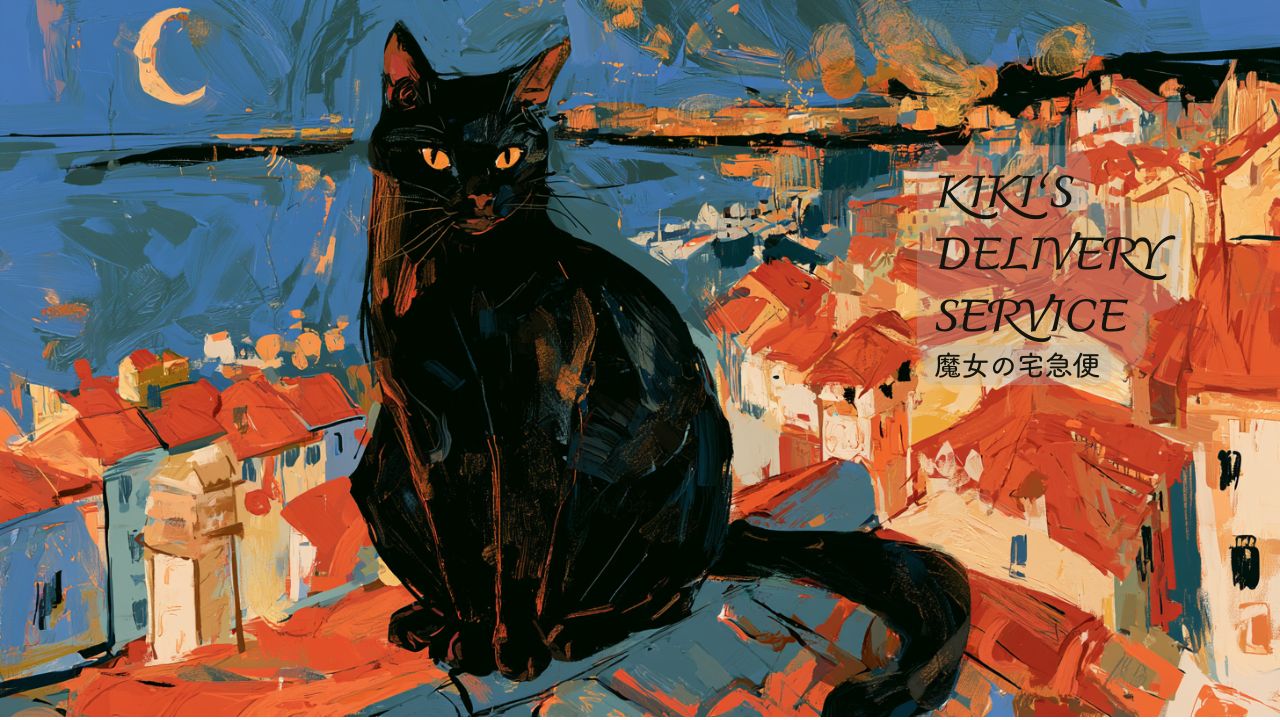
As the film to watch on this day, we recommend Hayao Miyazaki’s Kiki’s Delivery Service (1989).
At first glance, it may look as though it is recommending superstition. Witch and black cat — precisely the combination of superstition itself.
But the film’s Jiji is not a familiar. He is the partner of a 13-year-old girl, a frank conversation partner, and at times a sarcastic housemate.
We would like to watch this work as one that, while borrowing the old iconography of the witch’s black cat, rewrote its content into something entirely different.
Basic Information & Synopsis
→ For synopsis and production information, see our Database Article
Director: Hayao Miyazaki
Year: 1989
Runtime: 103 minutes
Production: Studio Ghibli
Commemorative Day: Black Cat Appreciation Day (August 17)
Background Knowledge
The Source Book and the Film
The source is Eiko Kadono’s children’s literature Kiki’s Delivery Service (1985).
The original is in the form of a linked series of short stories, a tale in which Kiki grows while carrying out various requests. There is no development of her losing the ability to fly, and her relationship with Tombo is depicted more gently.
In adapting it, Hayao Miyazaki added the plotline of Kiki falling into a slump. This is an element unique to the film.
Miyazaki has said that he conceived this work as a story of “the loneliness and independence a young woman experiences on coming out to the city.”
That Jiji’s Voice Does Not Return
What has been most debated in the film is the point that Jiji’s voice does not return.
In the original, Jiji goes on talking throughout. This alteration in the film was Miyazaki’s judgment.
The general interpretation is this. Jiji’s voice is Kiki’s own inner self, an expression of her childishness. When she truly became independent, that voice was no longer needed.
There is another view. That Jiji himself, having fallen in love and made a family, also became independent.
In any case, this is an ending that contains loss. To gain something, one lets go of something. There is here a quiet recognition that this is what becoming an adult from a child means.
The Word “Takkyūbin”
“Takkyūbin” is a registered trademark of Yamato Transport.
For this reason, when the original was published, Eiko Kadono received a point of concern from Yamato Transport. But in the end, the company granted permission.
At the time of the film adaptation, Yamato Transport joined as a sponsor. That the company’s logo is a mother cat and kitten is also said to be one factor in this connection.
The Course of the Production
This work was not a project originating from Ghibli. It was brought in through an advertising agency, and at that point the tie-up with Yamato Transport had already been decided.
Hayao Miyazaki was initially to be involved not as director but as producer. The one first slated to direct was Sunao Katabuchi (who later directed In This Corner of the World), who was young at the time.
But at the screenplay stage Miyazaki put his hand in, and as a result came to serve as director too.
At its release in 1989, it drew 2.64 million people in Japan and became the top Japanese-film distribution earner of that year.
Music
The music is by Joe Hisaishi. The theme songs are Yumi Arai (Yumi Matsutoya)’s “Rouge no Dengon” (opening) and “Yasashisa ni Tsutsumareta nara” (ending).
Both are 1970s songs, adopted at Miyazaki’s wish.
What Makes It Exceptional
Jiji Is Not a Familiar
The role Jiji plays in this work is not that of a witch’s familiar.
Jiji does not impart cunning to Kiki, does not assist with curses, and holds no supernatural power.
What Jiji does is complain, say ironic things, worry, and — pretending to be a stuffed toy — stay still for hours without moving.
This is an operation that, while borrowing the “witch and black cat” iconography since the Middle Ages, completely swaps out its content.
What had been an ill-omened being is here a caring housemate.
That He Is Modeled as a Black Cat
Jiji’s movements are observed as those of a cat.
The movement of the tail, the posture of leaping, the shape of curling up to sleep. Especially the scene where he becomes awkward on being drawn to the white cat Lily has persuasiveness as a cat’s behavior.
That he is not over-anthropomorphized makes this person (cat) attractive. He talks, but he has not stopped being a cat.
That It Depicted Failure
The protagonist of this work fails many times.
She lands in the middle of the road and is scolded, drops a delivery, gets soaked in the rain, delivers a pie that is not welcomed, and then becomes unable to fly.
That she can use magic is a special power, but it does not guarantee a living.
This sense of reality keeps this work away from a simple adventure tale.
The Way the Slump Is Depicted
The development of becoming unable to fly is an element not in the original.
Moreover, its cause is not clearly shown. Fatigue, loss of confidence, adolescence, comparison with others — a number of factors are entangled.
Ursula’s words, too, are not a solution. “When you can’t draw, don’t draw,” “You’ll want to draw again eventually” — these are a recommendation to wait.
And in fact, Kiki can fly again not as a result of effort, but through a friend’s crisis.
Related Articles
- Kiki’s Delivery Service Database – Synopsis & Production Details
- Hayao Miyazaki – Profile
- Minami Takayama – Profile
はじめに
魔女と黒猫——迷信が、友情の物語に書き換えられるまで
8月17日は「黒猫感謝の日」(Black Cat Appreciation Day)です。
2011年、アメリカのウェイン・H・モリスという人物が制定しました。きっかけは、姉のジューンと、彼女が20年連れ添った黒猫シンバッドの死でした。二人(一人と一匹)は同じ年に相次いで世を去りました。
モリスがこの日を作ったのは、黒猫にまつわる迷信を払拭したいと考えたからです。
なぜそんな日が必要なのか。
それは、迷信です。
黒猫が不吉とされる観念の起源は、中世ヨーロッパに遡ります。1233年、教皇グレゴリウス9世が発した文書『ヴォクス・イン・ラマ』では、黒猫が悪魔と結びつけられました。魔女狩りの時代、黒猫は魔女の使い魔とされ、共に迫害されました。
この日に観るべき作品として、宮崎駿監督**『魔女の宅急便』**(1989)を推薦します。
一見、迷信を推奨しているように見えるかもしれません。魔女と黒猫——まさに、迷信そのものの組み合わせです。
しかしこの映画のジジは、使い魔ではありません。彼は13歳の少女の相棒であり、率直な話し相手であり、時に嫌味を言う同居人です。
魔女の黒猫という古い図像を借りながら、その中身をまったく別のものに書き換えた作品として、本作を観てみたいと思います。
基本情報・あらすじ
→ あらすじや製作情報はデータベース記事へ
監督: 宮崎駿
製作年: 1989年
上映時間: 103分
制作: スタジオジブリ
記念日: 黒猫感謝の日(8月17日)
予備知識
原作と映画
原作は、角野栄子の児童文学『魔女の宅急便』(1985年)です。
原作は連作短編の形式で、キキが様々な依頼をこなしながら成長する物語です。飛べなくなるという展開はなく、トンボとの関係もより穏やかに描かれます。
宮崎駿は映画化にあたり、キキがスランプに陥るという筋を加えました。これは映画独自の要素です。
宮崎はこの作品を、「都会に出てきた若い女性が経験する孤独と自立」の物語として構想したと語っています。
ジジの声が戻らないこと
映画で最も議論されてきたのが、ジジの声が戻らないという点です。
原作では、ジジはずっと話し続けます。映画のこの改変は、宮崎の判断でした。
一般的な解釈は、こうです。ジジの声はキキ自身の内面であり、幼さの表れである。彼女が本当に自立したとき、その声は必要なくなった——と。
別の見方もあります。ジジ自身が恋をして家庭を持ったことで、彼もまた自立したのだ、と。
いずれにせよ、これは喪失を含む結末です。何かを得るために、何かを手放す。子どもから大人になるとはそういうことだという、静かな認識がここにあります。
「宅急便」という言葉
「宅急便」はヤマト運輸の登録商標です。
そのため原作の刊行時、角野栄子はヤマト運輸から指摘を受けました。しかし最終的に、同社は許諾しています。
映画化の際には、ヤマト運輸がスポンサーに加わりました。同社のロゴマークが親猫と子猫であることも、この縁の一因とされています。
制作の経緯
本作は、ジブリ発の企画ではありませんでした。広告代理店を通じて持ち込まれたもので、その時点でヤマト運輸のタイアップも決まっていました。
宮崎駿は当初、監督ではなくプロデューサーとして関わる予定でした。最初に監督に予定されていたのは、当時若手だった片渕須直(後に『この世界の片隅に』を監督)です。
しかし脚本の段階で宮崎が手を入れ、結果として監督も務めることになりました。
1989年の公開時、日本国内で264万人を動員し、その年の邦画配給収入1位となっています。
音楽
音楽は久石譲。主題歌は、荒井由実(松任谷由実)の「ルージュの伝言」(オープニング)と「やさしさに包まれたなら」(エンディング)です。
いずれも1970年代の楽曲で、宮崎の希望により起用されました。
優れている点
ジジは使い魔ではない
本作でジジが果たす役割は、魔女の使い魔ではありません。
ジジはキキに悪知恵を授けず、呪いも手伝わず、超自然的な力も持ちません。
ジジがすることは、文句を言い、皮肉を言い、心配し、そしてぬいぐるみのふりをして何時間も動かずにいることです。
これは、中世以来の「魔女と黒猫」の図像を借りながら、その中身を完全に入れ替える操作です。
不吉な存在だったものが、ここでは面倒見のいい同居人になっています。
黒猫として造形されていること
ジジの動きは、猫として観察されています。
しっぽの動き、跳躍の姿勢、丸まって眠る形。とりわけ、白猫のリリーに惹かれてぎこちなくなる場面は、猫の仕草として説得力があります。
擬人化されすぎていないことが、この人物(猫)を魅力的にしています。喋りますが、猫であることをやめてはいません。
失敗を描いたこと
本作の主人公は、何度も失敗します。
道の真ん中に降りて叱られ、届け物を落とし、雨に濡れ、届けたパイは喜ばれず、そして飛べなくなります。
魔法が使えることは、特別な力ではありますが、生活を保証してはくれません。
この現実感が、本作を単純な冒険譚から遠ざけています。
スランプの描き方
飛べなくなる展開は、原作にはない要素です。
しかもその原因は、明確に示されません。疲れ、自信の喪失、思春期、他人との比較——いくつもの要素が絡み合っています。
ウルスラの言葉も、解決策ではありません。「描けなくなったら描かない」「そのうちまた描きたくなる」というのは、待つことの勧めです。
そして実際、キキが再び飛べるのは、努力の結果ではなく、友人の危機によってでした。
関連記事
- 魔女の宅急便 データベース – あらすじ・製作情報
- 宮崎駿 – プロフィール
- 高山みなみ – プロフィール