
Choose Your Language / 言語を選択:
Introduction
One Night of a Man Given the Order to Destroy and a Man Who Tried to Stop It
On August 25, 1944, Paris was liberated. It was the day the German occupation, which had spanned 4 years and 2 months, ended. The Free French 2nd Armored Division led by General Leclerc entered the city, and that same afternoon the German commander signed the surrender document.
And Paris was unharmed. This was not a matter of course. In August of that year, Hitler sent a telegram to the commander of the defense of Paris. “If Paris falls into the enemy’s hands, it must be as ruins.” The order was specific. Blow up all the bridges over the Seine. Destroy the Eiffel Tower, the Louvre, the Opéra, Notre-Dame, Les Invalides, and the parliament building and the presidential residence. In fact, explosives were set at more than 45 bridges and structures.
But the destruction was not carried out. On the day of liberation, Hitler is said to have asked his chief of staff, “Is Paris burning?” (Brennt Paris?). The answer was no.
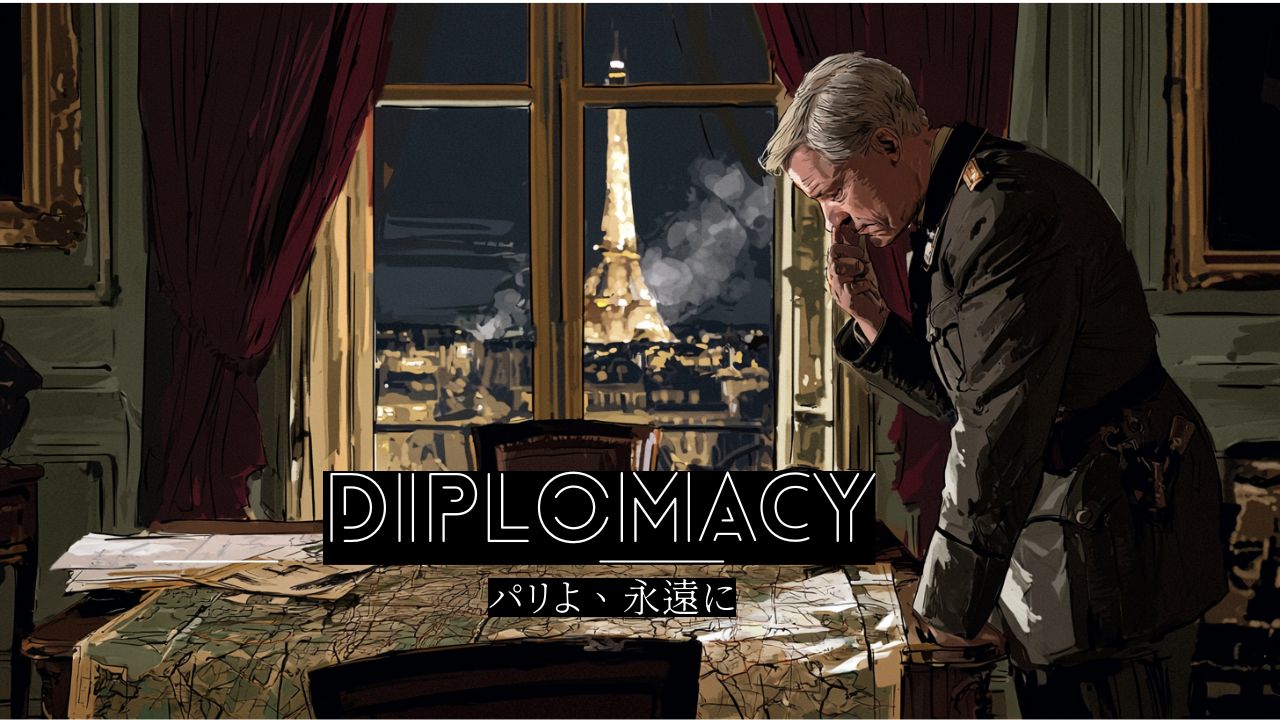
As the film to watch on this day, we recommend Volker Schlöndorff’s Diplomacy (original title: Diplomatie, 2014). It is a work depicting the dialogue said to have been exchanged in a room of the Hôtel Meurice in the early hours of August 25. The characters are essentially two. A German commander given the order of destruction, and a Swedish consul general who tries to make him reconsider. It is an almost chamber piece of just under 90 minutes.
Basic Information & Synopsis
→ For synopsis and production information, see our Database Article
Director: Volker Schlöndorff
Year: 2014
Runtime: 84 minutes
Production: Film Oblige / Gaumont / Blueprint Film
Commemorative Day: The Liberation of Paris (August 25)
Background Knowledge
What Actually Happened
First there is something that should be confirmed. The single night’s dialogue of this film is an invention. That Choltitz and Nordling actually met is a fact. But it was not once; it was over multiple occasions during August. And the one involved was not Nordling alone. According to researchers, over a dozen people, over these two weeks, were trying to persuade Choltitz. Schlöndorff condensed these into a single night’s dialogue. Also, there is no hidden passage in the Hôtel Meurice. The dramatic introduction of Nordling suddenly appearing is also an invention.
Raoul Nordling
Nordling (1882–1962) was a Paris-born Swede. Sweden was a neutral country, and he used that position to serve as a negotiator. What is certain among his achievements is the negotiation for the release of political prisoners. Regarding inmates whom the German army was about to execute before its withdrawal, he secured their release. Several thousand are said to have been saved. He also mediated a temporary ceasefire between the Resistance and the German army. There is also a record that he suffered a heart attack in the midst of negotiations, but even so it is related that he continued his activity from his sickbed.
From Stage to Film
The source is Cyril Gely’s 2011 play Diplomatie. It premiered at the Théâtre de la Madeleine in Paris, with Niels Arestrup playing Choltitz and André Dussollier playing Nordling. In the film version too, the same two play the same roles. Director Volker Schlöndorff is a German filmmaker. He won the Cannes Palme d’Or and the Academy Award for Best Foreign Language Film for The Tin Drum (1979). He is a person who has continued to handle war and the individual’s choice within it. This work was first shown at the Berlin International Film Festival in 2014. It was the year of the 70th anniversary of the liberation of Paris.
The Relationship with Is Paris Burning?
The same subject was once made into a film in 1966. It is René Clément’s Is Paris Burning? Based on the nonfiction by Larry Collins and Dominique Lapierre, Francis Ford Coppola and Gore Vidal took part in the screenplay. Orson Welles played Nordling and Gert Fröbe played Choltitz. This one was a major work of nearly three hours, an ensemble drama depicting the liberation from many viewpoints — the Resistance, the Allied forces, citizens. In contrast, this work narrowed to the single night of two men. As two works handling the same event in entirely different ways, there is something interesting in comparing them.
What Makes It Exceptional
Being a Chamber Piece
Most of this work proceeds in one room of the hotel. The characters are basically two. There is little movement, and there is only conversation. That the tension nonetheless persists is because the time is limited. When the night breaks, the Allied forces arrive. A decision must be made before then. Outside the window it gradually grows brighter. This visual passage of time functions as a quiet pressure.
The Two Actors
Niels Arestrup and André Dussollier had played these roles on stage for nearly three years. That accumulation shows on screen. Arestrup’s Choltitz is not intimidating. He suffers from asthma attacks, is tired, and often falls silent. Dussollier’s Nordling is eloquent but desperate. So as not to anger his counterpart, yet not to back down, he continues to choose his words carefully. The breathing of the two makes this film hold together.
The Structure of Persuasion
Nordling’s persuasion proceeds in stages. First he appeals to reason. Next he speaks of cultural value. And he brings up the safety of family, and finally presents the judgment of history. If his counterpart does not move, he plays the next hand. This accumulation produces something worth watching as a dialogue drama.
That It Was Not Made a Heroic Tale
The Choltitz of this work is not depicted as a person who awoke to conscience. He is calculating. About his family, his own position, the postwar. And that he finally moved was, probably, through the overlapping of several reasons. Even if the motive was not pure, as a result the city remained. This clear-eyed acceptance keeps this work away from a simple moving drama.
Related Articles
- Diplomacy Database – Synopsis & Production Details
- Volker Schlöndorff – Profile
- Niels Arestrup – Profile
はじめに
破壊命令を受けた男と、それを止めようとした男の一夜
1944年8月25日、パリは解放されました。4年2か月に及んだドイツ軍の占領が終わった日です。ルクレール将軍率いる自由フランス軍第2機甲師団が市内に入り、同日午後、ドイツ軍の司令官が降伏文書に署名しました。
そして、パリは無傷でした。これは、当然のことではありません。同年8月、ヒトラーはパリ防衛司令官に電報を送っています。「パリが敵の手に落ちるとすれば、それは廃墟としてでなければならない」。命令は具体的でした。セーヌ川の橋を全て爆破する。エッフェル塔、ルーヴル、オペラ座、ノートルダム、アンヴァリッド、そして国会議事堂や大統領官邸を破壊する。実際に、45か所以上の橋と建造物に爆薬が仕掛けられていました。
しかし、爆破は実行されませんでした。解放の日、ヒトラーは参謀総長に問うたと伝えられます。「パリは燃えているか」(Brennt Paris?)。答えは、否でした。
この日に観る作品として、フォルカー・シュレンドルフ監督『パリよ、永遠に』(原題:Diplomatie、2014)を推薦します。8月25日の未明、ホテル・ムーリスの一室で交わされたとされる対話を描いた作品です。登場人物はほぼ二人。破壊命令を受けたドイツ軍司令官と、それを思いとどまらせようとするスウェーデン総領事。90分弱の、ほぼ密室劇です。
基本情報・あらすじ
→ あらすじや製作情報はデータベース記事へ
監督: フォルカー・シュレンドルフ
製作年: 2014年
上映時間: 84分
制作: フィルム・オブリージュ/ゴーモン/ブループリント・フィルム
記念日: パリ解放の日(8月25日)
予備知識
実際に何があったのか
まず確認しておくべきことがあります。この映画の一夜の対話は、創作です。コルティッツとノルドリングが実際に会っていたのは事実です。しかし、それは一度ではなく、8月中に複数回にわたるものでした。そして関与したのはノルドリング一人ではありません。研究者によれば、十数人がこの二週間、コルティッツを説得しようとしていたとされます。シュレンドルフは、それらを一夜の対話に凝縮しました。またホテル・ムーリスに隠し通路は存在しません。ノルドリングが突然現れるという劇的な導入も、創作です。
ラウル・ノルドリング
ノルドリング(1882-1962)は、パリ生まれのスウェーデン人です。スウェーデンは中立国であり、彼はその立場を利用して交渉役を務めました。彼の功績として確実なのは、政治犯の釈放交渉です。ドイツ軍が撤退前に処刑しようとしていた収容者たちについて、彼は解放を取り付けました。数千人が助かったとされます。またレジスタンスとドイツ軍の間で、一時的な休戦を仲介してもいます。交渉の最中に心臓発作を起こしたという記録もありますが、それでも病床から活動を続けたと伝えられます。
舞台から映画へ
原作は、シリル・ジェリーによる2011年の戯曲『Diplomatie』です。パリのマドレーヌ劇場で初演され、コルティッツをニールス・アレストラップ、ノルドリングをアンドレ・デュソリエが演じました。映画版でも、同じ二人が同じ役を演じています。監督のフォルカー・シュレンドルフは、ドイツの映画作家です。『ブリキの太鼓』(1979)でカンヌ・パルムドールとアカデミー外国語映画賞を受賞しました。戦争と、その中での個人の選択を扱い続けてきた人です。本作は2014年のベルリン国際映画祭で初上映されました。パリ解放70周年の年でした。
『パリは燃えているか』との関係
同じ題材は、1966年に一度映画化されています。ルネ・クレマン監督『パリは燃えているか』です。ラリー・コリンズとドミニク・ラピエールのノンフィクションを原作とし、フランシス・フォード・コッポラとゴア・ヴィダルが脚本に参加しました。オーソン・ウェルズがノルドリング、ゲルト・フレーベがコルティッツを演じています。こちらは3時間近い大作で、レジスタンス、連合軍、市民など多くの視点から解放を描いた群像劇でした。対して本作は、二人の男の一夜に絞り込みました。同じ出来事を、まったく異なる方法で扱った二作として、比較すると興味深いものがあります。
優れている点
密室であること
本作の大半は、ホテルの一室で進行します。登場人物は基本的に二人。動きも少なく、あるのは会話だけです。にもかかわらず緊張が持続するのは、時間が限られているからです。夜が明ければ、連合軍が到着します。それまでに決断しなければならない。窓の外が少しずつ明るくなっていく。この視覚的な時間経過が、静かな圧力として機能します。
二人の俳優
ニールス・アレストラップとアンドレ・デュソリエは、舞台で3年近くこの役を演じてきました。その蓄積が、画面に出ています。アレストラップのコルティッツは、威圧的ではありません。喘息の発作に苦しみ、疲れており、しばしば黙り込みます。デュソリエのノルドリングは、雄弁ですが必死です。相手を怒らせないよう、しかし引き下がらないよう、慎重に言葉を選び続けます。二人の呼吸が、この映画を成立させています。
説得の構造
ノルドリングの説得は、段階を踏んでいます。まず理性に訴える。次に文化的価値を語る。そして家族の安全を持ち出し、最後に歴史における評価を提示する。相手が動かなければ、次の手を出す。この積み重ねが、対話劇として見応えを生んでいます。
英雄譚にしなかったこと
本作のコルティッツは、良心に目覚めた人物として描かれていません。彼は計算しています。家族のこと、自分の立場、戦後のこと。そして最終的に彼が動いたのは、おそらく複数の理由の重なりによってです。動機が純粋でなくても、結果として都市は残った。この割り切りが、本作を単純な感動作から遠ざけています。