

Choose Your Language / 言語を選択:
Introduction
Making Invisible Labor Visible — Alfonso Cuarón’s Quiet Masterpiece
June 16 is the International Domestic Workers Day.
The day was established to mark the 2011 adoption by the International Labour Organization of Convention No. 189 on Decent Work for Domestic Workers — a convention designed to protect the rights of the tens of millions of people worldwide who work in other people’s homes. Despite the convention, domestic workers in many countries remain effectively invisible: working long hours, earning low wages, excluded from social protection systems, and rarely counted in the narratives their employers’ societies tell about themselves.
For this day, the film to watch is Roma (2018), directed by Alfonso Cuarón.
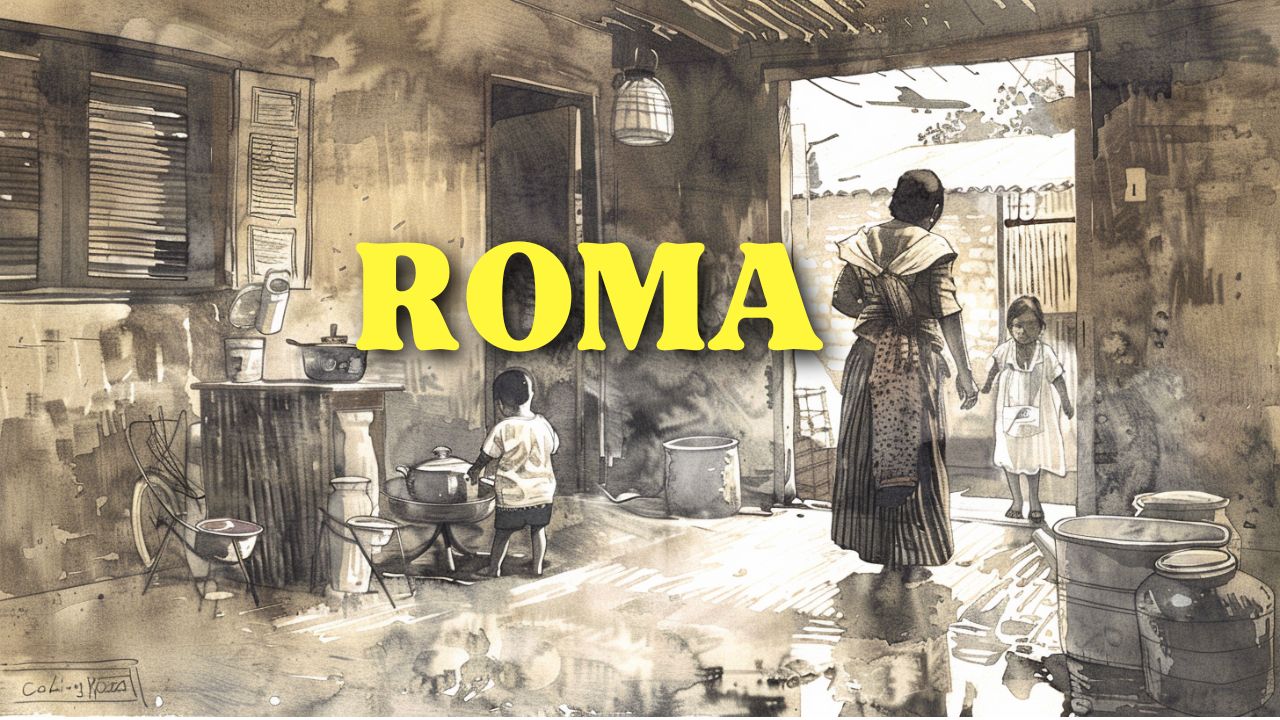
The film follows Cleo, a live-in domestic worker for a middle-class family in the Colonia Roma neighborhood of Mexico City in the early 1970s. She wakes before the family, works through the day, and is present in ways that the family both depends on and fails to fully see. The film sees her. It was made to see her.
Roma won Academy Awards for Best Director, Best Cinematography, and Best Foreign Language Film — making Cuarón the first person to win both directing and cinematography for the same film, and the first international film to win Best Director. At the Golden Globes it won Best Foreign Language Film and Best Director. Cuarón, in his acceptance speech, dedicated the film to domestic workers worldwide who are denied rights and pushed to the background of the societies they sustain.
Basic Information & Synopsis
→ For synopsis and production information, see our Database Article
Director: Alfonso Cuarón
Year: 2018
Runtime: 135 minutes
Production: Participant Media, Esperanto Filmoj
Commemorative Day: International Domestic Workers Day (June 16)
Synopsis: Mexico City, early 1970s. Cleo is an indigenous Mixtec woman who lives with and works for the Sofía family — a mother, four children, and a grandmother in a large house in the Colonia Roma. She wakes early, cleans, cooks, walks the children to school, and is present for everything the family requires. When Sofía’s husband leaves and does not return, and when Cleo discovers she is pregnant by a man who abandons her, both women face their separate crises in parallel, in the same house. The film follows one year.
Background Knowledge
An Intensely Personal Story — Cuarón’s Guilt and His Tribute to Libo Rodríguez
Roma began as a script that Cuarón did not allow anyone to read — not even his producer, Gabriela Rodríguez. She confirmed that she received the script but honored his request not to read it.
“This film is an expression of my own guilt around social class, race,” Cuarón told Variety. “I was a white middle-class Mexican boy, protected.” The film is semi-autobiographical: he is represented by the second-youngest child, Pepe. The domestic worker at the center of the film is based on Libo Rodríguez, the woman who raised him.
Libo Rodríguez participated in the preparation of the film. When she watched it at the New York Film Festival with Gabriela Rodríguez, she wept throughout. As Cuarón walked the red carpet, Libo said: “My baby — he’s grown up so beautifully.” To her, he will always be the child she raised.
This context is essential: Roma is not primarily social critique, though it functions as that. It is an act of gratitude and reparation toward a specific woman whose labor, life, and dignity Cuarón wanted the world to finally see.
The film’s title refers to Colonia Roma, the Mexico City neighborhood where Cuarón grew up. The house in the film is a reconstruction of his actual childhood home.
What Makes It Exceptional
The Monochrome Cinematography as Memory
Cuarón shot the film on 65mm and rendered it in black and white — and also served as his own cinematographer, an unusual choice for a director at his scale. The decision is not merely aesthetic. Black and white removes the noise of color from scenes that might otherwise be distracted by period-specific hues, and in doing so, produces the quality of memory rather than documentation: the past seen with the clarity and the selective emphasis of recollection.
The film’s characteristic long takes — the camera moving slowly through the interior of the house, panning across the city street, holding on a face — create the particular duration of memory. The light in the courtyard, the shadow in the bedroom, the dust in the afternoon: all rendered with an extraordinary depth of field that makes the ordinary house feel like a world.
The monochrome also produces a temporal universality. This is a film set in 1970s Mexico, but it is also, in its visual register, a film about now — about the domestic worker who is in every city, in every middle-class home, doing the labor that makes the household function while being seen incompletely by those she serves.
The Sound Design as Daily Labor
Roma contains almost no score. What fills it instead is the sound of daily life: water running, children’s voices, the street outside, dogs, engines, wind. The sound design is not ambient atmosphere but structure — it traces the continuous, uninterrupted nature of Cleo’s work. There is rarely silence, because there is rarely a moment when nothing is required of her.
The film’s opening and closing motif — the sound of water washing a tiled floor — functions as a frame for the entire work. The planes that pass overhead throughout the film are a recurring detail: the noise of a world that moves above the household, that Cleo can hear but cannot reach.
The absence of music forces the audience into unmediated contact with the texture of the world the film is depicting.
Yalitza Aparicio — A Non-Actor’s Miracle
Yalitza Aparicio was a preschool teacher from Oaxaca, of Mixtec indigenous heritage, with no acting experience, when Cuarón found her after auditioning more than 3,000 people over more than a year. She was 24. “Cleo is me,” she has said. “I’m also a teacher who loves children and sometimes becomes overprotective.” When she met Libo Rodríguez, she thought of her own mother, also a domestic worker.
Aparicio’s performance works through stillness. Cleo speaks infrequently. Her face and body and silence communicate everything that the film needs to communicate about what she is experiencing and what she is not permitted to show. The restraint of the performance — calibrated, genuine, and utterly specific — is what allows the audience to project what Cleo is not saying, which is most of the film’s emotional content.
Related Articles
- Roma Database – Synopsis & Production Details
- Alfonso Cuarón – Filmmaker Profile
はじめに
見えない労働を可視化する、アルフォンソ・キュアロンの静かなる傑作
毎年6月16日は「国際家事労働者デー(International Domestic Workers Day)」です。この日は、2011年に国際労働機関(ILO)が「家事労働者のディーセント・ワーク(働きがいのある人間らしい仕事)に関する条約(第189号)」を採択したことを記念して制定されました。
この条約の目的は、世界中で働く何千万人もの家事労働者の権利を保護し、彼らに尊厳ある労働条件を保障することです。しかし現実には、家事労働者は多くの国で「見えない存在」として扱われ、長時間労働、低賃金、社会保障の欠如に苦しんでいます。
この特別な日に観る作品として、アルフォンソ・キュアロン監督による2018年の『ROMA/ローマ』を強く推奨します。本作は、1970年代のメキシコシティで働く住み込み家政婦クレオの日常を通じて、家事労働の現実と尊厳を描いた傑作です。
美しいモノクロームで撮影された本作は、2019年のアカデミー賞で監督賞、撮影賞、外国語映画賞の3部門を受賞し、ゴールデングローブ賞でも外国語映画賞と監督賞を獲得しました。とりわけ外国語映画賞は、メキシコ映画として史上初の快挙でした。しかし、その真の価値は賞の数や記録ではなく、世界中の家事労働者に光を当て、彼らの人間性と尊厳を力強く描き出したことにあります。
キュアロン監督自身が語るように、この映画は「社会や階級、人種をめぐる私自身の罪悪感の表れ」であり、同時に、自分を育ててくれた家政婦リボ・ロドリゲスへの深い感謝と敬意の表現でもあります。
国際家事労働者デーに『ROMA/ローマ』を観ることは、私たちの日常を支える「見えない労働」を可視化し、そこで働く人々の人間性を再認識する機会となるでしょう。
基本情報・あらすじ
→ あらすじや製作情報はデータベース記事へ
監督: アルフォンソ・キュアロン
製作年: 2018年
上映時間: 135分
制作: Participant Media、Esperanto Filmoj
記念日: 国際家事労働者デー(6月16日)
あらすじ: 1970年代初頭、メキシコシティのコロニア・ローマ地区。クレオは先住民ミシュテカ出身の女性で、ソフィア家に住み込み家政婦として働いています。早朝から起き、掃除をし、料理をし、子どもたちを学校に連れていき、家族が必要とするすべてに対応します。ソフィアの夫が家を出て戻らなくなり、クレオは付き合っていた男性に妊娠を告げると捨てられる——二人の女性が同じ屋根の下で、別々の危機を並行して生き抜く一年間を映画は追います。
予備知識
極めて個人的な物語——監督の「罪悪感」とリボ・ロドリゲスへの敬意
『ROMA/ローマ』の脚本は、誰も通読してはなりませんでした。プロデューサーのガブリエラ・ロドリゲスさえも。アルフォンソ・キュアロン監督の半自伝的作品で、極めて個人的な物語だったからです。
本作は、社会や階級、人種をめぐる私自身の罪悪感の表れだと思うと、キュアロンはバラエティー紙に語っています。私は白人の中流階級のメキシコ人少年で、守られた立場にいた、と。映画の中で、キュアロン自身は次男ペペとして描かれています。
クレオの役作りに協力したキュアロン家の元家政婦リボ・ロドリゲスは、『ROMA/ローマ』の仕上がりに大いに満足しました。プロデューサーのロドリゲスは、ニューヨーク・フィルム・フェスティバルで、リボと一緒に『ROMA/ローマ』を見たといいます。リボは大泣きしていました。キュアロンがレッドカーペットを歩くときは、私のベイビー、本当に立派になって、と言っていました。
この逸話は、映画の核心を物語っています。『ROMA/ローマ』は、単なる社会批判の映画ではありません。それは、一人の女性への深い感謝と愛情の表現なのです。リボ・ロドリゲスは、映画の中でクレオとして描かれることで、ついに「見える存在」になりました。映画のタイトル「ローマ」は、メキシコシティの高級住宅地コロニア・ローマ地区を指しており、映画の舞台となった家は、実際の彼の生家を再現したものです。
優れしている点
モノクローム映像が描く記憶の質感
『ROMA/ローマ』を特別なものにしている最大の要素が、その圧倒的に美しいモノクローム映像です。キュアロンは本作を65mmフィルムで撮影し、モノクロームで仕上げました。これは単なる美的選択ではなく、記憶の質感を表現するための選択です。キュアロン自身が撮影監督も務めた本作の映像は、驚異的な奥行きと細部の描写で知られています。
特に印象的なのは長回しのシーンです。カメラはゆっくりと家の内部を移動し、街の喧騒を捉えます。白と黒の濃淡が1970年代のメキシコシティの光と影を映し出し、陽光が差し込む中庭から薄暗い室内まで、すべてが絵画のように美しく、しかし生々しい。このモノクロームは、時間の距離と普遍性も表現しています。これは1970年代のメキシコの物語であると同時に、現代の世界中の家事労働者の物語でもあるのです。
音響が織りなす日常のリアリティ
『ROMA/ローマ』のもう一つの優れた点は、その卓越した音響デザインです。本作にはほとんど音楽がなく、代わりに日常の音が映画を満たしています。水の流れる音、子供たちの声、街の喧騒、犬の鳴き声、車のエンジン音。この音響デザインは、クレオの世界をリアルに再現するだけでなく、彼女の労働の絶え間なさを表現しています。静寂の瞬間はほとんどなく、常に何かが彼女の注意を要求しています。
特に印象的なのは、冒頭と終わりに登場する床を洗う水の音です。これは映画全体を通じたモチーフであり、クレオの労働の象徴でもあります。また、飛行機の音も重要なモチーフです。頭上を通過する飛行機のエンジン音は、クレオには決して手の届かない世界を象徴しています。
ヤリッツァ・アパリシオの演技——未経験者が生み出した奇跡
主演のヤリッツァ・アパリシオは、メキシコ先住民族ミシュテカ出身の幼稚園教諭で、今回初めて演技に挑戦しました。キュアロンは1年以上をかけて3000人をオーディションした末に、当時24歳のアパリシオに出会いました。クレオは私そのもの。教師の私も子供が大好きで、ときどき過保護になってしまう、と彼女は語ります。
演技経験がないにもかかわらず、アパリシオはクレオという複雑なキャラクターに命を吹き込んでいます。アパリシオの演技の特徴は、その静けさです。クレオは多くを語りませんが、彼女の表情、仕草、沈黙がすべてを物語っています。
関連記事
- ROMA/ローマ データベース – あらすじ・製作情報
- アルフォンソ・キュアロン – 監督プロフィール