
Choose Your Language / 言語を選択:
Introduction
A Story of Intercultural Understanding Born in a Desert Café — And a New Family Woven from Diversity
May 21 is the World Day for Cultural Diversity for Dialogue and Development, established by the United Nations General Assembly in 2002, following UNESCO’s Universal Declaration on Cultural Diversity of 2001.
The day exists to protect and promote the diversity of cultural expressions, and to encourage dialogue and cooperation among cultures. It recognizes that cultural diversity — different languages, religions, artistic traditions, and values — is not a problem to be solved but a resource to be cultivated, a source of exchange, innovation, and creativity that is essential to a sustainable human future.
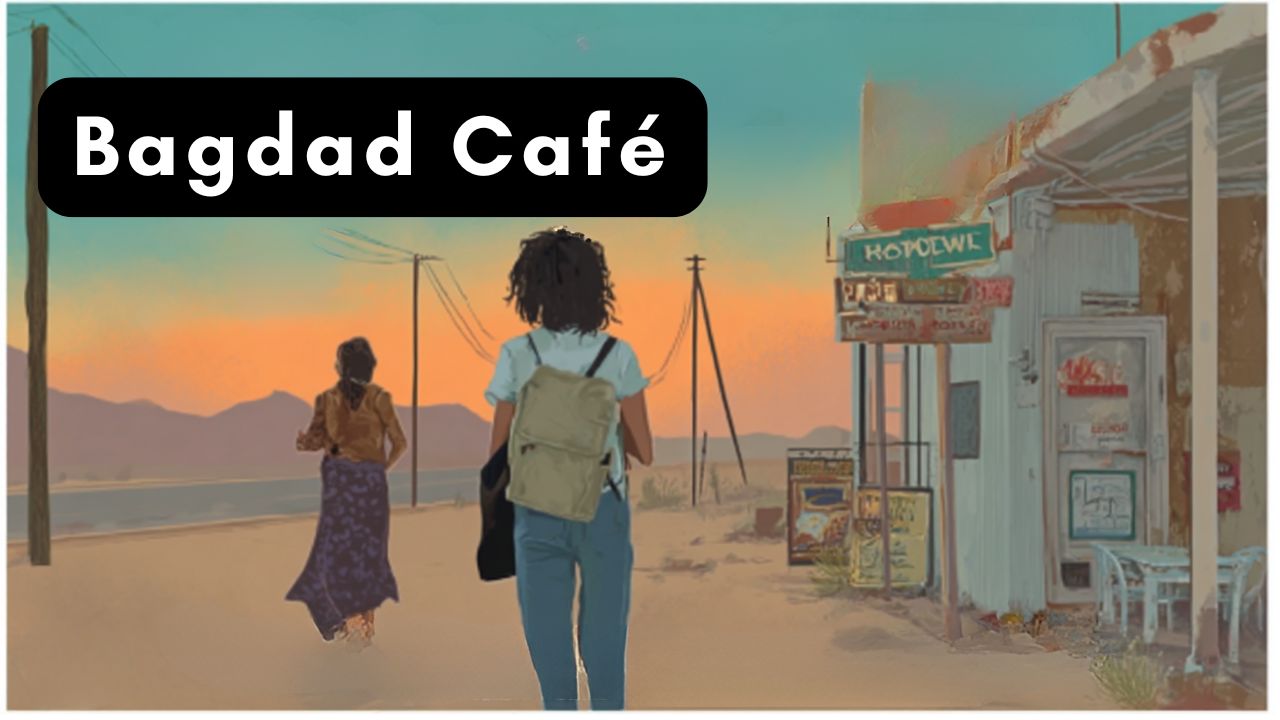
For this day, the film to watch is Bagdad Café (1987), directed by Percy Adlon.
The film is set in a run-down roadside motel and café in the Mojave Desert of California. Jasmine, a German tourist, arrives alone after an argument with her husband somewhere on the highway. The café is run by Brenda, an African-American woman whose marriage is also disintegrating, and populated by a small collection of idiosyncratic regulars. Jasmine and Brenda do not understand each other. Over time, improbably, they do.
The film contains no dramatic plot machinery. What happens is subtler and more durable: the gradual dissolution of suspicion, the discovery of unexpected competence in an unlikely person, the formation of something that begins to resemble a family.
Note: Two versions exist — the 1987 original (95 minutes) and a 2008 director’s cut by Adlon himself (108 minutes), which restores color adjustments and previously unreleased scenes. The director’s cut is recommended.
Basic Information & Synopsis
→ For synopsis and production information, see our Database Article
Director: Percy Adlon
Year: 1987
Runtime: 95 minutes (original) / 108 minutes (director’s cut)
Production: Pelemele Film, Pro-ject Filmproduktion
Commemorative Day: World Day for Cultural Diversity for Dialogue and Development (May 21)
Background Knowledge
Percy Adlon and the New German Cinema
Percy Adlon (1935–2024) was a German film director associated with the New German Cinema movement (roughly 1965–1985), known for films featuring strong female characters and a positive embrace of difference. His other works include Rosalie Goes Shopping (1989) and Salmonberries (1991). His films appeared regularly in competition at Cannes and Berlin.
His distinctive quality was a European perspective on America — filming the United States as a place of strangeness and possibility, seen from the outside. Bagdad Café is the fullest expression of that perspective.
Critical Reception and Kurosawa’s Affection
Roger Ebert gave the film 3.5 out of 4 stars and described its quality in terms that have since become the standard critical summary: “Adlon is saying something here about Europe and America, about the old and the new, about the desert edge being the edge of the American Dream.” He praised the film for being “all unexpected characters and unmotivated moments, all ambiguity and vitality.”
Akira Kurosawa included Bagdad Café in his list of one hundred favorite films. The film’s universality — its capacity to speak across cultures, genres, and expectations — was recognized by one of the twentieth century’s most demanding filmmakers.
The Real Baghdad and the Decline of Route 66
The fictional town of Baghdad is based on a real place — the actual town of Baghdad, California, which existed along U.S. Route 66. Route 66, known as the “Mother Road,” symbolized American mobility and prosperity. After Interstate 40 bypassed it in 1973, the small towns along the route were stranded; the real Baghdad was eventually abandoned and demolished.
The film was shot at the Sidewinder Café in Newberry Springs, 80 kilometers west of the former Baghdad site. After the film’s success, a new owner purchased the café and renamed it Bagdad Café. It remains a destination, particularly for European tourists — a place where a film about cross-cultural connection has become a location for actual cross-cultural connection.
The Theme Song — “Calling You”
“Calling You,” performed by Jevetta Steele, received an Academy Award nomination for Best Original Song. The song — about longing, solitude, and reaching across distance — functions as the film’s emotional summary, audible in the Mojave desert as both landscape and state of mind. Many viewers report that hearing the song recalls the film’s images immediately and completely.
What Makes It Exceptional
Marianne Sägebrecht’s Subtle Performance
The film’s greatest performance is Marianne Sägebrecht’s Jasmine. She arrives as a large, fair, oddly dressed German woman carrying a suitcase through the Mojave, visually incongruous in every possible way — and Sägebrecht plays her with complete self-possession. Jasmine does not know she is incongruous. She simply does what seems sensible: clean what is dirty, learn what can be learned, offer what she has.
The arc from Jasmine’s first frozen uncertainty to the ease of her presence in the café — particularly the sequence of her being painted by Rudi, where a kind of acceptance of herself becomes visible — is carried almost entirely in expression and physical comportment. The performance demonstrates something important about the film’s method: what is most significant is communicated without being stated.
The Honest Depiction of Intercultural Misunderstanding
Adlon does not idealize the process of intercultural understanding. Brenda is suspicious of Jasmine, calls the sheriff to investigate her, and remains hostile for a substantial portion of the film. The film acknowledges that this response — wariness toward an unexpected stranger — is comprehensible, not simply prejudiced.
What follows is not a conversion but an accumulation. The suspicion is overcome by time and by specific evidence: Jasmine’s cleaning, her magic trick, her effect on the children, her presence in the performances that begin to draw people to the café. Understanding is earned rather than assumed. This is the film’s most honest quality.
The New Chosen Family
The people at the café are, in different ways, outside the social mainstream — the African-American woman running a failing business, the German immigrant, the elderly Hollywood artist who has ended up here, the tattoo artist and the others. The film presents their combination not as a social problem but as a source of vitality. By the end, they have become something closer to a family than many families — not through shared blood or origin, but through the choice to stay and the willingness to be changed by one another.
This is not assimilation. It is not the dissolution of difference into a common identity. It is integration of a more precise kind: people who are different, remaining different, and finding that the difference is what makes the combination work.
Related Articles
- Bagdad Café Database – Synopsis & Production Details
- Percy Adlon – Filmmaker Profile
- Marianne Sägebrecht – Actor Profile
はじめに
砂漠のカフェで芽生える異文化理解と、多様性が紡ぐ新しい家族の物語
5月21日は、国際連合(UNESCO)により制定された「世界文化多様性デー」(World Day for Cultural Diversity for Dialogue and Development)です。正式名称を「対話と発展のための文化多様性に関する世界デー」といい、2001年の「文化多様性に関するユネスコ宣言」を受けて2002年に国連総会が制定されました。この国際デーは、文化の多様性を尊重し、異文化間の理解と対話を促進することを目的としています。各国・地域で異なる言語、宗教、芸術、価値観などの違いを受け入れ、平和的な共存や相互理解を深めるために、毎年世界各国で異文化フェスティバルや国際理解教育などの活動が行われています。
この特別な日に観る作品として、パーシー・アドロン監督による1987年の**『バグダッド・カフェ』**(Bagdad Café)を推奨します。本作は、モハーベ砂漠の小さなカフェを舞台に、ドイツ人女性と多様な背景を持つアメリカ人たちとの交流を描いた心温まるヒューマンドラマです。
マリアンネ・ゼーゲブレヒト演じるドイツ人観光客ジャスミンが、夫婦喧嘩の末にたどり着いた寂れたカフェで、CCHパウンダー演じるアフリカ系アメリカ人オーナーのブレンダや、個性豊かな常連客たちと出会い、言葉や文化の壁を越えて少しずつ心を通わせていく姿は、異文化理解の困難さと可能性、多様性を受け入れることで生まれる豊かさ、偏見を超えた相互理解と共生といった、世界文化多様性デーの理念に深く共鳴するテーマを美しく描き出しています。パーシー・アドロン監督の独特な演出と、ジュベッタ・スティールが歌う主題歌「コーリング・ユー」が、砂漠の片隅にある小さなカフェでの異文化交流の奇跡を、深い感動作へと昇華させています。
なお本作には、1987年公開のオリジナル版(95分)と、アドロン監督自身が2008年に色調を補正し未公開シーンを復元した「ニュー・ディレクターズ・カット版」(108分)の2バージョンが存在します。鑑賞の際はディレクターズ・カット版をお薦めします。
基本情報・あらすじ
→ あらすじや製作情報はデータベース記事へ
監督: パーシー・アドロン
製作年: 1987年
上映時間: 95分(オリジナル版)/ 108分(ディレクターズ・カット)
制作: Pelemele Film、Pro-ject Filmproduktion
記念日: 世界文化多様性デー(5月21日)
予備知識
パーシー・アドロン監督とニュージャーマンシネマ
パウル・ルドルフ・パルジファル”パーシー”アドロン(1935-2024)は、ニュージャーマンシネマ運動(1965年頃-1985年)に参加したドイツの映画監督です。強い女性キャラクターと多様性の肯定的な描写で知られ、『バグダッド・カフェ』のほか、『ロザリーは買い物へ行く』(1989年)、『サーモンベリーズ』(1991年)などの作品を手がけました。
アドロンの映画は、カンヌ国際映画祭、ベルリン国際映画祭などの国際映画祭で定期的にコンペティション部門に出品され、高い評価を受けました。特にヨーロッパ人の視点からアメリカを描く独特のスタイルと、文化的境界を超えた人間関係の描写に定評があります。
批評家の評価と黒澤明の愛した作品
『バグダッド・カフェ』は批評家から絶賛され、ロジャー・イーバートは4つ星中3.5つ星の評価を与え、「アドロンはこの映画でヨーロッパとアメリカ、古いものと新しいもの、砂漠の端がアメリカンドリームの端であることについて何かを語っている」と述べています。また、この映画の魅力は「すべての登場人物とすべての瞬間が予想外で、動機が曖昧で、意味が定まらず、生命力に満ちている」ことにあると評しました。
日本の映画監督、黒澤明は『バグダッド・カフェ』を彼のお気に入りの映画100本の一つに挙げており、文化や国境を超えて人間の本質に訴えかける普遍性が、世界的な巨匠にも認められた証となっています。
実在したバグダッドの町とルート66の衰退
舞台となるカリフォルニア州バグダッドは、かつてアメリカ国道66号線沿いにあった実在の町です。ルート66は「マザーロード」と呼ばれ、アメリカの繁栄と移動の自由を象徴する道路でした。しかし1973年に州間高速道路40号線が迂回路としてできた後、多くの小さな町は取り残されて衰退し、バグダッドも放棄され、最終的には取り壊されました。
この歴史的背景は、映画のテーマと深く結びついています。かつて栄えた場所が忘れ去られ、主流から外れた人々が集まる場所――そこでこそ、真の人間的なつながりと多様性の価値が見出されるという皮肉と希望が描かれています。
映画の撮影は、バグダッドから西に80キロ離れたニューベリー・スプリングスのサイドワインダー・カフェで行われました。この実在のカフェは映画のヒットを受けて新しいオーナーが買い取り、「バグダッド・カフェ」に改名。現在も特にヨーロッパからの観光客に人気の聖地となっており、異文化交流を描いた映画が、実際の異文化交流の場となっているのは象徴的です。
主題歌「コーリング・ユー」
ジュベッタ・スティールが歌う主題歌「Calling You」は、孤独と切望、そして呼びかけをテーマにした美しい楽曲です。この曲はアカデミー歌曲賞にノミネートされ、映画を観た多くの人々の心に残り続けています。
言葉を超えた感情の伝達という意味で、この歌は映画のテーマと完璧に調和しています。砂漠の風景と相まって、この曲を聴くだけで映画の情景が浮かぶという声が多く、異なる文化圏の人々の心にも普遍的に響く音楽の力を体現しています。
優れしている点
マリアンネ・ゼーゲブレヒトの繊細な演技
本作の最大の優れた点は、マリアンネ・ゼーゲブレヒト演じるジャスミンの繊細で深みのある演技です。言葉も文化も異なる異国の地で、孤独と不安を抱えながらも、少しずつ心を開いていく過程を、台詞以上に表情と仕草で見事に表現しています。
特に印象的なのは、最初は緊張と防衛心で固まっていた彼女の表情が、カフェの人々と非言語的なコミュニケーションを重ねるごとに柔らかくなり、やがて笑顔を見せるようになる変化の描写です。ルディに描かれる肖像画のシーンでは、徐々に自分自身を受け入れ、異文化の中で新しいアイデンティティを見出していく女性の内面的成長が美しく表現されています。
異文化間の誤解と理解の丁寧な描写
アドロン監督は、異文化理解を理想化せず、その困難さと時間のかかるプロセスを正直に描いています。ブレンダがジャスミンを疑い、保安官に調査を依頼する場面は、外国人に対する警戒心と偏見をリアルに表現しています。
しかし、この映画が優れているのは、そこで終わらない点です。共に過ごす時間の中で、少しずつ相手の善意を認め、文化的背景の違いを超えた人間としての共通点を発見していく過程が、劇的ではなく、ゆっくりと、しかし確実に描かれます。言葉が完璧に通じなくても、掃除や手品、音楽といった非言語的なコミュニケーションを通じて、真の理解が生まれることを示しています。
多様性が生み出す、新しい疑似家族の誕生
カフェに集まる人々は、それぞれが社会の主流から外れた存在です。アフリカ系アメリカ人の女性経営者、ドイツ人移民、高齢のアーティスト、タトゥーアーティスト、そして様々な背景を持つ家族たち——本作の優れた点は、こうした多様性を「問題」ではなく「豊かさ」として描いていることです。
そして映画の終盤、彼らは単なるコミュニティの仲間を超えます。血縁も国籍も言語も共有しない人々が、互いの欠落を補い合い、互いの個性を尊重し合うことで、新しい「家族」を形成する——それが本作の到達点です。同化ではなく、互いの違いを認め合った先に生まれる真の統合が、ここに描かれています。