
Choose Your Language / 言語を選択:
Introduction
An Island Pagan Community and One Policeman’s Three Days — the Origin of Folk Horror
August 22 is designated “World Folklore Day.”
Its origin is clear. On August 22, 1846, the English antiquary William John Thoms, in a letter to the London magazine The Athenaeum, used for the first time the coined word “folklore,” combining “folk” (the common people) and “lore” (knowledge).
It was the moment when a single name was given to a field that until then had had only such names as “popular antiquities” and “folk literature.”
Regarding the movement to make this day a commemorative day, there is a description that it was fixed at an international folklore congress held in 1960, but the circumstances of its establishment differ by source, and it is not easy to trace to a single authoritative source. Nor is it included in the official list of international days of the UN or UNESCO.
That said, several countries, such as Brazil, Ghana, and Peru, hold folklore events on this day. Oral literature, folk beliefs, rituals, traditional performing arts — it is regarded as a day to turn one’s eyes to what has been handed down in forms that do not remain in writing.
As the film to watch on this day, we recommend Robin Hardy’s 1973 The Wicker Man.
Set on the fictional island of Summerisle off Scotland, it depicts the confrontation between a community that practices ancient Celtic-style pagan customs and a devoutly Christian policeman.
Regarded as the origin of the genre “folk horror,” its influence extends even to contemporary works such as Midsommar and Hereditary.
However, the interest of this work lies not in the horror itself so much as in the way it handles folkloric material. What the screenwriter and director referred to was the anthropologist James Frazer’s The Golden Bough.
Basic Information & Synopsis
→ For synopsis and production information, see our Database Article
Director: Robin Hardy
Year: 1973
Runtime: 91 minutes (Final Cut)
Production: British Lion Films
Commemorative Day: World Folklore Day (August 22)
Background Knowledge
How the Project Came to Be
In the early 1970s, Christopher Lee felt he was at an impasse. Having made his name in the role of Dracula for Hammer Films, he wanted to break out of that image.
In 1971, Lee met the screenwriter Anthony Shaffer. The two agreed to make a film together, and director Robin Hardy joined.
What they aimed for was the very opposite of Hammer horror. To bring out neither monsters nor supernatural phenomena, and to take ancient religion itself as the subject.
Shaffer read David Pinner’s novel Ritual (1967). It was a story of a devout policeman investigating the ritual murder of a girl in a rural village.
They bought the rights from Pinner, but Shaffer soon judged that a direct adaptation would not work. As a result, an entirely different story was written, borrowing only the elements.
The Golden Bough as an Underlay
What Shaffer and Hardy used as their main reference material was the Scottish anthropologist James Frazer’s The Golden Bough (first edition 1890).
It is a great work comparing the myths, religions, and rituals of various parts of the world, discussing in detail, above all, the themes of “the killing of the king” and “fertility ritual.”
According to Frazer, many ancient cultures had the practice of the king or priest being killed after a fixed period and replaced by a new one. It functioned, he held, as a ritual guaranteeing the fertility of the earth.
The warning Howie gives Lord Summerisle in the film — that “if next year fails too, next it will be you who is burned” — directly follows this theory.
The leader himself is the final candidate for sacrifice. This structure gives the story an eerie cycle.
The Origin of the Wicker Man
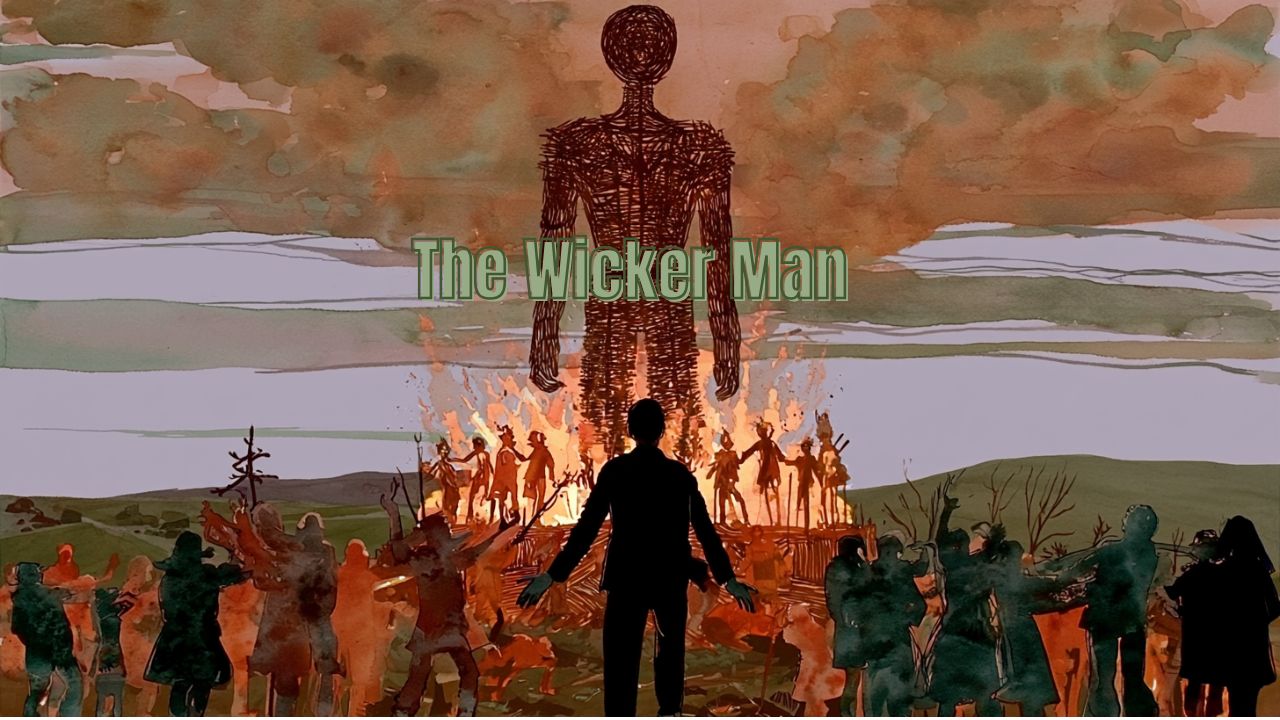
The image of the “wicker man” that became the title is based on the description in Julius Caesar’s The Gallic War.
Caesar recorded that the Gauls (ancient Celts) wove a huge human-shaped image from willow, packed living humans inside it, and burned it.
Shaffer called this “the most terrifying and magnificent image I have ever seen.”
However, how far Caesar’s description reflects fact is historically debated. The point that there was a political intent to depict a hostile people as barbaric has been made since long ago, and archaeological backing is also limited.
In other words, this film can also be said to have revived, as a visual image, a description not established as historical fact.
The Folkloric Elements Depicted
Many of the customs appearing in the work are based on actual records and research.
Beltane (the May festival) — May 1 was one of the four great Celtic festivals, a day celebrating the beginning of summer. Customs of lighting fires, blessing livestock, and praying for fertility are recorded in various places.
The Maypole — the custom of dancing around a pole decorated with ribbons is seen in spring festivals across Europe. Its connection with prayers for fertility has been pointed out.
The Green Man — a design of a human face surrounded by leaves, also seen in medieval church decoration. It is also the name of the pub in the work.
Paul Giovanni, who handled the music, referred to the work of folk-song collectors such as Cecil Sharp and combined real folk songs with new songs made to seem like them.
The Problem of Versions
This work has multiple versions, and this has produced a troublesome problem.
During production, the management of the production company British Lion changed. The new management did not value this work and demanded substantial shortening.
As a result, what was released theatrically was the 88-minute version (also given as 87 minutes). Moreover, it was treated as the supporting feature in a double bill with Nicolas Roeg’s Don’t Look Now.
The subsequent course of events is complex.
Hardy had sent a print to Roger Corman seeking advice, and a copy of it remained. Based on this, a 96-minute version was restored in 1979.
In 2001, a 99-minute version was made, combining telecine footage and other material.
And in 2013, the 1979 print was discovered at Harvard University’s film archive, and based on it the “Final Cut” (91 minutes) was produced.
Here, caution is needed.
It is not that the longest, 99-minute version is the best. What Hardy himself recognized as the final form was the 91-minute Final Cut.
The reason is the order of the story. In this version, it becomes clear that the events on the island span 72 hours, and Lord Summerisle appears at an early stage. The structure Hardy originally intended was recovered.
If you are going to watch it, we first recommend the Final Cut.
What Makes It Exceptional
That It Did Not Make the Villain a Villain
The core of this work lies in the modeling of Lord Summerisle, played by Christopher Lee.
He is not a fanatic. He is cultured, eloquent, and holds conviction in their choices.
The scene where he speaks of the island’s history while guiding a visitor through the garden. The calm tone, the erudition, and the pride. He believes he is doing the right thing.
That is precisely why it is frightening.
Lee spoke of this work as one of his finest jobs. This role, chosen to break out of the Dracula role, certainly became his signature work.
That It Did Not Make Howie a Hero Either
The protagonist Howie, for his part, is also not a simple good man.
He is stubborn, narrow-minded, and denies others’ culture out of hand. His purity-principled refusal of premarital sex looks both high-minded and inflexible.
His attitude of condemning the island’s people as “barbaric” and “corrupt” is by no means one that invites sympathy.
This ambivalence keeps this work away from a simple story of good and evil.
Horror That Sheds No Blood
Shaffer wished for a film that did not rely on violence or bloodshed. He had grown tired of horror that merely shows entrails.
In fact, this work has almost no bloodshed.
What there is instead is brightness. Daytime sunlight, a green island, song and dance, smiling people.
Even in the final scene, the setting sun sinking beyond the blazing flames is shown beautifully.
Horror rises up not from darkness but from brightness. This structure makes this work a singular one.
The Music
Paul Giovanni’s music is a major element that makes this work hold together.
The characters often sing. In the pub, in the classroom, in the procession. It is presented not as background scoring but as part of the community’s life.
Especially “The Willow’s Song” became an unforgettable piece — sensual yet eerie.
Related Articles
- The Wicker Man Database – Synopsis & Production Details
- Robin Hardy – Profile
- Christopher Lee – Profile
はじめに
孤島の異教共同体と、ある警官の三日間——フォークホラーの原点
8月22日は「世界フォークロアの日」(World Folklore Day)とされています。
由来は明確です。1846年8月22日、イギリスの好古家ウィリアム・ジョン・トムズが、ロンドンの雑誌『アシーニアム』への投書の中で、”folk”(民衆)と “lore”(知識)を組み合わせた造語 “folklore” を初めて用いました。
それまでは「大衆的古物」「民間文学」といった呼び方しかなかった領域に、一つの名前が与えられた瞬間です。
この日を記念日とする動きについては、1960年にブエノスアイレスで開かれた国際民俗学会議で定められたとする記述が見られますが、制定の経緯については資料により説明が異なります。国連やユネスコの公式な国際デーの一覧には含まれていません。
とはいえ、ブラジル、ガーナ、ペルーなど複数の国が、この日に民俗行事を行っています。口承文学、民間信仰、祭祀、伝統芸能——文字に残らない形で受け継がれてきたものに、目を向ける日とされています。
この日に観るべき作品として、ロビン・ハーディ監督による1973年の『ウィッカーマン』(The Wicker Man)を推薦します。
スコットランド沖の架空の島サマーアイルを舞台に、古代ケルト的な異教の風習を実践する共同体と、敬虔なキリスト教徒である警官の対峙を描いた作品です。
「フォークホラー」というジャンルの原点とされ、『ミッドサマー』『ヘレディタリー』といった現代作品にまで影響が及んでいます。
ただし本作の面白さは、恐怖そのものよりも、民俗学的な素材の扱い方にあります。脚本家と監督が参照したのは、人類学者ジェームズ・フレイザーの『金枝篇』でした。
基本情報・あらすじ
→ あらすじや製作情報はデータベース記事へ
監督: ロビン・ハーディ
製作年: 1973年
上映時間: 91分(ファイナル・カット)
制作: ブリティッシュ・ライオン・フィルムズ
記念日: 世界民俗学の日(8月22日)
予備知識
企画の成り立ち
1970年代初頭、クリストファー・リーは行き詰まりを感じていました。ハマー・フィルムのドラキュラ役で名を成した彼は、そのイメージから抜け出したいと考えていたのです。
1971年、リーは脚本家アンソニー・シェイファーと出会います。二人は共同で映画を作ることに合意し、監督のロビン・ハーディが加わりました。
彼らが目指したのは、ハマー・ホラーとは正反対のものでした。怪物も超自然現象も出さず、古代宗教そのものを題材にする。
シェイファーは、デヴィッド・ピナーの小説『儀式』(Ritual, 1967)を読みます。敬虔な警官が田舎の村で少女の儀式殺人を捜査するという物語でした。
彼らはピナーから権利を買い取りましたが、シェイファーはすぐに、直接の翻案では機能しないと判断します。結果として、要素だけを借りたまったく別の物語が書かれました。
『金枝篇』という下敷き
シェイファーとハーディが主要な参考資料としたのは、スコットランドの人類学者ジェームズ・フレイザーの『金枝篇』(The Golden Bough, 1890年初版)です。
世界各地の神話、宗教、儀式を比較した大著で、とりわけ「王殺し」と「豊穣儀礼」の主題を詳細に論じています。
フレイザーによれば、多くの古代文化には、王や祭司が一定期間の後に殺され、新しい者に交代する慣行がありました。それは大地の豊穣を保証する儀式として機能していた、というのです。
映画の中でハウイがサマーアイル卿に告げる警告——「来年も失敗すれば、次はお前が焼かれる」——は、この理論をそのまま踏まえたものです。
指導者自身が最終的な生贄候補である。この構造が、物語に不気味な循環を与えています。
ウィッカーマンの由来
タイトルとなった「ウィッカーマン」の像は、ユリウス・カエサルの『ガリア戦記』の記述に基づきます。
カエサルは、ガリア人(古代ケルト人)が巨大な人型の像を柳で編み、その中に生きた人間を詰め込んで焼いたと記しました。
シェイファーはこれを「これまで見た中で最も恐ろしく、荘厳なイメージ」と評しています。
ただし、カエサルの記述がどこまで事実を反映しているかについては、歴史学的に議論があります。敵対する民族を野蛮なものとして描く政治的意図があったという指摘は古くからあり、考古学的な裏付けも限定的です。
つまりこの映画は、史実として確定していない記述を、視覚的なイメージとして再生させたとも言えます。
描かれる民俗的要素
作中に登場する慣行の多くは、実際の記録や研究に基づいています。
ベルテーン(五月祭) — 5月1日はケルトの四大祭の一つで、夏の始まりを祝う日でした。火を焚き、家畜を祝福し、豊穣を祈願する習俗が各地に記録されています。
メイポール(五月柱) — リボンで飾った柱の周りで踊る習慣は、ヨーロッパ各地の春祭りに見られます。豊穣祈願との関連が指摘されてきました。
グリーンマン — 葉に囲まれた人面の意匠で、中世の教会装飾にも見られます。作中のパブの名前でもあります。
音楽を担当したポール・ジョヴァンニは、民謡収集家セシル・シャープらの仕事を参照し、実在の民謡と、それらしく作られた新曲を組み合わせました。
版の問題
本作には複数の版があり、これが厄介な問題を生んでいます。
制作中に、製作会社ブリティッシュ・ライオンの経営が変わりました。新経営陣は本作を評価せず、大幅な短縮を求めます。
結果、劇場公開されたのは88分版(87分とも表記されます)でした。しかもニコラス・ローグ監督『赤い影』との二本立ての、添え物としての扱いでした。
その後の経緯は複雑です。
ハーディはロジャー・コーマンに助言を求めてプリントを送っており、そのコピーが残っていました。これを基に、1979年に96分版が復元されます。
2001年には、テレシネ映像なども組み合わせた99分版が作られました。
そして2013年、ハーバード大学の映画アーカイブで1979年のプリントが発見され、それを基に『ファイナル・カット』(91分)が制作されます。
ここで注意が必要です。
最も長い99分版が最良というわけではありません。ハーディ自身が最終形と認めたのは、91分のファイナル・カットでした。
理由は、物語の順序です。この版では、島での出来事が72時間にわたることが明確になり、サマーアイル卿が早い段階で登場します。ハーディが本来意図した構成が回復されたのです。
観るなら、まずファイナル・カットを勧めます。
優れている点
悪役を悪役にしなかったこと
本作の核心は、クリストファー・リー演じるサマーアイル卿の造形にあります。
彼は狂信者ではありません。教養があり、雄弁で、自分たちの選択に確信を持っています。
庭を案内しながら島の来歴を語る場面。穏やかな口調、博識、そして誇り。彼は自分が正しいことをしていると信じています。
だからこそ恐ろしいのです。
リーは本作を、自身の最も優れた仕事の一つと語っていました。ドラキュラ役から脱するために選んだこの役は、確かに彼の代表作となりました。
ハウイも英雄にしなかったこと
一方の主人公ハウイも、単純な善人ではありません。
彼は頑固で、狭量で、他者の文化を頭から否定します。婚前交渉を拒む純潔主義は、高潔にも、融通の利かなさにも見えます。
島の人々を「野蛮」「堕落」と断じる態度は、決して共感を誘うものではありません。
この両義性が、本作を単純な善悪の物語から遠ざけています。
血を流さない恐怖
シェイファーは、暴力や流血に頼らない映画を望んでいました。内臓を見せるだけのホラーに飽きていたのです。
実際、本作にはほとんど流血がありません。
代わりにあるのは、明るさです。昼間の陽光、緑の島、歌と踊り、笑顔の人々。
最後の場面ですら、燃え盛る炎の向こうに沈む夕日が美しく映されます。
恐怖が暗闇からではなく、明るさから立ち上がってくる。この構造が、本作を特異なものにしています。
音楽
ポール・ジョヴァンニの音楽は、本作を成立させている大きな要素です。
登場人物たちは、しばしば歌います。パブで、教室で、行列で。それは劇伴ではなく、共同体の生活の一部として提示されます。
とりわけ「ウィローの歌」は、官能的でありながら不気味な、忘れがたい一曲となりました。
関連記事
- ウィッカーマン データベース – あらすじ・製作情報
- ロビン・ハーディ – プロフィール
- クリストファー・リー – プロフィール