
Choose Your Language / 言語を選択:
Introduction
Hollywood’s Masterpiece Self-Indictment
May 4 is the anniversary of the founding of the Academy of Motion Picture Arts and Sciences.
On May 4, 1927, the Academy was established — and from the following year, the Academy Awards it presented became the highest honor in Hollywood cinema, a symbol of the industry’s idea of its own excellence.
But behind the excellence are the ones who no longer belong to it. The stars who fell. The people the era left behind. Those who have nothing left but the memory of what they were.
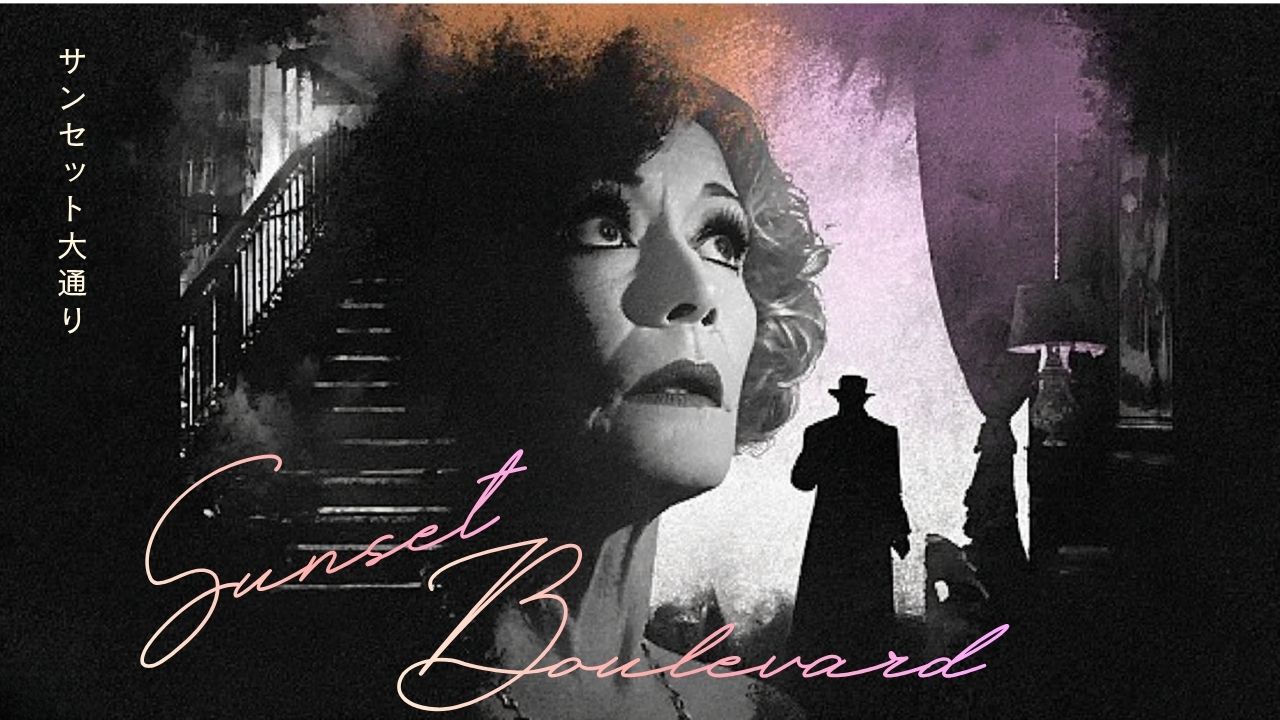
Sunset Boulevard (1950), directed by Billy Wilder, is the film in which Hollywood looked at that shadow directly and did not look away.
A silent film actress named Norma Desmond lives in a decaying mansion on Sunset Boulevard, convinced that she is on the verge of her great return. The studios have never called. Her only audience is her butler. Into her world comes Joe Gillis — a broke screenwriter fleeing his creditors who takes shelter there, then cannot leave. The film is told by Joe in narration, from the moment of his death, floating face-down in Norma’s pool.
Sunset Boulevard received eleven Academy Award nominations at the 23rd ceremony — second only to All About Eve‘s fourteen. It won three: Best Original Screenplay, Best Art Direction, and Best Original Score. Gloria Swanson’s performance did not win Best Actress. It is nonetheless among the most indelible acting performances in the history of American cinema.
Basic Information & Synopsis
→ For synopsis and production information, see our Database Article
Director: Billy Wilder
Year: 1950
Runtime: 110 minutes
Production: Paramount Pictures
Commemorative Day: Academy of Motion Picture Arts and Sciences Founding Anniversary (May 4)
Synopsis: Hollywood, 1949. Joe Gillis is a screenwriter with no credits, no prospects, and two men from the finance company about to repossess his car. Hiding from them in what he thinks is an abandoned driveway on Sunset Boulevard, he discovers the house is occupied: by Norma Desmond, once one of the great stars of the silent era, and by her butler Max, who was once her director and her husband. Norma has spent years writing a screenplay about Salome that she intends to bring to Cecil B. DeMille. She offers Joe money to help her polish it. He accepts. He stays. The arrangement tightens. When Joe eventually tries to leave, it is already very late.
Background Knowledge
Academy Awards Recognition
Sunset Boulevard received eleven Academy Award nominations at the 23rd ceremony in 1951 — at the time, second only to All About Eve‘s fourteen. The film is one of a small number to have received nominations in all four acting categories simultaneously. It did not win in any acting category. The Best Actress vote was split between Bette Davis (All About Eve) and Swanson, allowing the newcomer Judy Holliday (Born Yesterday) to take the award.
Sunset Boulevard — The Street and Its History
Sunset Boulevard had been associated with Hollywood film production since 1911, when the city’s first film studio, Nestor, opened there. As the industry grew through the 1920s, the area filled with mansions — often disproportionately large for their owners’ actual circumstances — built by people for whom money and fame had arrived at the same time. By the late 1940s, when Wilder made the film, many of those houses remained, occupied by people who had been part of the silent era and were no longer part of anything.
Wilder’s Conception
In the 1920s, Billy Wilder had been a young man in Berlin whose interest in America was primarily driven by American cinema. By the late 1940s, living in Los Angeles, he passed those decaying mansions regularly. He began to wonder what the people inside them did with their days — now that the parade had moved on. From that curiosity, he constructed the story.
Wilder and Charles Brackett submitted their screenplay to Paramount and to the Breen Office (the Production Code’s enforcement arm) in sections, concealing the full arc of the story. The Breen Office required specific line changes. Paramount executives believed they were adapting a nonexistent property called A Can of Beans and gave the production unusual latitude. When shooting began in May 1949, only the first third of the script existed. Wilder did not yet know how the film would end.
Censorship and Production
The Breen Office required changes throughout the process. A line of Joe’s — “I’m up that creek and I need a job” — was changed to “I’m over a barrel, I need a job.” The deliberate concealment of the full story from studio oversight, the incremental submission of pages, and the production’s unusual degree of creative freedom all reflect the particular conditions under which Sunset Boulevard was made.
What Makes It Exceptional
Gloria Swanson’s Performance
Swanson’s Norma Desmond is one of the great performances in American film history, and not separable from the fact that Swanson herself was a genuine star of the silent era. She knew what it was to be that famous. She knew what it was to have been forgotten. That knowledge is in the performance.
Norma is not written as a simple grotesque. She has pride, loneliness, and a fragility that comes from being unable to see what is actually in front of her. “I am big — it’s the pictures that got small!” The line captures the mechanism of her self-deception. And the final sequence — Norma descending the staircase toward the cameras, toward the policemen and press photographers she has mistaken for a film crew, saying “All right, Mr. DeMille, I’m ready for my close-up” — is among the most haunting endings in the history of cinema. Swanson’s face in that moment is not entirely performance. It is also recognition.
Billy Wilder’s Screenplay
The screenplay — credited to Wilder, Charles Brackett, and D.M. Marshman Jr. — attacks Hollywood’s internal logic without mercy. The cruelty of the star system, the disposability of people who are no longer useful, the gap between what the industry presents and what it actually is — all of it is in the writing.
“There’s nothing tragic about being fifty. Not unless you try to be twenty-five.” The line lands as both comedy and diagnosis. The script operates in the space between black comedy and film noir — every funny moment has grief beneath it, every beautiful moment has corruption beneath that.
John F. Seitz’s Cinematography
John F. Seitz’s black-and-white photography is among the great technical achievements of the film noir period. Wilder trusted Seitz extensively and gave him considerable latitude in his decisions.
For interior shots, Seitz scattered dust before the lens to achieve an atmosphere of age and decay — a technique he had used on Double Indemnity (1944). The shot from the bottom of the pool looking up through the water at Joe’s floating body required particular ingenuity: a mirror was placed on the pool floor and the reflection of Holden was filmed through the water surface from above.
Film historian Tom Stempel: “In both Double Indemnity and Sunset Boulevard, Seitz does something that always impresses me. Both are film noirs, and he manages the fact that both are set in Los Angeles, the sunniest place on earth. He pulls together light and dark within the same film, the real-world lighting of Joe Gillis and the Gothic look of Norma Desmond’s mansion, without showing the seams.”
Franz Waxman’s Score
Waxman’s music was the final element added to the film. Norma’s theme is based on the tango — inspired by the detail that she had once danced the tango with Rudolph Valentino — and is set against Joe’s bebop-inflected theme. Waxman also incorporated distorted arrangements of popular film music styles from the 1920s and 1930s to suggest the state of Norma’s mind. The score won the Academy Award for Best Original Score.
Related Articles
- Sunset Boulevard Database – Synopsis & Production Details
- Billy Wilder – Filmmaker Profile
- Gloria Swanson – Actor Profile
はじめに
ハリウッドが自らの闇を暴いた不朽の傑作
5月4日は「アカデミー賞設立記念日」です。1927年のこの日、映画芸術科学アカデミー(Academy of Motion Picture Arts and Sciences)が設立され、翌年から始まったアカデミー賞は、今やハリウッドの栄光を象徴する最高峰の映画賞となりました。
しかし、その栄光の裏には、光を失った者たちの暗闇があります。スターの座から転落した者、時代に取り残された者、過去の栄華にしがみつく者——ハリウッドは、夢を与える場所であると同時に、夢を奪う場所でもあるのです。
ビリー・ワイルダー監督の**『サンセット大通り』**(1950年)は、まさにそのハリウッドの光と闇を描いた作品です。サイレント映画時代の大女優ノーマ・デズモンドが、自分がまだスターであるという妄想に取り憑かれ、破滅へと向かう物語——それは、ハリウッド自身が自らの残酷さを告発した、勇気ある映画です。
本作は1951年のアカデミー賞で11部門にノミネートされ、脚本賞、美術賞、音楽賞の3部門を受賞しました。主演女優賞にノミネートされたグロリア・スワンソンは惜しくも受賞を逃しましたが、彼女の演技は映画史に永遠に刻まれることになりました。
アカデミー賞設立記念日に『サンセット大通り』を観ることは、ハリウッドの栄光がいかに儚いものか、そして芸術が時に自らを批判する勇気を持つべきかを、改めて考える機会となるでしょう。
基本情報・あらすじ
→ あらすじや製作情報はデータベース記事へ
監督: ビリー・ワイルダー
製作年: 1950年
上映時間: 110分
制作: パラマウント・ピクチャーズ
記念日: アカデミー賞設立記念日(5月4日)
あらすじ: 1949年、ハリウッド。ジョー・ギリスは実績のない脚本家で、車のローンを取り立てる男たちに追われています。逃げ込んだ先はサンセット大通りの廃屋と思しき邸宅——そこにはノーマ・デズモンドが住んでいました。サイレント映画時代の大女優。彼女を一人で仕えるのは、かつて彼女の監督でもあった執事のマックスだけです。ノーマは何年もかけてサロメを題材にした脚本を書き上げ、セシル・B・デミルに持ち込もうとしています。ジョーはその原稿の手直しを頼まれ、報酬を受け取り、邸宅に住み込みます。関係は徐々に締め付けていきます。ジョーが出て行こうとした時、すでに手遅れでした。映画はジョーのナレーションで語られます——プールに顔を下にして浮かぶ、自分の死の瞬間から。
予備知識
アカデミー賞での評価
『サンセット大通り』は1951年(第23回)アカデミー賞で11部門にノミネートされました。これは当時、『イヴの総て』(14部門)に次ぐ記録でした。
本作は演技部門全4部門でノミネートを獲得した稀有な作品の一つです。しかし、演技部門では一つも受賞できませんでした。主演女優賞は『イヴの総て』のベティ・デイヴィスとスワンソンが互いに票を食い合い、結果的に新人ジュディ・ホリデイ(『ボーン・イエスタディ』)が受賞しました。
制作の背景
サンセット大通りという場所:「サンセット大通り」は、1911年に町初の映画スタジオ「ネスター」が開業して以来、ハリウッド映画製作と深く結びついた通りです。1920年代には利益と給与がかつてないほど上昇し、スター・システムの台頭とともに、このエリアには壮麗な邸宅が次々と建てられました。
ワイルダーの着想:1920年代、ベルリンに住んでいた若きワイルダーはアメリカ映画に魅せられ、1940年代後半にはロサンゼルスに住んでいました。かつてのスターたちがまだそこに住んでいながら、映画業界にはもう関わっていない——その「パレードが過ぎ去った後の世界」を彼は日常的に目にしており、そこから物語の構想が生まれました。
検閲との戦い:ワイルダーとブラケットは、パラマウント・スタジオと厳格なブリーン・コードから物語の全容を隠すため、脚本を数ページずつ提出しました。パラマウントの幹部は、ワイルダーが『A Can of Beans』(実在しない)という物語を脚色していると思い込み、比較的自由に進めることを許可しました。撮影が1949年5月初旬に始まった時点では、脚本の最初の3分の1しか書かれておらず、ワイルダーは映画がどのように終わるか確信がありませんでした。
優れている点
グロリア・スワンソンの圧倒的な演技
グロリア・スワンソンのノーマ・デズモンド役は、映画史上最も記憶に残る演技の一つです。彼女自身が実際のサイレント映画時代のスターだったからこそ、ノーマの狂気と悲しみに説得力があります。
ノーマは単なる「狂った老女優」ではありません。スワンソンは、彼女の誇り、孤独、そして現実を受け入れられない脆弱さを見事に表現しています。「I am big, it’s the pictures that got small!(私は大きいままよ。小さくなったのは映画の方よ!)」というセリフは、ノーマの自己欺瞞と悲劇を象徴しています。
最後のシーン、大階段を降りながら「さあ、デミルさん、クローズアップの準備はできてよ(All right, Mr. DeMille, I’m ready for my close-up)」と言う瞬間——狂気に満ちた表情でカメラに近づくスワンソンの姿は、映画史上最も衝撃的な結末の一つです。
ビリー・ワイルダーの辛辣な脚本
ワイルダーとチャールズ・ブラケット、D・M・マーシュマン・Jr.の脚本は、ハリウッドの内幕を容赦なく暴きます。映画業界の残酷さ、スターシステムの非情さ、そして忘れ去られた者たちの悲劇——すべてが鋭い観察眼で描かれています。
「There’s nothing tragic about being fifty. Not unless you try to be twenty-five.(50歳であることは悲劇じゃない。25歳のふりをしなければね)」というセリフは、ノーマの悲劇の本質を突いています。脚本は、ブラックコメディとフィルム・ノワールの要素を巧みに融合させています。笑えるシーンの裏には常に悲しみがあり、美しいシーンの裏には常に腐敗があります。
ジョン・F・サイツの陰影に満ちた撮影
撮影監督ジョン・F・サイツのモノクロ撮影は、フィルム・ノワールの傑作です。ワイルダーはサイツを信頼し、多くの判断を任せました。
いくつかの室内ショットでは、サイツは撮影前にカメラの前に埃を撒いて「古びた感じ」を演出しました。これは彼が『深夜の告白』(1944年)でも使った技法です。
プールの底からジョーの死体を映すショットは、特別な苦労を要しました。最終的に、プールの底に鏡を置き、上から水面を通してホールデンの反射を撮影することで実現しました。
映画史家トム・ステンペルは書いています。「『深夜の告白』と『サンセット大通り』の両方で、サイツは私を常に感心させることをしている。どちらもフィルム・ノワールであり、彼は両作品がロサンゼルスという最も日差しの強い場所を舞台にしているという事実を巧みに処理している…現実世界のジョー・ギリスのリアルな照明と、ノーマ・デズモンドの邸宅のゴシック調の外観をまとめ上げている」
フランツ・ワックスマンの音楽
作曲家フランツ・ワックスマンの音楽は、映画の最後の要素として加えられました。ノーマのテーマはタンゴ音楽に基づいており、彼女がルドルフ・ヴァレンティノとタンゴを踊ったことに着想を得ています。このスタイルは、ジョーのビバップ・テーマと対比されています。ワックスマンはまた、1920年代と1930年代の人気映画音楽スタイルの歪んだアレンジを使用し、ノーマ・デズモンドの精神状態を示唆しています。
関連記事
- サンセット大通り データベース – あらすじ・製作情報
- ビリー・ワイルダー – 監督プロフィール
- グロリア・スワンソン – 俳優プロフィール