
Choose Your Language / 言語を選択:
Introduction
A Chameleon Western, and a Fable of Vanishing Water
August 14 is “World Lizard Day.”
This commemorative day, however, requires a little caution. No firm record remains of who established it, or when. There is a theory that American reptile enthusiasts began it in 2009, and a theory that it has been celebrated since the 1990s, but both lack conclusive proof.
Nor is it a day adopted by a large-scale conservation organization like the WWF. In reality, it is a day of the kind that has spread mainly through people such as schools, zoos, and reptile enthusiasts, by way of social media and the like. Its focus, too, tends to be placed on correct understanding of reptiles as pets rather than on wild conservation.
That said, the subject this day deals with is not a light one.
Some 6,000 species of lizard are known, distributed across every continent except Antarctica. In size they range from the leaf chameleon a few centimeters long to the Komodo dragon of nearly 3 meters. They prey on pest insects, become prey for other animals, and bear a part of the mesh of the ecosystem.
On the other hand, reptiles are exposed to the threats of habitat destruction, climate change, and capture through the pet trade. One study reported that roughly 21% of reptile species are at risk of extinction. In addition, reptiles readily become objects of the prejudice that they are “gross” or “scary,” and tend to be treated as a low priority for protection.
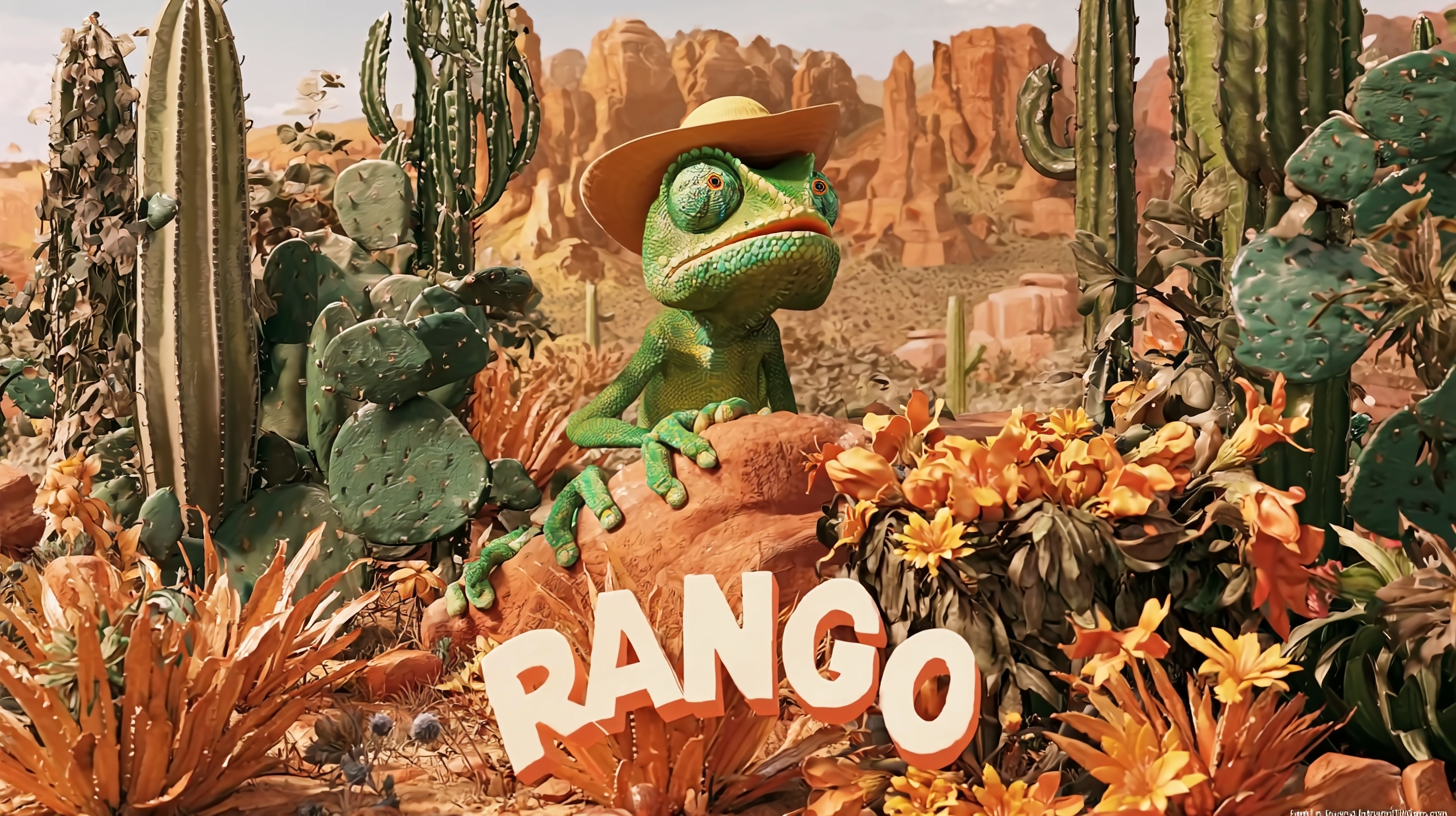
As the film to watch on this day, we recommend the 2011 Rango. It is a Western directed by Gore Verbinski with a single chameleon as protagonist. It won the Academy Award for Best Animated Feature.
It is a work placing a reptile as protagonist, and at the same time a fable dealing with the contemporary theme of the exhaustion of water resources.
Basic Information & Synopsis
→ For synopsis and production information, see our Database Article
Director: Gore Verbinski
Year: 2011
Runtime: 107 minutes
Production: Paramount Pictures / Nickelodeon Movies / Industrial Light & Magic
Commemorative Day: World Lizard Day (August 14)
Background Knowledge
Chinatown as an Underlay
The story structure of this work clearly uses Roman Polanski’s Chinatown (1974) as its underlay.
Chinatown is a work taking as its subject a conspiracy over water rights that actually occurred in Los Angeles in the early 1900s. A structure in which a water source is manipulated for the city’s development, and behind it land is bought up.
The mayor’s plan in Rango traces this almost exactly. What is more, there is even a scene in the film where the mayor quotes a line from Chinatown.
Though it is a story of desert animals, its skeleton is an adult neo-noir. As a children’s animation, it was a rather unusual choice.
The Participation of Roger Deakins
Indispensable in discussing this work’s imagery is the presence of Roger Deakins.
The cinematographer known for The Shawshank Redemption, No Country for Old Men, and Blade Runner 2049 participated in this work as a visual consultant.
What he guided was the reproduction of the high-contrast, dry light seen in Sergio Leone’s Westerns. The near-blown-out brightness of the desert, and the deep shadows inside the saloon. Though it is animation, the shooting techniques of live action were brought in.
The collaboration of Verbinski and Deakins continued afterward, and it has been reported that Deakins is set to be involved in a new animation the director is conceiving.
ILM’s First Animated Feature
The visual effects were handled by Industrial Light & Magic (ILM). This work was the company’s first animated feature.
What they aimed for was a direction different from that of Disney or Pixar. Not rounded, adorable characters, but creatures covered in dust, etched with wrinkles, and somehow grimy.
To pursue the texture of the lighting, the team is said to have studied the grain of 35mm film and lens flares.
“Emotion Capture”
Director Verbinski adopted a method different from ordinary animation production.
In many animations, voice actors record their lines individually in a recording booth. But in this work, the actors wore costumes, stood on a set, and actually performed together. That footage became reference material for the animators.
The director called this, in contrast to motion capture, “emotion capture.”
The distinctive vividness of the conversational back-and-forth is due to this method.
Hans Zimmer’s Music
The music was handled by Hans Zimmer.
His score has, throughout, nods to Ennio Morricone’s For a Few Dollars More and Elmer Bernstein’s The Magnificent Seven. Including the device of mariachi owls singing the story onward like the chorus of a Greek tragedy, an affection for Western music runs through the whole.
Awards
This work won Best Animated Feature at the 84th Academy Awards on February 26, 2012.
This win was the first in five years for a work outside the Disney/Pixar lineage. It also won the Animated Film award at the British Academy Awards.
The Desert Animals
Many of the animals appearing in the film are species that actually inhabit the Mojave Desert and its surroundings.
The desert iguana (Beans), the desert tortoise (the mayor), the rattlesnake (Jake), the red-tailed hawk — these are real residents of the desert.
On the other hand, out of the story’s necessity, animals from other regions also appear. The Gila monster (Bad Bill) is a species of the adjacent Sonoran Desert, and the nine-banded armadillo (Roadkill) is distributed mainly in the southeastern United States.
And the protagonist chameleon originally inhabits mainly the African continent and Madagascar, and does not naturally occur in the American desert.
This setting itself, in fact, holds important meaning.
Why Was the Chameleon in the Desert
Rango had been kept as a pet.
Carried to a place far removed from his original habitat, living inside a tank, and thrown out by an accident — this course of events directly reflects the reality of the exotic pet trade.
Around the world, reptiles are traded as pets. Some of them are captured from the wild, and many die during transport. There are also individuals abandoned through failure at keeping them, and cases have been reported of them disturbing local ecosystems as invasive species.
The film does not deal with this problem as its theme. But that this structure is placed at the protagonist’s starting point is a point that cannot be ignored when watching it in the context of the commemorative day.
All the more so, given that “World Lizard Day” is a day that deals mainly with understanding of reptiles as pets.
What Makes It Exceptional
The Grimy Texture
This work’s imagery differs in direction from general animation.
The characters are not cute. They have wrinkles, disordered fur, clouded eyes, and look thoroughly unhealthy. Rango himself has a thin, unreliable build.
But this “grime” conveys the harshness of the desert environment. This is no paradise, but a place where merely staying alive is all one can manage.
The texture of the rock faces, the way the sand dances, the depiction of dry plants. The lighting design, aided by Deakins’s advice, gives these a weight like that of live action.
The Use of Being a Chameleon
That the protagonist is a chameleon is not a mere setting.
The ability to change body color, the independently moving eyes, the long tongue. These are used at the story’s key points.
Especially important is the point that mimicry is tied to the theme itself. The chameleon is a creature that changes itself to match its surroundings, and Rango, too, has gone on performing himself to match his environment.
As a protagonist who holds the question “who am I,” there is no animal more suited than the chameleon.
An Environmental Theme That Does Not Preach
The exhaustion of water resources, the driving-out of residents by development, the destruction of the ecosystem. What this work deals with is a heavy theme.
But the film does not tell these as a lesson. Strictly within the framework of the Western, it presents them as a villain’s conspiracy.
The audience experiences, together with the protagonist, a world where water is life itself. What comes out when you turn a tap in the city is here a matter of life and death — this gap comes across without explanation.
Johnny Depp’s Voice
Johnny Depp, who handled Rango’s voice, carefully plays the change from the unreliable delivery of his unconfident times to the calm voice after he has made up his mind.
That, through emotion capture, he actually performed alongside the other actors contributes to the naturalness of the back-and-forth.
Related Articles
- Rango Database – Synopsis & Production Details
- Gore Verbinski – Profile
- Johnny Depp – Profile
はじめに
カメレオンの西部劇と、枯れゆく水の寓話
8月14日は「世界トカゲの日」(World Lizard Day)です。
ただし、この記念日には少し注意が必要です。誰がいつ制定したのか、確かな記録が残っていません。2009年にアメリカの爬虫類愛好家たちが始めたという説、1990年代から祝われてきたという説などがありますが、いずれも確証を欠いています。
WWFのような大規模な自然保護団体が採用した日でもありません。実際には、学校、動物園、爬虫類愛好家といった人々が中心となり、SNSなどを通じて広まってきた性格の日です。焦点も、野生保護というよりペットとしての爬虫類への正しい理解に置かれる傾向があります。
とはいえ、この日が扱う主題は軽くありません。
トカゲは約6,000種が知られ、南極を除くすべての大陸に分布しています。大きさは体長数センチのヒメカメレオンから、3メートル近いコモドオオトカゲまで。彼らは害虫を捕食し、他の動物の餌となり、生態系の網目の一部を担っています。
一方で、爬虫類は生息地の破壊、気候変動、そしてペット取引による捕獲という脅威にさらされています。ある研究では、爬虫類種のおよそ21%が絶滅の危機にあると報告されました。加えて、爬虫類は「気持ち悪い」「怖い」という偏見の対象にもなりやすく、保護の優先順位が低く扱われがちです。
この日に観るべき映画として、2011年の『ランゴ』(Rango)を推薦します。ゴア・ヴァービンスキー監督による、一匹のカメレオンを主人公にした西部劇です。アカデミー賞長編アニメーション映画賞を受賞しました。
爬虫類を主人公に据えた作品であり、同時に水資源の枯渇という現代的な主題を扱った寓話でもあります。
基本情報・あらすじ
→ あらすじや製作情報はデータベース記事へ
監督: ゴア・ヴァービンスキー
製作年: 2011年
上映時間: 107分
制作: パラマウント・ピクチャーズ/ニコロデオン・ムービーズ/インダストリアル・ライト&マジック
記念日: 世界トカゲの日(8月14日)
予備知識
『チャイナタウン』という下敷き
本作の物語構造は、**ロマン・ポランスキー監督の『チャイナタウン』(1974)**を明確に下敷きにしています。
『チャイナタウン』は、1900年代初頭のロサンゼルスで実際に起きた水利権をめぐる陰謀を題材にした作品です。都市の発展のために水源が操作され、その裏で土地の買い占めが行われるという構造。
『ランゴ』の市長の計画は、これをほぼそのままなぞっています。しかも劇中、市長は『チャイナタウン』の台詞を引用する場面まであります。
砂漠の動物たちの物語でありながら、その骨格は成人向けのネオ・ノワールなのです。子ども向けアニメーションとしては、かなり異例の選択でした。
ロジャー・ディーキンスの参加
本作の映像を語るうえで欠かせないのが、ロジャー・ディーキンスの存在です。
『ショーシャンクの空に』『ノーカントリー』『ブレードランナー 2049』などで知られる撮影監督である彼は、本作にビジュアル・コンサルタントとして参加しました。
彼が指導したのは、セルジオ・レオーネの西部劇に見られるような、高コントラストの乾いた光の再現です。砂漠の白飛びしそうな明るさと、酒場の内部の深い影。アニメーションでありながら、実写の撮影技法が持ち込まれました。
ヴァービンスキーとディーキンスの協働はその後も続いており、監督が構想する新作アニメーションにもディーキンスが関わる予定だと報じられています。
ILM初の長編アニメーション
視覚効果を手がけたのは、インダストリアル・ライト&マジック(ILM)です。本作は、同社にとって初の長編アニメーション作品でした。
彼らが目指したのは、ディズニーやピクサーとは異なる方向性でした。丸みを帯びた愛らしいキャラクターではなく、埃にまみれ、皺が刻まれ、どこか薄汚れた生き物たち。
照明の質感を追求するため、チームは35mmフィルムの粒子やレンズフレアを研究したと言われます。
「エモーション・キャプチャー」
ヴァービンスキー監督は、通常のアニメーション制作とは異なる手法を採りました。
多くのアニメでは、声優が個別に録音ブースで台詞を録音します。しかし本作では、俳優たちが衣装を着てセットに立ち、実際に一緒に演技をしました。その映像がアニメーターの参考資料となります。
監督はこれを、モーション・キャプチャーに対して「エモーション・キャプチャー」と呼びました。
会話の掛け合いに独特の生々しさがあるのは、この手法によるものです。
ハンス・ジマーの音楽
音楽はハンス・ジマーが担当しました。
そのスコアには、エンニオ・モリコーネの『続・夕陽のガンマン』や、エルマー・バーンスタインの『荒野の七人』への目配せが随所にあります。マリアッチのフクロウたちがギリシャ悲劇のコロスのように物語を歌い継ぐ趣向も含め、西部劇音楽への愛着が全編を貫いています。
受賞
本作は2012年2月26日、第84回アカデミー賞で長編アニメーション映画賞を受賞しました。
この受賞は、ディズニー/ピクサー系列以外の作品としては5年ぶりのことでした。英国アカデミー賞でもアニメ映画賞を獲得しています。
砂漠の動物たち
映画に登場する動物の多くは、実際にモハーヴェ砂漠やその周辺に生息する種です。
砂漠イグアナ(ビーンズ)、砂漠ガメ(市長)、ガラガラヘビ(ジェイク)、赤尾ノスリ――これらは実在の砂漠の住人です。
一方で、物語上の必要から他地域の動物も登場します。ギラモンスター(バッド・ビル)は隣接するソノラ砂漠の種であり、九つ帯アルマジロ(ロードキル)は主にアメリカ南東部に分布します。
そして主人公のカメレオンは、本来アフリカ大陸とマダガスカルを中心に生息しており、アメリカの砂漠には自然分布していません。
この設定自体が、実は重要な意味を持っています。
なぜカメレオンは砂漠にいたのか
ランゴは、ペットとして飼われていました。
本来の生息地から遠く離れた場所へ運ばれ、水槽の中で暮らし、事故によって放り出される――この経緯は、エキゾチックペット取引の現実をそのまま映しています。
世界中で、爬虫類が愛玩用に取引されています。その一部は野生から捕獲されたものであり、輸送中に多くが死にます。飼育に失敗して遺棄される個体もおり、外来種として現地の生態系を乱す例も報告されています。
映画はこの問題を主題として扱ってはいません。しかし、主人公の出発点にこの構造が置かれていることは、記念日の文脈で観るとき無視できない点です。
「世界トカゲの日」が主にペットとしての爬虫類への理解を扱う日であることを踏まえれば、なおさらです。
優れている点
汚れた質感
本作の映像は、一般的なアニメーションとは方向性が異なります。
キャラクターたちは可愛くありません。皺があり、毛が乱れ、目が濁り、いかにも不健康です。ランゴ自身、痩せて頼りない体つきをしています。
しかしこの「汚れ」が、砂漠という環境の過酷さを伝えます。ここは楽園ではなく、生きるのがやっとの場所なのだと。
岩肌の質感、砂の舞い方、乾いた植物の描写。ディーキンスの助言を得た照明設計が、これらに実写のような重みを与えています。
カメレオンであることの活用
主人公がカメレオンであることは、単なる設定ではありません。
体色を変える能力、独立して動く両目、長い舌。これらが物語の要所で使われます。
とりわけ重要なのは、擬態が主題そのものと結びついている点です。カメレオンは周囲に合わせて自分を変える生き物であり、ランゴもまた、環境に合わせて自分を演じ続けてきました。
「自分は何者か」という問いを抱える主人公として、カメレオン以上に適した動物はいません。
説教にならない環境の主題
水資源の枯渇、開発による住民の追い出し、生態系の破壊。本作が扱うのは重い主題です。
しかし映画は、これらを教訓として語りません。あくまで西部劇の枠組みの中で、悪役の陰謀として提示します。
観客は、水が命そのものである世界を主人公とともに体験します。都市で蛇口をひねれば出てくるものが、ここでは死活問題である――この落差が、説明なしに伝わります。
ジョニー・デップの声
ランゴの声を担当したジョニー・デップは、自信のない時の頼りない発声から、覚悟を決めた後の落ち着いた声まで、変化を丁寧に演じ分けています。
エモーション・キャプチャーによって他の俳優と実際に共演したことが、掛け合いの自然さに寄与しています。
関連記事
- ランゴ データベース – あらすじ・製作情報
- ゴア・ヴァービンスキー – プロフィール
- ジョニー・デップ – プロフィール