
Choose Your Language / 言語を選択:
Introduction
A 24-Hour Chamber Drama — the Backstage of the Decision to End the War, Where True Feelings and Public Positions Crossed
August 15 is the day the war ended.
At noon on this day in 1945, the voice of Emperor Shōwa flowed from the radio. Recorded the previous day, it was the so-called Gyokuon-hōsō (the Jewel Voice Broadcast). The acceptance of the Potsdam Declaration was conveyed to the people, and the long war came to an end.
The government-sponsored National Memorial Service for the War Dead began in 1963. Since then, this day has continued as a day to mourn the war dead and to wish for peace.
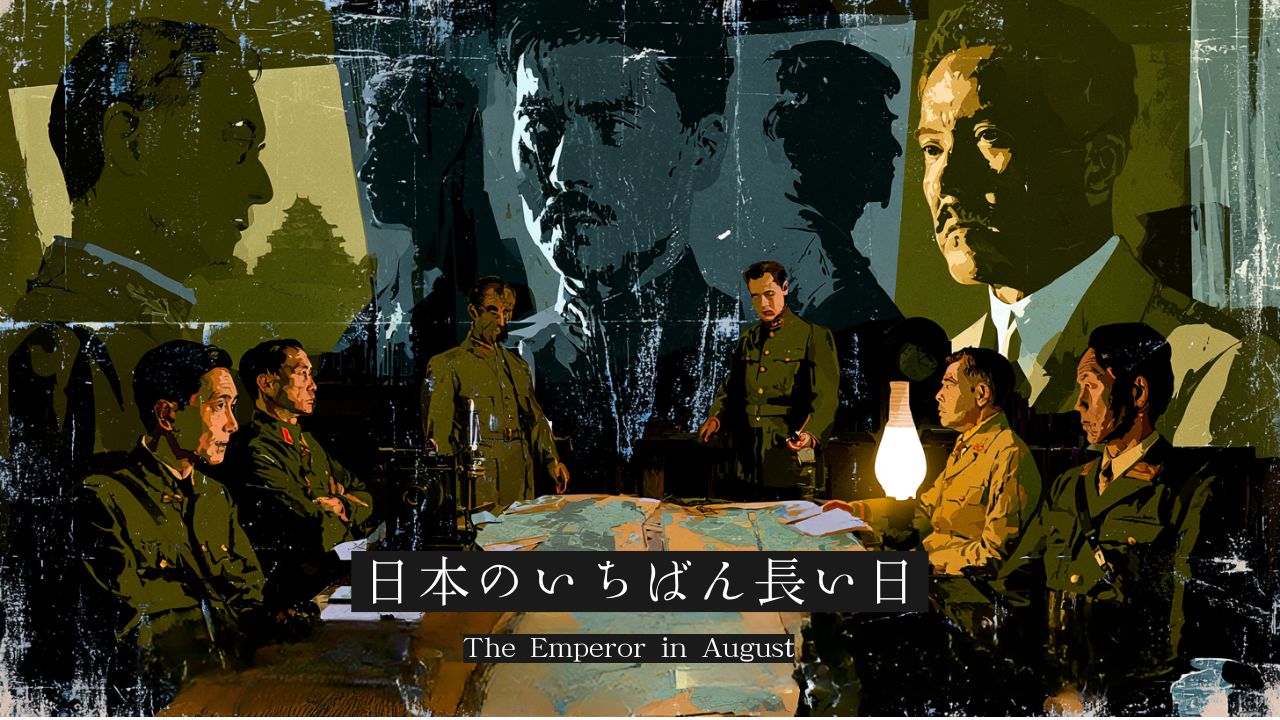
As the film to watch on this day, we recommend The Emperor in August, released in 2015. It is a work in which director Masato Harada adapted Kazutoshi Hando’s nonfiction Japan’s Longest Day: The Definitive Edition.
Kōji Yakusho plays War Minister Korechika Anami, Masahiro Motoki plays Emperor Shōwa, Tsutomu Yamazaki plays Prime Minister Kantarō Suzuki, and Tori Matsuzaka plays Major Kenji Hatanaka.
The same source was also made into a film in 1967 by director Kihachi Okamoto, and that too is known as a masterpiece remaining in the history of Japanese cinema. The two films, while dealing with the same events, took entirely different approaches.
Though it is a war film, this work has almost no battle scenes. What is depicted are conference rooms, offices, and the corridors of the official residence. That the tension nonetheless never breaks is because the lives and deaths of many people hang on the words exchanged there.
Basic Information & Synopsis
→ For synopsis and production information, see our Database Article
Director: Masato Harada
Year: 2015
Runtime: 136 minutes
Production: Shochiku
Commemorative Day: The Anniversary of the End of the War (August 15)
Background Knowledge
The Source Book and How It Came to Be
The source is Kazutoshi Hando’s Japan’s Longest Day.
Working as an editor at Bungeishunjū, Hando accumulated interviews with people involved in the ending of the war. Gathering testimony from many parties who were still living at the time, he reconstructed the backstage that does not remain in official records.
When it was first published in 1965, it was issued under the name of Sōichi Ōya. Later a “definitive edition” was put out under Hando’s own name.
What this book revealed was that the ending of the war was not a story of a simple decision. Countless meetings, the adjustment of draft wording, behind-the-scenes maneuvering, and a coup d’état that ended in failure. It was atop the accumulation of these that that broadcast came about.
Differences from the 1967 Version
The same source was made into a film in 1967 by director Kihachi Okamoto. Toshiro Mifune played Anami, and a tense 24 hours were depicted on a black-and-white screen.
That version is still highly regarded, and in its vividness — the muggy heat, the shouting, the sweat-drenched soldiers — there are not a few voices that give the palm to the 1967 version.
The difference between the two versions lies in the approach.
The 1967 version took a documentary-like method, following events from the outside without deeply entering the inner life of any particular person. It is an ensemble drama in which many people move about carrying their own designs. The Emperor, since he was alive and reigning at the time, was kept to the degree of being suggested by his back or his voice.
The 2015 version digs into each person’s position and steps into the structure of why the Kyūjō Incident occurred. And it depicted the Emperor clearly as a single person.
It is not a matter of which is superior, but a difference in the way of depicting made possible by the change of the times.
The Interpretation Around Korechika Anami
The greatest feature of the 2015 version is its way of depicting Korechika Anami.
Anami is known as a person who continued to insist on thorough resistance to the end. But this work interpreted that insistence as a “performance” to restrain the runaway of the army.
By making hardline statements representing the hardline army, he kept the army within the frame of the government. Had Anami agreed to acceptance from the start, he might have lost control of the army, and more radical forces might have run out of control.
A person who, while using true feelings and public position separately, tried to avoid catastrophe — that is this image of Anami.
Whether this interpretation is correct as historical fact is debated even among researchers. But as a film, this rereading gave the story depth. The Anami played by Kōji Yakusho rises up as a person who, while making hardline statements, is thinking something else behind them.
And it is a structure in which that duality leads to the final seppuku.
To Play Emperor Shōwa
Masahiro Motoki’s Emperor Shōwa became a great topic of discussion at the time of release.
There had, until then, been almost no Japanese film that depicted Emperor Shōwa head-on as a person. In the 1967 version his figure was almost not shown, and in later works too the treatment was cautious.
Regarding Motoki’s performance, there were also voices from the generation that knew the actual Emperor Shōwa saying “the impression is different.” Assessments over the degree of reproduction of his bearing and manner of speech are divided.
On the other hand, the modeling of him as a single human being who hesitates, wavers, and yet hands down a decision reached many viewers.
Incidentally, in 2014 the Imperial Household Agency published The Annals of Emperor Shōwa, and director Harada has stated that he referred to this as well.
The Appearance of Women
The prominent female role in the 1967 version was only Michiyo Aratama, who played a maid in Prime Minister Suzuki’s residence.
In the 2015 version, many women appear — Anami’s wife and children, the Suzuki couple, the chief lady-in-waiting, an NHK broadcasting-station staff member (Erika Toda), and others.
This is not a mere change in cast composition. That there was life outside the conference room, that there were families, that there was a site preparing the broadcast — these appear on screen.
Playing Empress Kōjun was Yuki Ikenobō, head of the Ikenobō school of flower arrangement. She is a person related to the Empress. Though her appearance is brief, the production team’s stance can be glimpsed in such casting.
What Makes It Exceptional
The Technique of Making a Film Out of Meetings
Most of this work is scenes of people sitting and talking.
That it is nonetheless not boring is owing to the power of the direction.
The camera moves as if weaving between the people, capturing who is looking at whom, who is staying silent. The lines are fast, overlapping, requiring concentration to catch.
And the sound of the electric fan, the voices of cicadas, the sweat. The heat of Tokyo in August 1945 comes across from the screen.
Kōji Yakusho’s Modeling
Kōji Yakusho’s Anami is the center of this work.
He makes hardline statements. But it gradually becomes clear to the audience that he seems to be thinking something else. Yakusho played through that duality without becoming expository.
Especially the scene in which he avoids clear statement when urged by the young officers to rise up. What he is doing by saying nothing is shown by his expression alone.
Tsutomu Yamazaki’s Kantarō Suzuki
Prime Minister Suzuki, played by Tsutomu Yamazaki, is nonchalant.
He is hard of hearing, appears to be dozing, and irritates the young bureaucrats. But at the key points, he moves with astonishing precision.
The role a 77-year-old man played in the final phase. Yamazaki modeled that elusiveness charmingly.
Tori Matsuzaka’s Kenji Hatanaka
As for Major Hatanaka, the impassioned image of the young man played by Toshio Kurosawa in the 1967 version is famous.
Tori Matsuzaka in the 2015 version is quieter. While harboring madness in his eyes, he does not raise his voice. The scene of shooting Division Commander Mori is also carried out in silence.
Whether this way of depicting is closer to historical fact is unknown. But in the point of the eeriness of a human possessed by conviction, this one may perhaps reach the contemporary audience better.
Related Articles
- The Emperor in August Database – Synopsis & Production Details
- Masato Harada – Profile
- Kōji Yakusho – Profile
はじめに
24時間の密室劇——本音と建前が交錯した、終戦決断の舞台裏
8月15日は、終戦の日です。
1945年のこの日正午、ラジオから昭和天皇の声が流れました。前日に録音された、いわゆる玉音放送です。ポツダム宣言の受諾が国民に伝えられ、長く続いた戦争が終わりを告げました。
政府主催の全国戦没者追悼式が始まったのは1963年から。以来、この日は戦没者を悼み、平和を願う日として続いています。
この日に観るべき作品として、2015年公開の『日本のいちばん長い日』を推薦します。原田眞人監督が、半藤一利のノンフィクション『日本のいちばん長い日 決定版』を映画化した作品です。
役所広司が阿南惟幾陸軍大臣を、本木雅弘が昭和天皇を、山﨑努が鈴木貫太郎首相を、松坂桃李が畑中健二少佐を演じています。
同じ原作は1967年にも岡本喜八監督によって映画化されており、こちらも日本映画史に残る名作として知られています。二つの映画は、同じ出来事を扱いながら、まったく異なるアプローチを取りました。
戦争映画でありながら、本作に戦闘場面はほとんどありません。描かれるのは、会議室と執務室と官邸の廊下です。それでも緊張が途切れないのは、そこで交わされる言葉に、多くの人の生死がかかっているからです。
基本情報・あらすじ
→ あらすじや製作情報はデータベース記事へ
監督: 原田眞人
製作年: 2015年
上映時間: 136分
制作: 松竹
記念日: 終戦の日(8月15日)
予備知識
原作と、その成り立ち
原作は、半藤一利による『日本のいちばん長い日』です。
半藤は文藝春秋の編集者として働きながら、終戦をめぐる関係者への聞き取りを重ねました。当時まだ存命だった多くの当事者から証言を集め、公式記録には残らない舞台裏を再構成しています。
1965年に発表された当初は、大宅壮一の名義で刊行されました。後に半藤自身の名で「決定版」が出されています。
この本が明らかにしたのは、終戦が単純な決断の物語ではなかったということでした。無数の会議、文案の調整、水面下の駆け引き、そして未遂に終わったクーデター。それらの積み重ねの上に、あの放送があったのです。
1967年版との違い
同じ原作は、1967年に岡本喜八監督によって映画化されています。三船敏郎が阿南を演じ、白黒の画面で緊迫した24時間が描かれました。
こちらは今も高く評価されており、蒸し暑さ、怒号、汗だくの軍人たちといった生々しさにおいて、1967年版に軍配を上げる声も少なくありません。
二つの版の違いは、アプローチにあります。
1967年版は、特定の人物の内面に深く立ち入らず、出来事を外側から追うドキュメンタリー的な手法を取りました。多くの人物が思惑を抱えて動き回る群像劇です。天皇は、当時存命・在位中であったため、後ろ姿や声で示唆される程度に留められました。
2015年版は、それぞれの立場を掘り下げ、なぜ宮城事件が起きたのかという構造に踏み込みます。そして、天皇を明確に一人の人物として描きました。
どちらが優れているという話ではなく、時代が変わったことで可能になった描き方の違いです。
阿南惟幾をめぐる解釈
2015年版の最も大きな特徴は、阿南惟幾の描き方です。
阿南は最後まで徹底抗戦を主張し続けた人物として知られています。しかし本作は、その主張を陸軍の暴走を抑えるための「芝居」だったと解釈しました。
強硬な陸軍を代表して強硬な発言をすることで、陸軍を政府の枠内に留めておく。もし阿南が最初から受諾に賛成すれば、彼は陸軍の統制を失い、より過激な勢力が独走したかもしれない。
本音と建前を使い分けながら、破局を回避しようとした人物――そういう阿南像です。
この解釈が史実として正しいかどうかは、研究者の間でも議論があります。しかし映画としては、この読み替えが物語に厚みを与えました。役所広司が演じる阿南は、強硬な発言をしながら、その裏で別のことを考えている人物として立ち上がります。
そして、その二重性が最後の切腹につながる構成になっています。
昭和天皇を演じるということ
本木雅弘による昭和天皇は、公開当時大きな話題となりました。
昭和天皇を人物として正面から描いた日本映画は、それまでほとんどありませんでした。1967年版では姿がほぼ映されず、後年の作品でも扱いは慎重でした。
本木の演技については、実際の昭和天皇を知る世代から「印象が違う」という声もありました。所作や口調の再現度をめぐる評価は分かれています。
一方で、迷い、逡巡し、それでも決断を下す一人の人間としての造形は、多くの観客に届きました。
なお2014年に宮内庁が『昭和天皇実録』を公表しており、原田監督はこれも参照したと述べています。
女性たちの登場
1967年版で目立つ女性の役は、鈴木首相邸の女中を演じた新珠三千代のみでした。
2015年版では、阿南の妻子、鈴木夫妻、女官長、NHKの放送局員(戸田恵梨香)など、多くの女性が登場します。
これは単なるキャスト構成の変化ではありません。会議室の外に生活があり、家族があり、放送を準備する現場があったということが、画面に現れます。
香淳皇后を演じたのは、華道家元池坊の池坊由紀。皇后の縁戚にあたる人物です。出番は短いものの、こうした配役に制作陣の姿勢が窺えます。
優れている点
会議を映画にする技術
本作の大半は、人が座って話している場面です。
にもかかわらず退屈しないのは、演出の力によるものです。
カメラは人物の間を縫うように動き、誰が誰を見ているか、誰が黙っているかを捉えます。台詞は早く、重なり合い、聞き取るのに集中が要ります。
そして、扇風機の音、蝉の声、汗。1945年8月の東京の暑さが、画面から伝わってきます。
役所広司の造形
役所広司の阿南は、本作の中心です。
彼は強硬な発言をします。しかし観客には、彼が別のことを考えているらしいと徐々に分かってきます。その二重性を、役所は説明的にならずに演じ切りました。
とりわけ、青年将校たちに決起を促されて明言を避ける場面。何も言わないことで彼が何をしているのかが、表情だけで示されます。
山﨑努の鈴木貫太郎
山﨑努が演じる鈴木首相は、飄々としています。
耳が遠く、居眠りしているように見え、若い官僚たちを苛立たせます。しかし要所では、驚くほど的確に動きます。
77歳の老人が、最後の局面で果たした役割。その掴みどころのなさを、山﨑は魅力的に造形しました。
松坂桃李の畑中健二
畑中少佐については、1967年版で黒沢年男が演じた激情型の青年像が有名です。
2015年版の松坂桃李は、より静かです。目に狂気を宿しながら、声を荒らげません。森師団長を撃つ場面も、無言で行われます。
この描き方が史実に近いかどうかは分かりません。ただ、確信に取り憑かれた人間の不気味さという点では、こちらの方が現代の観客には届くかもしれません。
関連記事
- 日本のいちばん長い日 データベース – あらすじ・製作情報
- 原田眞人 – プロフィール
- 役所広司 – プロフィール