
Choose Your Language / 言語を選択:
Introduction
Whose Story Was It Told As? — A Work to Be Faced Together with Its Criticisms
On August 4, 1964, the bodies of three young men were dug out of an earthen dam in Neshoba County, Mississippi. James Chaney (21, a Black man from Mississippi), Andrew Goodman (20, a white student from New York), and Michael Schwerner (24, a white social worker from New York). On June 21, the three had been driving to investigate the damage to the burned-down Mount Zion Church — the site of a “Freedom School” run by the Congress of Racial Equality (CORE). Arrested by deputy sheriff Cecil Price on the pretext of a traffic violation and released at 10 p.m., they were, immediately afterward, abducted by a lying-in-wait band of the Ku Klux Klan and shot at close range. Chaney had also been severely beaten. The bodies remained buried in the dam for 44 days.
This incident occurred in the midst of “Freedom Summer,” the large-scale movement to advance the registration of Black voters in the South. The FBI gave the investigation the code name “MIBURN (Mississippi Burning)” and committed more than 200 agents. In the course of searching for the three, the bodies of other murdered Black people were also discovered one after another. Herbert Oarsby, a 14-year-old wearing a CORE T-shirt; Henry Dee, 19, and Charles Eddie Moore; and five unidentified people. Their deaths were scarcely reported.
As the film to watch on this day, we take up Alan Parker’s 1988 work Mississippi Burning.
This article, however, does not simply recommend the work. From the time of its release down to the present, this is a film that has been fiercely criticized over its depiction of the civil rights movement. Outstanding cinematic achievement and historical distortion that cannot be overlooked reside side by side within it. The meaning of watching this work on a day of remembrance lies in considering “whose story this incident was told as.”
Basic Information & Synopsis
→ For synopsis and production information, see our Database Article
Director: Alan Parker
Year: 1988
Runtime: 128 minutes
Production: Orion Pictures
Commemorative Day: The day the three Freedom Summer victims’ bodies were found (August 4)
Background Knowledge
What Actually Happened
The film borrows the skeleton of the incident, but many of the details are invention. In the summer of 1964, civil rights organizations were carrying out “Freedom Summer.” It was a movement to advance the registration of Black voters in the South and to provide education at Freedom Schools, and several hundred student volunteers from across the nation took part. Klan members in Mississippi numbered over 10,000; that April, crosses were burned simultaneously at 61 places within the state, and over the course of the summer 20 Black churches were set afire.
On June 16, the Mount Zion Church was burned. On June 21, Chaney, Goodman, and Schwerner set out to investigate and, after being arrested and released, were abducted and murdered. At first, officials including President Lyndon Johnson spoke of the possibility that the disappearance was “a publicity-seeking hoax.” Under pressure from Attorney General Robert Kennedy, the FBI launched a full-scale investigation and found the bodies on August 4. The decisive information was obtained by giving Klan member Delmar Dennis $30,000 and immunity from prosecution.
The state of Mississippi arrested no one. The federal government indicted 19 people for violating civil rights law, and in 1967 seven were found guilty, but no one served more than six years. They were not tried for murder. Edgar Ray Killen, the Klan leader and Baptist minister said to be the ringleader, was set free at the time on a hung verdict, and was not found guilty under state law until June 21, 2005 — 41 years after the incident, on the anniversary of the victims’ deaths. The charge was not murder but manslaughter. In 2014, the three were posthumously awarded the Presidential Medal of Freedom.
A Project Conceived as a “Detective Story”
Not to be overlooked in understanding this work is the question of what motive it was born from.
The starting point was not the director but the screenwriter, Chris Gerolmo. In the mid-1980s he came across an article based on a chapter of a book documenting FBI investigations of the Hoover era, and began writing a screenplay on the subject. What Gerolmo conceived was not a record of the civil rights movement itself, but “a grand, passionate, violent detective story set against the backdrop of the greatest transformation in twentieth-century America.” From the very start, the project was conceived within a framework that told the incident as a “mystery to be solved.” The core of the criticism this film would later receive — that the struggle of Black people themselves is replaced by a detective drama of white agents — was, one can say, already latent in this starting point.
Symbolic of the screenwriting is the shaping of a certain character. In historical fact, the identity of the informant who provided the lead to the discovery of the bodies was never made public. Gerolmo thought that it was precisely in this blank of “no one knowing the identity” that room for drama lay. If the facts are missing, one can freely raise up a character as story — from that judgment was born one of the film’s most shadowed characters. The choice to fill a blank in the historical record with invention greatly influences the emotional quality of this work.
Receiving the screenplay, director Alan Parker piled on his own research. A colleague gathered books, newspaper articles, and news footage about the murders, and Parker himself visited the road where the three were killed. But he and Gerolmo clashed again and again over the story’s focus. To bridge this gap, the distributor Orion allowed Parker a month of rewriting on the condition that he take no credit. Parker boldly reworked characters from the original draft and created a new character to carry the film’s final stretch. The finished shape of the film was settled at the end of this tug-of-war.
The Work’s Reception
The work’s reception was high: at the 61st Academy Awards it was nominated in seven categories including Best Picture, Best Director, Best Actor (Hackman), and Best Supporting Actress (McDormand), and won Best Cinematography (Peter Biziou). Though it missed a top prize such as Best Picture at the Academy Awards and the Golden Globes, at the National Society of Film Critics Awards it swept the four major categories of Best Film, Best Director, Best Actor, and Best Supporting Actress, and at the British Academy Awards (BAFTA) it won three categories: cinematography, editing, and sound. At the Berlin International Film Festival, Hackman won the Silver Bear (Best Actor). While its handling of history was fiercely denounced, its craft and performances as a film were widely recognized at major awards — this very split in reception tells of the work’s singular position. For the record, against a production cost of $15 million, its North American box-office gross was $34.6 million.
What Makes It Exceptional
Gene Hackman’s Complex Characterization
The work of Gene Hackman, playing Rupert Anderson, is the greatest highlight of this film.
What he plays is no simple champion of justice. A man who grew up in the South and lived breathing the air of racial discrimination, yet who still draws a line. Hackman expresses that delicate positioning without being heavy-handed. Especially fine is the scene in which he speaks of his father. He tells, as a familiar memory, of the mechanism by which poor whites come to hate Black people. By telling the process by which hatred is born not as accusation but as reminiscence, its deep-rootedness comes through.
Frances McDormand’s Restrained Performance
Frances McDormand, playing Mrs. Pell, received her first Academy Award nomination for this work.
What she plays is a woman surrounded by her violent husband and the community logic he embodies. She has no place to flee. Fear and resignation, and a faint remnant of dignity. Her restrained performance rescues this character from the stereotype.
Peter Biziou’s Cinematography
The work of Peter Biziou, who won the Academy Award for Best Cinematography, powerfully evokes the atmosphere of the era.
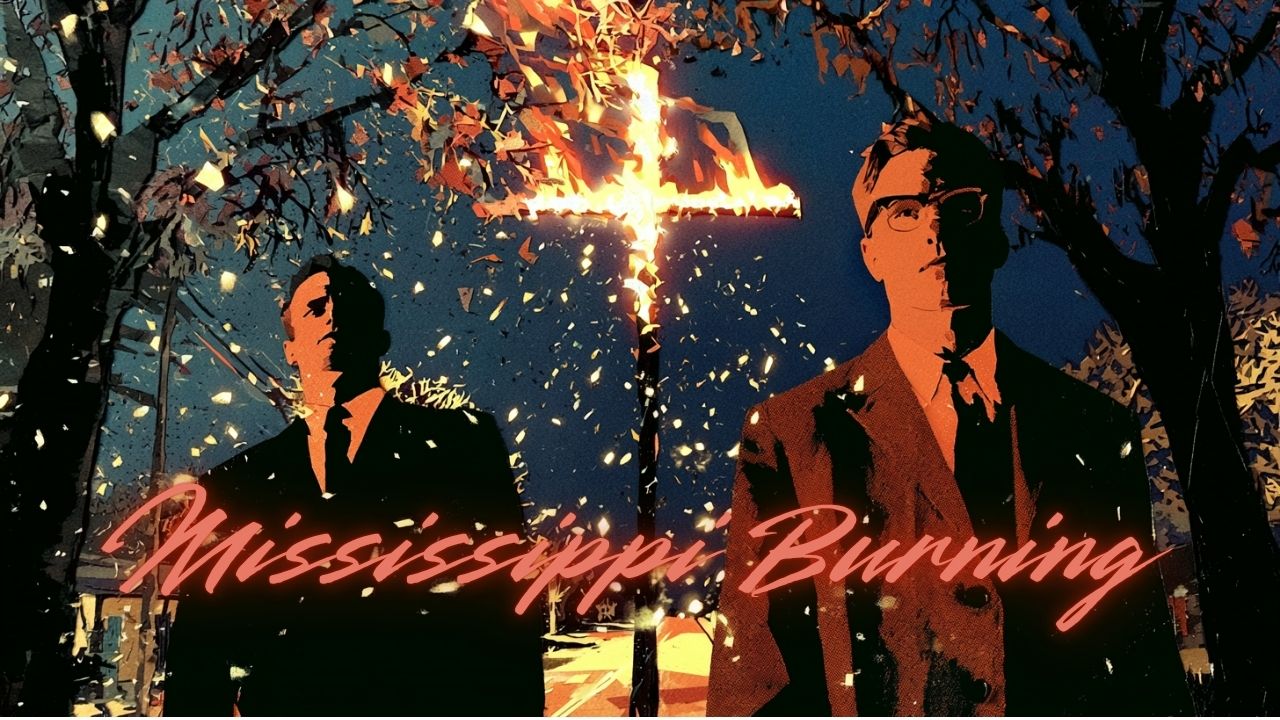
The humid air, the cotton fields, the dusty roads. And the cross blazing up in the darkness of night. Precisely because it is beautifully shot, the ugliness of what is being done there stands out. The opening murder scene — the nighttime road, the pursuit, and then the gunshots — leaves an impression that is concise yet unforgettable.
Related Articles
- Mississippi Burning Database – Synopsis & Production Details
- Alan Parker – Profile
- Gene Hackman – Profile
はじめに
誰の物語として語られたのか——批判とともに向き合うべき一作
1964年8月4日、ミシシッピ州ネショバ郡の土手ダムから、三人の若者の遺体が掘り出されました。ジェームズ・チェイニー(21歳、ミシシッピ出身の黒人)、アンドリュー・グッドマン(20歳、ニューヨーク出身の白人学生)、マイケル・シュワーナー(24歳、ニューヨーク出身の白人ソーシャルワーカー)。三人は6月21日、焼き討ちされたマウント・ザイオン教会——人種平等会議(CORE)の「フリーダム・スクール」の会場だった場所——の被害を調査するため車を走らせていました。交通違反を口実に保安官助手セシル・プライスに逮捕され、夜10時に釈放された直後、待ち構えていたクー・クラックス・クランの一団に拉致され、至近距離から射殺されます。チェイニーは激しい暴行も受けていました。遺体は44日間、ダムに埋められたままでした。
この事件は、南部の黒人有権者登録を進める大規模な運動「フリーダム・サマー」のさなかに起きました。FBIは捜査コードネームを「MIBURN(Mississippi Burning)」とし、200名以上の捜査官を投入します。三人を捜索する過程では、殺害された他の黒人たちの遺体も次々に発見されました。COREのTシャツを着た14歳のハーバート・オーズビー、19歳のヘンリー・ディーとエディ・モア、そして身元不明の五人。彼らの死は、ほとんど報じられませんでした。
この日に観る作品として、アラン・パーカー監督による1988年の『ミシシッピー・バーニング』(原題:Mississippi Burning)を取り上げます。
ただし本記事は、この作品を単純に推薦するものではありません。本作は公開当時から現在に至るまで、公民権運動の描き方をめぐって激しく批判されてきた映画です。優れた映画的達成と、看過できない歴史的歪曲が同居しています。追悼の日にこの作品を観ることの意味は、「誰の物語として、この事件は語られたのか」を考えることにあります。
基本情報・あらすじ
→ あらすじや製作情報はデータベース記事へ
監督: アラン・パーカー
製作年: 1988年
上映時間: 128分
制作: オリオン・ピクチャーズ
記念日: フリーダム・サマーの三人の遺体発見の日(8月4日)
予備知識
実際に起きたこと
映画は事件の骨格を借りていますが、細部の多くは創作です。1964年夏、公民権運動の団体は「フリーダム・サマー」を展開していました。南部の黒人有権者登録を進め、フリーダム・スクールで教育を行う運動で、全米から数百人の学生ボランティアが参加しました。ミシシッピのクラン構成員は1万人を超え、その年の4月には州内61か所で同時に十字架が燃やされ、夏の間に20の黒人教会が焼き討ちされています。
6月16日、マウント・ザイオン教会が焼かれます。6月21日、チェイニー、グッドマン、シュワーナーが調査に向かい、逮捕・釈放後に拉致・殺害されました。当初、リンドン・ジョンソン大統領を含む当局者は、失踪が「宣伝目的の狂言」である可能性を口にしていました。ロバート・ケネディ司法長官の圧力を受けてFBIが本格捜査に着手し、8月4日に遺体を発見します。決定的な情報は、クラン構成員デルマー・デニスに3万ドルと訴追免除を与えて得たものでした。
ミシシッピ州は誰も逮捕しませんでした。連邦政府が公民権法違反として19人を起訴し、1967年に7人が有罪となりましたが、誰も6年を超える服役はしていません。殺人罪では裁かれなかったのです。首謀者とされたクラン指導者でバプテスト派牧師のエドガー・レイ・キレンは、この時は評決不一致で放免され、州法で有罪となったのは2005年6月21日——事件から41年後、犠牲者の命日でした。罪状は殺人ではなく故殺でした。2014年、三人には大統領自由勲章が追贈されています。
「探偵物語」として構想された企画
本作を理解するうえで見逃せないのが、この映画がどのような動機から生まれたかという点です。
出発点は、監督ではなく脚本家のクリス・ジェロルモでした。彼は1980年代半ば、フーバー長官時代のFBI捜査を記録した書物の一章に基づく記事に出会い、これを題材に脚本を書き始めます。ジェロルモが構想したのは、公民権運動そのものの記録ではなく、「20世紀アメリカ最大の変革を背景にした、壮大で情熱的で暴力的な探偵物語」でした。企画は最初から、事件を”謎解き”として語る枠組みで発想されていたのです。後にこの映画が浴びる批判の核心——黒人自身の闘いが、白人捜査官の探偵劇に置き換えられている——は、すでにこの出発点に胚胎していたと言えます。
脚本づくりで象徴的なのが、ある登場人物の造形です。史実では、遺体発見の糸口をもたらした情報提供者の正体が、最後まで公にされませんでした。ジェロルモは、この「誰も正体を知らない」という空白にこそドラマの余地があると考えます。事実が欠けているなら、物語として自由に人物を立ち上げられる——その判断から、映画屈指の陰影を帯びた登場人物が生まれることになりました。史実の空白を創作で埋めるという選択が、本作の情感を大きく左右しているのです。
脚本を受け取った監督のアラン・パーカーは、独自の調査を重ねました。同僚が殺人事件に関する書籍や新聞記事、ニュース映像を集め、パーカー自身も三人が殺害された道路を訪ねています。しかし彼とジェロルモは、物語の焦点をめぐって何度も対立しました。この溝を埋めるため、配給元オリオンはパーカーに、クレジットを付けない条件で一か月の書き直しを認めます。パーカーは原案にあった人物を大胆に作り替え、終盤の展開を担う新たな登場人物を生み出しました。完成した映画のかたちは、こうした綱引きの果てに定まったものです。
作品としての評価
作品としての評価は高く、第61回アカデミー賞では作品賞・監督賞・主演男優賞(ハックマン)・助演女優賞(マクドーマンド)を含む7部門にノミネートされ、撮影賞(ピーター・ビジウー)を受賞しました。アカデミー賞やゴールデングローブでは作品賞級の受賞こそ逃したものの、全米映画批評家協会賞では作品賞・監督賞・主演男優賞・助演女優賞の主要四部門を独占し、英国アカデミー賞(BAFTA)でも撮影・編集・録音の三部門を受賞しています。ベルリン国際映画祭では、ハックマンが銀熊賞(男優賞)を獲得しました。歴史の描き方が激しく糾弾される一方で、映画としての技術と演技は主要な賞で広く認められた——この評価の分裂そのものが、本作の特異な位置を物語っています。なお、製作費1,500万ドルに対し、北米興行収入は3,460万ドルでした。
優れている点
ジーン・ハックマンの複雑な造形
ルパート・アンダーソンを演じるジーン・ハックマンの仕事は、本作の最大の見どころです。
彼が演じるのは、単純な正義漢ではありません。南部で育ち、人種差別の空気を吸って生きてきた男が、それでも一線を引いている。その微妙な立ち位置を、ハックマンは押しつけがましさなしに表現しています。とりわけ優れているのは、彼が父親について語る場面です。貧しい白人が黒人を憎むようになる仕組みを、身近な記憶として語る。憎悪が生まれる過程を、告発ではなく回想として語ることで、その根深さが伝わります。
フランシス・マクドーマンドの抑制された演技
ペル夫人を演じるフランシス・マクドーマンドは、本作で初のアカデミー賞ノミネートを受けました。
彼女が演じるのは、暴力的な夫と、彼が体現する共同体の論理に囲まれた女性です。彼女には逃げ場がありません。恐怖と諦めと、わずかな尊厳の残滓。彼女の抑えた演技が、この人物を紋切り型から救っています。
ピーター・ビジウーの撮影
アカデミー撮影賞を受賞したピーター・ビジウーの仕事は、時代の空気を強烈に喚起します。
湿った空気、綿花畑、埃っぽい道。そして夜の闇に燃え上がる十字架。美しく撮られているからこそ、そこで行われていることの醜さが際立ちます。冒頭の殺害場面——夜の道路、追跡、そして銃声——は、簡潔でありながら忘れがたい印象を残します。
関連記事
- ミシシッピー・バーニング データベース – あらすじ・製作情報
- アラン・パーカー – プロフィール
- ジーン・ハックマン – プロフィール