
Choose Your Language / 言語を選択:
Introduction
One Man Before He Became a Hero — the Loss That Silence Speaks, and the Reason He Went to the Moon
On August 5, 1930, a baby boy was born on his grandparents’ farm near Wapakoneta, Ohio. Neil Alden Armstrong. For his parents, Stephen and Viola, he was the eldest of three children.
Wapakoneta is a small town located roughly halfway between Toledo and Dayton. Its population at the time was about 5,000. It was a town of no particular distinction, of the kind found anywhere in the American Midwest.
The boy first rode in an airplane at age six and became possessed by the sky. Working after school at a pharmacy, he obtained his pilot’s license on his sixteenth birthday. This was before his driver’s license. In the Boy Scouts he reached the highest rank of Eagle Scout, and in high school he played the baritone horn.
He studied aeronautical engineering at Purdue University, and in the Korean War experienced 78 combat sorties as a naval aviator. After returning to complete his degree, he became a test pilot for NACA (the predecessor of NASA). In 1962, he was selected in the second group of astronauts.
And on July 20, 1969, he became the first human being to set foot on the surface of the Moon.
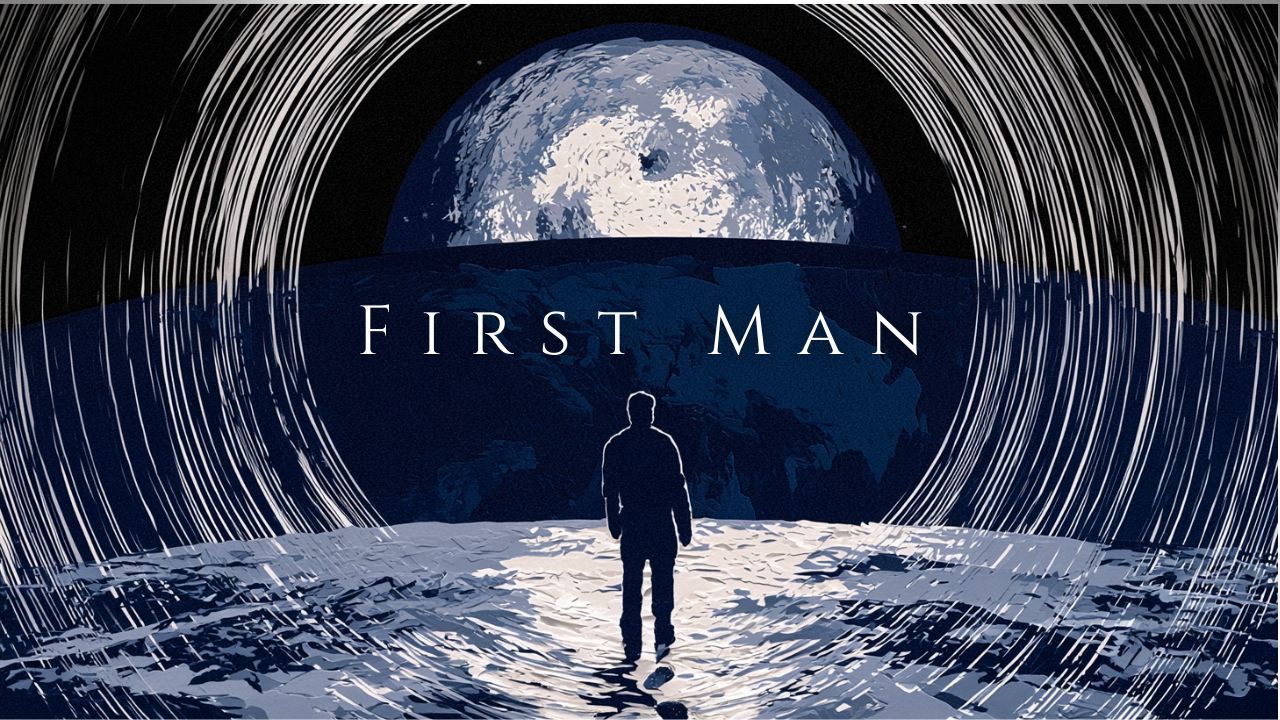
As the film to watch on this day, we recommend Damien Chazelle’s 2018 work First Man.
What this work depicts is not Armstrong as a hero. It is one man who lost a daughter, lost colleagues one after another, and yet continued his mission with few words. To watch this work on the day of his birth becomes an occasion to look anew at the individual behind the title of “the first man to walk on the Moon.”
Basic Information & Synopsis
→ For synopsis and production information, see our Database Article
Director: Damien Chazelle
Year: 2018
Runtime: 141 minutes
Production: Universal Pictures / DreamWorks Pictures
Commemorative Day: Neil Armstrong’s Birthday (August 5)
Background Knowledge
The Source Book First Man
This work is based on the official biography by the historian James R. Hansen, First Man: The Life of Neil A. Armstrong (2005).
Hansen wrote this biography with the cooperation of Armstrong himself, known for his reticence. Based on extensive interviews with family, colleagues, and NASA figures, it is regarded as the definitive volume.
The film’s screenplay was handled by Josh Singer, who won the Academy Award for Best Original Screenplay for Spotlight.
The Interpretation of Daughter Karen’s Death
At the center of the film is the presence of the eldest daughter, Karen, who died in 1962 at the age of two.
This is historical fact. Karen Anne Armstrong was diagnosed with a malignant tumor of the brainstem and received radiation treatment, but died of pneumonia on January 28, 1962. It was immediately after this that Armstrong applied to become an astronaut.
However, connecting Karen’s death and the journey to the Moon as cause and effect is the interpretation of the film (and the source book).
The real Armstrong scarcely spoke of his daughter throughout his life. In the biography, Hansen, drawing on the examples of presidents who lost children, suggests the possibility that this loss drove him toward a realm far from the home.
The film’s climax — the scene of dropping a bracelet into a crater — does not exist in the record. That said, the conjecture that Armstrong may have carried something to the Moon has been spoken of before.
How to receive this interpretation is left to the viewer. There are also voices that criticize as sentimental the placing of loss at the creative core.
The Controversy Over the Stars and Stripes
Before its release, this work became embroiled in political controversy in the United States.
It was reported that the scene of planting the Stars and Stripes on the lunar surface was not depicted, and criticism that this was “anti-American” erupted. Voices of condemnation rose even from politicians of the time.
In response, director Chazelle issued a statement. In the film the Stars and Stripes is shown standing on the lunar surface, and not showing the moment of planting the flag was merely one of the several EVA (extravehicular activity) scenes on which he did not place focus. And he stated clearly that “the answer to whether this is a political statement is no.”
Ryan Gosling, who played Armstrong, said at the Venice Film Festival: “I’m Canadian, so there may be some cognitive dissonance, but I think this achievement was widely received not as an American feat but as a feat of humanity. Neil himself did not consider himself an American hero. Quite the opposite. He was an extremely humble person. We made the film respecting how he saw himself.”
Armstrong’s sons Rick and Mark also defended the film together with the author Hansen. In a statement, they said the film was “not anti-American in the slightest,” and that “of course it celebrates an American achievement. At the same time, it also celebrates an achievement ‘for all mankind,’ as the plaque Neil and Buzz left on the Moon puts it.”
Armstrong as a Real Person
As the film depicts, Armstrong was a reticent person.
He was known to dislike the media, and even after the Moon landing gave almost no lectures or interviews. For this reason he was sometimes called a “recluse,” but this is not accurate. He served as a professor of aeronautical engineering at the University of Cincinnati, held successive corporate directorships, and took on public office. He simply refused to sell himself as a hero.
He repeatedly stated that “going to the Moon was not my achievement alone,” emphasizing that he was one part of a program involving 400,000 people.
In his private life, he divorced Janet, whom he married in 1956, in 1994. It was a 38-year marriage. That same year he remarried Carol Knight, and on August 25, 2012, he died at the age of 82 from complications following heart surgery.
The Contrast with The Right Stuff
This work is often contrasted with Philip Kaufman’s The Right Stuff (1983).
Where The Right Stuff depicted the astronauts of the Mercury program boldly and festively, First Man is thoroughly inward. There are no cheers, no proud parades.
What Chazelle focused on was the sacrifice behind the achievement. He said, “This program cost money and tore families apart. Behind the success story everyone knows, there was tremendous sacrifice and loss.” Screenwriter Singer, too, stated that “by focusing on that loss and sacrifice and failure, we humanized a figure who is idolized, so that one could understand that this was not an easy thing, that it wasn’t done by a superhero.”
What Makes It Exceptional
Imagery Committed to the Subjective
The most singular achievement of this work is that it depicted spaceflight not as “a grand spectacle seen from outside” but as “terror experienced from within.”
In the launch scenes, the camera stays almost entirely inside the cockpit. What the audience sees is only the shaking instrument panel, the groaning of rivets, the flames streaming past outside the window. The full view of the rocket is not shown.
The sound is the same. A roar and the shriek of metal dominate, and no solemn music plays.
By this method, the audience does not “see” spaceflight but “experiences” it. How fragile, how dangerous these machines were comes across physically.
The Lunar Surface as Contrast
After the inward, claustrophobic imagery continues, the imagery transforms completely in the lunar surface scene.
That vista, shot with an IMAX camera, spreads out together with a sudden silence. Gray wilderness continuing to the horizon. A jet-black sky. A world without sound.
This contrast is superb. At the end of a journey that had been narrow, loud, and dangerous, there was a place this quiet — that gap conveys the meaning of arrival without words.
Ryan Gosling’s Restraint
Ryan Gosling takes on the difficult task of playing a person who does not show emotion on the surface.
His Armstrong hardly smiles. He shows no anger. To his daughter’s death, to his colleagues’ deaths, he does not respond in words.
Yet what lies beneath comes across to the audience. It is the minute changes of expression, the way of averting the gaze, the quality of the silence. The choice to play not the acting-out of emotion but the effort to suppress emotion rescues this person from the stereotype.
Claire Foy’s Anger
Claire Foy, playing Janet Armstrong, is another core of this work.
What she plays is not the enduring wife. She is angry. At her husband saying nothing to the family, at NASA hiding information, and at being forced into the role of “an astronaut’s wife.”
The scene on the eve of departure, in which she presses her husband to “explain it to your sons,” is the highlight of this work. She is not pleading. She is demanding. In this scene Foy expresses suppressed anger to perfection.
Related Articles
- First Man Database – Synopsis & Production Details
- Damien Chazelle – Profile
- Ryan Gosling – Profile
はじめに
英雄になる前の一人の男——沈黙が語る喪失と、月へ向かった理由
1930年8月5日、オハイオ州ワパコネタ近郊の祖父母の農場で、一人の男児が生まれました。ニール・オールデン・アームストロング。両親のステファンとヴァイオラにとって、三人の子の長男でした。
ワパコネタは、トレドとデイトンのほぼ中間に位置する小さな町です。当時の人口は5,000人ほど。取り立てて特徴のない、アメリカ中西部のどこにでもある町でした。
少年は6歳で初めて飛行機に乗り、空に取り憑かれます。放課後に薬局で働いて、16歳の誕生日にパイロット免許を取得しました。自動車の運転免許より先のことです。ボーイスカウトでは最高位のイーグルスカウトになり、高校ではバリトンホルンを吹いていました。
パデュー大学で航空工学を学び、朝鮮戦争で海軍航空隊のパイロットとして78回の戦闘出撃を経験。復学して学位を取得した後、NACA(NASAの前身)のテストパイロットとなります。1962年、宇宙飛行士の第2期生に選抜されました。
そして1969年7月20日、彼は月面に降り立った最初の人間となります。
この日に観るべき作品として、デイミアン・チャゼル監督による2018年の『ファースト・マン』(First Man)を推薦します。
本作が描くのは、英雄としてのアームストロングではありません。娘を失い、同僚を次々に失い、それでも言葉少なに任務を続けた一人の男です。生誕日にこの作品を観ることは、「人類初の月面着陸者」という称号ではない個人を見つめ直す機会となるでしょう。
基本情報・あらすじ
→ あらすじや製作情報はデータベース記事へ
監督: デイミアン・チャゼル
製作年: 2018年
上映時間: 141分
制作: ユニバーサル・ピクチャーズ/ドリームワークス・ピクチャーズ
記念日: ニール・アームストロング生誕の日(8月5日)
予備知識
原作『First Man』
本作は、歴史学者ジェームズ・R・ハンセンによる公式伝記『First Man: The Life of Neil A. Armstrong』(2005)を原作としています。
ハンセンは、寡黙で知られたアームストロング本人の協力を得て、この評伝を執筆しました。家族、同僚、NASA関係者への広範な取材に基づく、決定版とされる一冊です。
映画の脚本は、『スポットライト 世紀のスクープ』でアカデミー脚本賞を受賞したジョシュ・シンガーが担当しました。
娘カレンの死という解釈
映画の中心にあるのは、1962年に2歳で亡くなった長女カレンの存在です。
これは史実です。カレン・アン・アームストロングは脳幹の悪性腫瘍と診断され、放射線治療を受けましたが、1962年1月28日に肺炎で亡くなりました。アームストロングが宇宙飛行士に応募したのは、その直後のことです。
ただし、カレンの死と月への旅を因果でつなぐのは、映画(および原作)の解釈です。
実際のアームストロングは、生涯を通じて娘についてほとんど語りませんでした。ハンセンは評伝の中で、子どもを失った大統領たちの例を引きながら、この喪失が彼を家庭から遠い領域へと駆り立てた可能性を示唆しています。
映画のクライマックス——ブレスレットをクレーターに落とす場面——は、記録には存在しません。ただし、アームストロングが月に何かを持っていったのではないかという推測は、以前から語られてきました。
この解釈をどう受け止めるかは、観る者に委ねられています。喪失を創作の核に据えたことを、感傷的だと批判する声もあります。
星条旗をめぐる論争
本作は公開前、アメリカで政治的な論争に巻き込まれました。
月面に星条旗を立てる場面が描かれていないことが報じられ、「反米的だ」という批判が噴出したのです。当時の政治家からも非難の声が上がりました。
これに対し、チャゼル監督は声明を出しています。映画の中で星条旗は月面に立っている姿として映っており、旗を突き立てる瞬間を映さなかったのは、EVA(船外活動)の複数の場面のうち焦点を当てなかったものの一つに過ぎない、と。そして「これが政治的な声明かという問いへの答えは、ノーだ」と明言しました。
アームストロングを演じたライアン・ゴズリングは、ヴェネツィア映画祭でこう述べています。「私はカナダ人なので認知的不協和があるかもしれないが、この達成はアメリカの偉業としてではなく、人類の偉業として広く受け止められたと思う。ニール自身、自分をアメリカの英雄だとは考えていなかった。むしろ正反対だ。彼は極めて謙虚な人物だった。我々は彼が自分自身をどう見ていたかを尊重して映画を作った」
アームストロングの息子リックとマークも、原作者ハンセンとともに映画を擁護しました。彼らは声明で、この映画は「少しも反米的ではない」とし、「もちろんアメリカの偉業を称えている。同時に、ニールとバズが月に残した銘板にあるとおり『全人類のため』の達成をも称えているのだ」と述べています。
実在の人物としてのアームストロング
映画が描くとおり、アームストロングは寡黙な人物でした。
彼はメディア嫌いで知られ、月面着陸後も講演やインタビューをほとんど受けませんでした。そのため「隠遁者」と呼ばれることもありましたが、これは正確ではありません。彼はシンシナティ大学で航空工学の教授を務め、企業の役員を歴任し、公職にも就いています。単に、自らを英雄として売り込むことを拒んだのです。
彼は「月に行ったのは自分だけの功績ではない」と繰り返し述べ、40万人が関わった計画の一部であることを強調しました。
私生活では、1956年に結婚したジャネットと1994年に離婚しています。38年の結婚生活でした。同年にキャロル・ナイトと再婚し、2012年8月25日、心臓手術後の合併症により82歳で亡くなりました。
『ライトスタッフ』との対比
本作はしばしば、フィリップ・カウフマン監督の『ライトスタッフ』(1983)と対比されます。
『ライトスタッフ』が、マーキュリー計画の宇宙飛行士たちを豪快で祝祭的に描いたのに対し、『ファースト・マン』は徹底して内向きです。歓声も、誇らしげな行進もありません。
チャゼルが焦点を当てたのは、達成の裏側にあった犠牲でした。彼は「この計画は金がかかり、家族を引き裂いた。誰もが知る成功譚の裏に、途方もない犠牲と喪失があった」と語っています。脚本のシンガーも「その喪失と犠牲と失敗に焦点を当てることで、偶像視されている人物を人間化し、これが簡単なことではなかった、スーパーヒーローがやったのではないと理解できるようにした」と述べました。
優れている点
主観に徹した映像
本作の最も特異な達成は、宇宙飛行を「外から見た壮大な光景」ではなく、「内側から体験した恐怖」として描いたことです。
打ち上げの場面で、カメラはほとんどコックピットの中に留まります。観客が見るのは、震える計器盤、リベットの軋み、窓の外を流れる炎だけです。ロケットの全景は映りません。
音響も同様です。轟音と金属の悲鳴が支配し、荘厳な音楽は流れません。
この手法により、観客は宇宙飛行を「見る」のではなく「体験」します。これらの機械が、いかに脆く、いかに危険だったかが、身体的に伝わってきます。
対比としての月面
内向きで閉塞的な映像が続いた後、月面の場面で映像は一変します。
IMAXカメラで撮影されたその光景は、突然の静寂とともに広がります。地平線まで続く灰色の荒野。漆黒の空。音のない世界。
この対比は見事です。狭く、うるさく、危険だった旅の果てに、これほど静かな場所があった——その落差が、到達の意味を言葉なしに伝えます。
ライアン・ゴズリングの抑制
ライアン・ゴズリングは、感情を表に出さない人物を演じるという困難な課題に取り組んでいます。
彼のアームストロングは、ほとんど笑いません。怒りも見せません。娘の死にも、同僚の死にも、彼は言葉で反応しません。
しかし観客には、その下にあるものが伝わります。それは表情の微細な変化であり、視線の逸らし方であり、沈黙の質です。感情を演じるのではなく、感情を抑え込む努力を演じるという選択が、この人物を紋切り型から救っています。
クレア・フォイの怒り
ジャネット・アームストロングを演じるクレア・フォイは、本作のもう一つの核です。
彼女が演じるのは、耐える妻ではありません。彼女は怒っています。夫が家族に何も語らないことに、NASAが情報を隠すことに、そして自分が「宇宙飛行士の妻」という役割に押し込められることに。
出発前夜、彼女が夫に「息子たちに説明しなさい」と迫る場面は、本作の白眉です。彼女は懇願しているのではありません。要求しているのです。フォイはこの場面で、抑えた怒りを完璧に表現しています。
関連記事
- ファースト・マン データベース – あらすじ・製作情報
- デイミアン・チャゼル – プロフィール
- ライアン・ゴズリング – プロフィール