
Choose Your Language / 言語を選択:
Introduction
The Universe Underfoot — What a Single Day in the Grass Can Teach You
June 4 is Mushi no Hi — Insect Day — in Japan.
The day was established in 1988 by the Japan Insect Club, founded in part by the manga artist Osamu Tezuka, from a wordplay on the date: “mu” (6) + “shi” (4) = mushi, the Japanese word for insect. Its purpose is to promote awareness of insects and to advocate for environments in which they can live. The anatomist Takashi Yoro later became involved in the observance, establishing an insect memorial — a mushi-zuka — at Kenchoji Temple in Kamakura, on the principle that even insects deserve memorial care.
Insects are the most diverse and numerous class of animals on Earth. Approximately one million species have been documented; estimates of total species including undiscovered ones exceed five million. We walk through their world every day without noticing.
For this day, the film to watch is Microcosmos: Le peuple de l’herbe (1996), directed by Claude Nuridsany and Marie Pérennou.
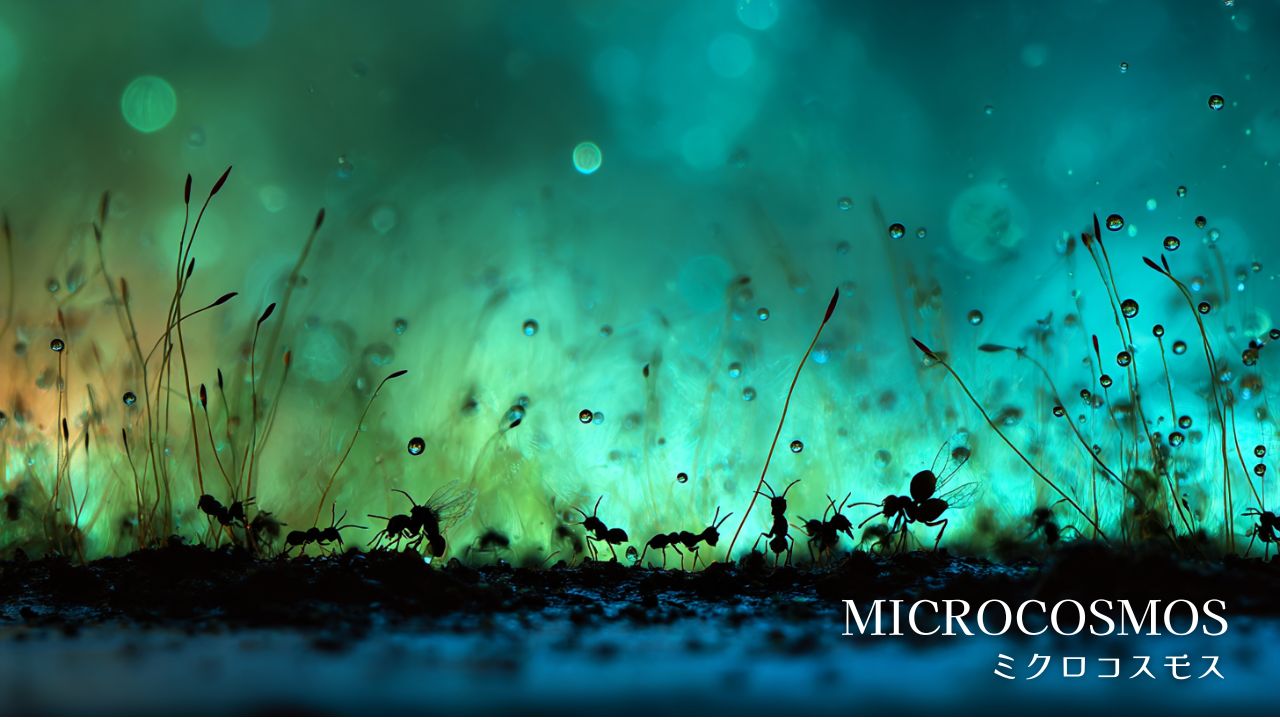
A single day in a meadow and pond in the Aveyron region of southern France, filmed through macro lenses, slow motion, and time-lapse, with almost no narration — only music and the sounds the creatures themselves make. The filmmakers spent three years developing specialized camera and lighting equipment before spending three more years filming. The result is 77 minutes of footage from a world that exists alongside ours and that most people have never actually seen.
Budget: $3.8 million. Worldwide gross: $52.8 million. IMDb: 7.9. Metacritic: 87. Screened out of competition at Cannes in 1996, and quietly beloved ever since.
Basic Information & Synopsis
→ For synopsis and production information, see our Database Article
Director: Claude Nuridsany, Marie Pérennou
Year: 1996
Runtime: 77 minutes
Production: Galatée Films, France 2 Cinéma, Bac Films
Commemorative Day: Insect Day (June 4)
Background Knowledge
Claude Nuridsany and Marie Pérennou — Biologists Making Cinema
Both directors are biologists, not filmmakers. Over twenty-five years of researching and documenting insect life, they developed the desire to show the world of small creatures to a general audience through the medium of cinema. They had no precedent for how to do this technically.
Over three years, they designed and built specialized macro camera systems and lighting equipment from scratch — existing technology could not achieve the extreme close-up work and slow-motion capture they needed. The filming itself then required three more years. The resulting footage was compressed into 77 minutes.
The Decision to Remove Narration
Conventional nature documentaries use narrators to explain the images, attribute emotions and motivations to the animals, and provide context that makes the footage legible. Nuridsany and Pérennou refused this approach. A brief opening narration (voiced by Jacques Perrin in the French version, Kristin Scott Thomas in the English version) establishes the setting; after that, the film is sound and image alone.
This is an act of intellectual honesty: the film does not impose a human interpretation on what the insects are doing. It presents the images and leaves the interpretation to the viewer. Whether that is experienced as liberating or demanding depends on the viewer.
The Music — Bruno Coulais
Composer Bruno Coulais wrote a score designed to track the visual rhythm of the insects’ movements rather than explain the emotional content of the scenes. The dung beetle’s laborious struggle gets a grandiose orchestral passage. The snails’ mating receives tender strings. The music does not describe what is happening — it amplifies it. This is an unusual relationship between score and image, and it is the film’s second major formal achievement after the photography.
The Location — Aveyron, Southern France
The Aveyron region was chosen because it sits on the boundary between Mediterranean and Atlantic climates, giving it an unusually diverse range of plant species and insect life — a concentrated version of French meadow ecology.
What Makes It Exceptional
Showing a World That Exists but Has Not Been Seen
The film’s primary achievement is showing something real that most people have never observed. Through the macro lenses, a single drop of dew becomes a transparent sphere. A compound eye has the structure of a kaleidoscope. Pollen drifts as golden particles. These are not metaphors and not CGI — they are what these things actually look like when viewed at this scale.
The sensation the film produces — “is this really from Earth?” — is a disorientation of the genuinely strange that has been made visible for the first time. It changes how the viewer looks at a lawn or a garden afterward, which is perhaps the film’s most lasting effect.
No CGI, No Staging — Pure Reality
Everything in the film actually happened. The dung beetle fell. The mosquito hatched. The snails chose each other. None of this was arranged. That fact — that the camera was simply present when these events occurred, as a result of years of patience and technical preparation — gives the footage a quality of encounter rather than spectacle.
The Manipulation of Time
The film’s third formal achievement is the use of slow motion and time-lapse to make events visible that are normally either too fast to see or too slow to watch. The mosquito hatching through the water surface in slow motion acquires the scale of a spacecraft launching through the ocean floor. The snails’ mating in time-lapse gives a viewer the experience of living at the tempo of a snail. In both cases, a technical adjustment reveals something that the unaided eye and the unaided patience cannot access. This is what documentary cinema, specifically, can do.
Related Articles
- Microcosmos Database – Synopsis & Production Details
- Claude Nuridsany & Marie Pérennou – Filmmaker Profile
はじめに
足元にある宇宙——草むらの一日が教えてくれること
6月4日は「虫の日」です。
「6(む)4(し)」の語呂合わせから、1988年に手塚治虫氏をはじめとする昆虫愛好家たちが設立した日本昆虫クラブが制定しました。「昆虫が棲める街づくり」をテーマに、昆虫への関心と、昆虫が生きやすい環境の保全を呼びかける記念日です。後に解剖学者の養老孟司氏も「虫にも供養が大切」として記念日の制定に関わり、鎌倉の建長寺に虫塚を建立しています。
昆虫は地球上で最も繁栄している生き物のグループです。現在記録されている種だけで約100万種、未記録を含めれば500万種を超えるとも言われています。しかし私たちは日々、その存在をほとんど意識せずに歩き、踏み、見過ごして生きています。
この6月4日に観る作品として、クロード・ニュリドサニーとマリー・ペレノー監督による1996年のフランスのドキュメンタリー映画『ミクロコスモス』(Microcosmos: Le peuple de l’herbe)をお薦めします。
フランスのアヴェロン地方の草原と池の一日を舞台に、昆虫や小さな生き物たちの生活をマクロ撮影・スローモーション・タイムラプスで記録した本作は、3年以上かけて専用のカメラと照明機材を開発しながら制作されました。ナレーションはほぼなく、BGMのみ。言葉の代わりに、映像と音だけが草むらの宇宙を語ります。
製作費380万ドルに対して全世界で5280万ドルを稼ぎ出し、IMDbスコア7.9、Metacriticスコア87という高い評価を受けています。1996年カンヌ映画祭でコンペティション外上映され、その後世界中で静かに、しかし深く愛され続けている作品です。
基本情報・あらすじ
→ あらすじや製作情報はデータベース記事へ
監督: クロード・ニュリドサニー、マリー・ペレノー
製作年: 1996年
上映時間: 77分
制作: Galatée Films、France 2 Cinéma、Bac Films
記念日: 虫の日(6月4日)
予備知識
クロード・ニュリドサニーとマリー・ペレノー——生物学者が映画を作る
両監督は映画監督ではなく生物学者です。25年以上にわたって昆虫の生態を研究し記録してきた二人が、「小さな生き物の世界を映画として人々に見せたい」という動機から本作に取り組みました。
撮影のために、3年かけて専用のマクロカメラと照明機材を開発しました。通常の撮影機材では不可能な極限の接写と、昆虫の動きに合わせたスローモーション撮影を実現するために、既存の技術を一から再設計したのです。撮影自体にも3年を費やし、その膨大なフッテージを77分に凝縮しました。
ナレーションをほぼなくすという決断
通常の自然ドキュメンタリーは、ナレーターが映像を説明し、動物に感情や動機を付与します。本作はその手法を意図的に拒否しました。ごく短い冒頭のナレーション(フランス語版はジャック・ペラン、英語版はクリスティン・スコット・トーマス)を除けば、映像は音楽と昆虫が発する音だけで語られます。
この選択は「昆虫を人間の目線で解釈しない」という誠実さの表れでもあります。映像は昆虫をどう見るかを観客に委ねます。
音楽——ブルーノ・クレーの役割
音楽を担当したのはフランスの作曲家ブルーノ・クレーです。彼の音楽は昆虫の動きと映像のリズムに完璧に合わせて設計されており、フンコロガシの苦闘には荘厳なオーケストラが、カタツムリの交尾には甘美な弦楽が流れます。音楽が「感情の説明」ではなく「映像の拡張」として機能している稀有な例です。
撮影地——フランス・アヴェロン地方
撮影はフランス南部のアヴェロン地方で行われました。地中海性気候と大西洋性気候の境界に位置し、多様な植生と昆虫相を持つこの地方は、「フランスの草原の縮図」として選ばれました。
優れしている点
「見たことのない世界」を見せる映像
本作の最も際立った優れた点は、同じ地球上にありながら私たちが一度も見たことのない世界を見せることです。専用のマクロカメラで撮影された映像では、露の一粒が透き通ったガラス玉のように見え、昆虫の複眼が万華鏡のような構造を持ち、花粉が黄金の粒として空中を舞います。
「これは地球上の映像か」と思わせる異質な美しさが、観客の認識を根底から揺さぶります。
CGなし、演出なしのリアリティ
3年以上かけて、コンピュータグラフィックスを一切使わずに撮影されたこの映画は、映し出されるすべてが「実際に起きたこと」です。フンコロガシが転げ落ちるのも、カタツムリが交尾するのも、蚊が羽化するのも——演出された場面はありません。その事実が映像に圧倒的なリアリティをもたらします。
スローモーションとタイムラプスという「時間の操作」
本作の映像的な卓越性は、時間の操作にあります。蚊が水面を突き破って羽化する瞬間をスローモーションで見ると、それは宇宙船が水中から打ち上がるような壮大さを持ちます。反対にタイムラプスで撮影されたカタツムリの交尾は、「ゆっくりな生き物」の時間感覚を人間が追体験する場面になります。
通常の速度では「一瞬」か「長すぎて退屈」な出来事が、時間を操作することで初めて「見える」ようになる——これがドキュメンタリー映像の持つ固有の力です。
関連記事
- ミクロコスモス データベース – あらすじ・製作情報
- クロード・ニュリドサニー&マリー・ペレノー – 監督プロフィール