
Choose Your Language / 言語を選択:
Introduction
The Circle of Life the King of Beasts Teaches, and What the Real Lion Faces
August 10 is “World Lion Day.”
This commemorative day began in 2013. Sources differ on the circumstances of its founding: one account has it that the Botswana-based documentary makers Dereck and Beverly Joubert launched it in partnership with National Geographic’s Big Cat Initiative, while another has it that Rae Kokeš and David Youldon of the conservation organization ALERT conceived it, with the first event held in Livingstone, Zambia, on August 10, 2013. In either case, the starting point was a sense of crisis over the rapid decline of lions.
At present, for the wild lion population, the IUCN (International Union for Conservation of Nature) estimates 23,000–39,000, and the WWF estimates 20,000–25,000. The estimates have a range because surveys across the vast habitat are difficult. What is certain is the fact that the African lion declined by 43% over about 20 years from 2001.
On the IUCN Red List, the lion is classified as “Vulnerable.” The main threats are loss of habitat through conversion to farmland, conflict with humans over livestock damage, poaching aimed at the illegal trade in bones and body parts, and climate change.
Furthermore, there is also the problem that, to obtain bones as material for traditional medicine, several thousand lions are bred in various places around the world. Some individuals are made the object of what is called “canned hunting” — hunting in which they can be surely brought down within an enclosure.
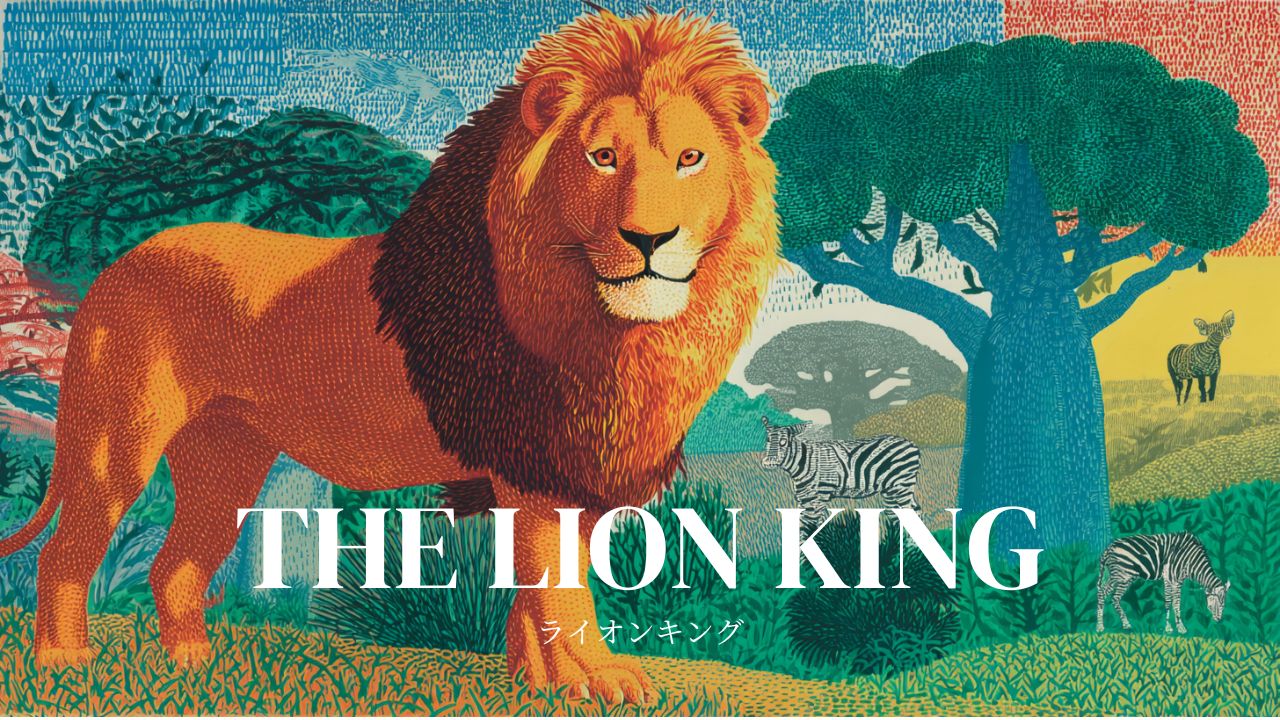
As the film to watch on this day, we take up the 1994 Disney animation The Lion King, directed by Roger Allers and Rob Minkoff.
This work is the most widely known in the world among works with a lion as protagonist. For many, it is also the work that shaped their image of the lion as an animal. In this article, however, we also touch on the differences between what the film depicted and the ecology and situation of the real lion.
Basic Information & Synopsis
→ For synopsis and production information, see our Database Article
Director: Roger Allers, Rob Minkoff
Year: 1994
Runtime: 88 minutes
Production: Walt Disney Pictures / Walt Disney Feature Animation
Commemorative Day: World Lion Day (August 10)
Background Knowledge
Where Is It Set
Pride Lands, the setting of this work, is a fictional place. The film gives no specific country name.
For the production, the staff visited Hell’s Gate National Park in Kenya and researched the scenery and the animals. The modeling of Pride Rock and the depiction of the savanna are based on this research.
Therefore, descriptions such as “set in Tanzania” are not accurate. It is appropriate to understand it as a fictional land referring to the landscape of East Africa.
Hamlet as an Underlay
The story structure of this work is strongly influenced by Shakespeare’s Hamlet.
A king is killed by his brother, a prince meets his father’s ghost, and confronts the usurper — Mufasa corresponds to King Hamlet, Scar to Claudius, Simba to Hamlet, and Nala to Ophelia.
The ending, however, differs greatly. Where Hamlet ends with the deaths of nearly all the main characters, this work concludes with rebirth and succession.
The Background of the Production
The project began in 1988, and was initially advanced under working titles such as Kingdom of the Sun. It was the first Disney work set in Africa, and is also a feature by an original screenplay.
The animators observed real animals such as lions in approaching their drawing. Wildlife specialists brought animals to the studio and, it is said, gave advice on movement and behavior.
The wildebeest stampede scene was made with 3DCG, advanced for its time. Several wildebeest were created and multiplied into several hundred, given hand-drawn-style shading, and made to run down the mountainside each on a different path. Five animators and technicians spent more than two years on this two-and-a-half-minute scene.
The music was by Elton John (composition) and Tim Rice (lyrics), with the score by Hans Zimmer, all of whom won Academy Awards.
Incidentally, midway through production, George Scribner, the original director, stepped down over being unable to agree to the musical direction, and Rob Minkoff joined.
On the Direction of “Be Prepared”
The scene of “Be Prepared,” sung by Scar and the hyenas, has an unease unusual for a Disney work.
The lurid green and red color tones, the geometrically aligned formation of hyenas, Scar looking down from atop a cliff — this direction is known to refer to Leni Riefenstahl’s Nazi propaganda film Triumph of the Will (1935).
It is an ambitious scene that brought an expression of totalitarian agitation into a work for children.
The Film’s Lions, and Real Lions
If you watch this work on the commemorative day, there is a point worth keeping in mind. Lion society in the film differs considerably from that in reality.
The reality of the pride
A real lion pride has related females at its core. Daughters remain in the pride they were born into and spend their whole lives with their mother and sisters. Males, when they grow up, leave the pride and try to take over other prides.
In other words, it is the females who carry the continuity of the pride, and the males are ones who are replaced within a few years. The “succession of the throne from father to son” that the film depicts almost never happens in reality.
Who hunts
The females handle most of the hunting. They are skilled at the technique of cooperatively driving prey into a corner, and supply much of the pride’s food.
Males mainly play the role of defending the pride’s territory from other males. Being large and conspicuous, they are ill-suited to hunting.
In the film, Mufasa and Simba reign as kings, and the role of the females is little depicted. In reality, it is Nala and Sarabi and the others who are the presence that supports the pride.
The reality of infanticide
The film’s Scar is depicted as an individual who kills his brother out of a lust for power. But the real lion has a harsher habit.
A male who has newly taken over a pride commonly kills the previous male’s cubs. Because a nursing female does not come into heat, by removing the cubs he can leave his own offspring sooner.
This is behavior explained not as cruelty but as a breeding strategy. What the film depicted as a story of good and evil is, in reality, outside the frame of morality.
On the “Circle of Life”
Mufasa’s teaching of the “Circle of Life” — the lion eats the antelope, becomes grass after death, and the antelope eats that grass — is an excellent expression for conveying the cycle of the ecosystem to children.
The cycling of energy and matter through trophic levels is, in fact, just so.
On the other hand, if one reads this teaching with the implication that “the lion at the top of the food chain governs nature,” it is somewhat misleading. There is no king in an ecosystem. The apex predator plays an important role, but that is not governance — it is one part of an interaction.
That said, it is a fact that large predators like the lion are important to the ecosystem. By their regulating the population of herbivores, vegetation is protected and biodiversity is maintained. That an ecosystem which has lost its predators collapses has been confirmed in various places.
What Makes It Exceptional
Respect for the Lion as an Animal
What this work certainly achieved was to depict the lion as an object of reverence.
Mufasa’s dignity through hand-drawn animation, the expression of the mane, the figure surveying the savanna. These draw out to the maximum the formal beauty of this animal.
The image many people hold of the lion derives in no small part from this film. As a doorway to getting people to take an interest in the lion as an object of protection, its influence is not small.
The Depiction of the African Landscape
From the opening “Circle of Life” to the dawn savanna, the changes of wet and dry seasons, and the starry sky, the background art of this work is extremely rich.
The fruits of the production team’s research in Kenya are reflected in the expression of color and light.
Environmental Ruin as Visualization
The depiction of Pride Lands becoming a wasteland under Scar’s rule shows the collapse of an ecosystem in a form even children can understand.
Excessive predation, the exhaustion of resources, and then the death of the land. The structure whereby everyone suffers if the balance breaks down has functioned as material for environmental education.
That It Depicted Death
Mufasa’s death has a weight unusual for a children’s animation.
The stillness of the scene in which Simba finds his father’s body and crawls under his foreleg was engraved in the memory of many viewers. That it depicted loss without hiding it lifts this work above mere entertainment.
Related Articles
- The Lion King Database – Synopsis & Production Details
- Roger Allers – Profile
- Rob Minkoff – Profile
はじめに
百獣の王が教える生命の環と、現実のライオンが直面するもの
8月10日は「世界ライオンの日」(World Lion Day)です。
この記念日は2013年に始まりました。創設の経緯については資料が分かれており、ボツワナを拠点とするドキュメンタリー作家デレック&ベヴァリー・ジュベール夫妻が、ナショナル・ジオグラフィックのビッグ・キャット・イニシアチブと連携して立ち上げたとする説と、保護団体ALERTのレイ・コケシュとデヴィッド・ユールドンが考案し、2013年8月10日にザンビアのリヴィングストンで最初の催しが開かれたとする説があります。いずれにせよ、ライオンの急激な減少への危機感が出発点でした。
現在、野生のライオンの個体数について、IUCN(国際自然保護連合)は23,000〜39,000頭、WWFは20,000〜25,000頭と推計しています。推計に幅があるのは、広大な生息域での調査が困難なためです。確かなのは、アフリカのライオンが2001年からの約20年で43%減少したという事実です。
IUCNのレッドリストにおいて、ライオンは「危急種(Vulnerable)」に分類されています。主な脅威は、農地への転換による生息地の喪失、家畜被害をめぐる人間との衝突、骨や体の一部の違法取引を目的とした密猟、そして気候変動です。
さらに、伝統薬の材料として骨を得るために、世界各地で数千頭のライオンが飼育されているという問題もあります。「缶詰狩猟(canned hunting)」と呼ばれる、囲いの中で確実に仕留められる狩猟の対象とされる個体もいます。
この日に観る作品として、ロジャー・アラーズ&ロブ・ミンコフ監督による1994年のディズニー・アニメーション『ライオン・キング』(The Lion King)を取り上げます。
本作は、ライオンを主人公にした作品として世界で最も広く知られたものです。多くの人にとって、ライオンという動物のイメージを形作った作品でもあります。ただし本記事では、映画が描いたものと、現実のライオンの生態や置かれた状況との違いにも触れていきます。
基本情報・あらすじ
→ あらすじや製作情報はデータベース記事へ
監督: ロジャー・アラーズ、ロブ・ミンコフ
製作年: 1994年
上映時間: 88分
制作: ウォルト・ディズニー・ピクチャーズ/ウォルト・ディズニー・フィーチャー・アニメーション
記念日: 世界ライオンの日(8月10日)
予備知識
舞台はどこか
本作の舞台であるプライドランドは、架空の場所です。映画は具体的な国名を示していません。
制作にあたって、スタッフはケニアのヘルズゲート国立公園を訪れ、風景と動物たちを取材しました。プライドロックの造形や、サバンナの描写は、この取材に基づいています。
したがって「タンザニアが舞台」といった記述は正確ではありません。アフリカ東部の景観を参照した、架空の土地と理解するのが適切です。
『ハムレット』という下敷き
本作の物語構造は、シェイクスピアの『ハムレット』に強く影響を受けています。
王が弟に殺され、王子が父の亡霊と出会い、簒奪者と対決する――ムファサはハムレット王、スカーはクローディアス、シンバはハムレット、ナラはオフィーリアに対応します。
ただし結末は大きく異なります。『ハムレット』が主要人物のほぼ全員の死で終わるのに対し、本作は再生と継承で締めくくられます。
制作の背景
企画は1988年に始まり、当初は『Kingdom of the Sun』などの仮題で進められました。ディズニー作品として初めてアフリカを舞台とし、オリジナル脚本による長編でもあります。
アニメーターたちは、ライオンなどの動物を実際に観察して作画に臨みました。野生動物専門家がスタジオに動物を連れて訪れ、動きや行動について助言したといいます。
ヌーの暴走場面は、当時としては先進的な3DCGで制作されました。数体のヌーを作成して数百体に増殖させ、手描き風の陰影を施し、それぞれ異なる経路で山腹を駆け下りさせています。5人のアニメーターと技術者が、2分半のこの場面に2年以上を費やしました。
音楽はエルトン・ジョン(作曲)とティム・ライス(作詞)、スコアはハンス・ジマーが担当し、いずれもアカデミー賞を受賞しています。
なお制作途中で、当初監督だったジョージ・スクリブナーが、ミュージカル化の方針に同意できず降板し、ロブ・ミンコフが加わりました。
「Be Prepared」の演出について
スカーとハイエナが歌う「Be Prepared(準備をしておけ)」の場面は、ディズニー作品としては異例の不穏さを持っています。
緑と赤の毒々しい色調、幾何学的に整列するハイエナの隊列、崖の上から見下ろすスカー――この演出は、レニ・リーフェンシュタールのナチス宣伝映画『意志の勝利』(1935年)を参照したものとして知られています。
全体主義的な扇動の表現を、子ども向け作品に持ち込んだ意欲的な場面です。
映画のライオンと、本物のライオン
記念日にこの作品を観るなら、押さえておきたい点があります。映画のライオン社会は、現実のそれとかなり異なるということです。
群れの実態
現実のライオンの群れ(プライド)は、血縁関係にあるメスたちが中核です。娘は生まれた群れに留まり、母や姉妹とともに生涯を過ごします。オスは成長すると群れを離れ、他の群れを乗っ取ろうとします。
つまり、群れの継続性を担っているのはメスであり、オスは数年で入れ替わる存在です。映画が描く「父から息子への王位継承」は、現実にはほとんど起こりません。
狩りをするのは誰か
狩りの大半はメスが担います。連携して獲物を追い込む技術に長けており、群れの食料の多くを供給しています。
オスは主に、群れの縄張りを他のオスから守る役割を果たします。体が大きく目立つため、狩りには不向きです。
映画では、ムファサやシンバが王として君臨し、メスたちの役割はあまり描かれません。実際には、ナラやサラビたちこそが群れを支える存在です。
子殺しという現実
映画のスカーは、権力欲から兄を殺す個体として描かれます。しかし現実のライオンには、より過酷な習性があります。
新たに群れを乗っ取ったオスは、前のオスの子を殺すことが一般的です。授乳中のメスは発情しないため、子を排除することで早く自分の子を残せるからです。
これは残虐性ではなく、繁殖戦略として説明される行動です。映画が善悪の物語として描いたものは、現実には道徳の枠外にあります。
「生命の環」について
ムファサが説く「生命の環」――ライオンがアンテロープを食べ、死後は草になり、その草をアンテロープが食べる――という教えは、生態系の循環を子どもに伝える表現として優れています。
栄養段階を通じたエネルギーと物質の循環は、実際にそのとおりです。
一方で、この教えを「食物連鎖の頂点にいるライオンが自然を統治している」という含意で読むと、やや誤解を招きます。生態系に王はいません。頂点捕食者は重要な役割を担いますが、それは統治ではなく相互作用の一部です。
とはいえ、ライオンのような大型捕食者が生態系にとって重要であることは事実です。彼らが草食動物の個体数を調整することで、植生が守られ、生物多様性が維持されます。捕食者を失った生態系が崩れることは、各地で確認されています。
優れている点
ライオンという動物への敬意
本作が確かに達成したのは、ライオンを畏敬の対象として描いたことです。
手描きアニメーションによるムファサの威厳、たてがみの表現、サバンナを見渡す姿。これらは、この動物の造形的な美しさを最大限に引き出しています。
多くの人がライオンに抱くイメージは、少なからずこの映画に由来しています。保護の対象として関心を持ってもらう入り口として、その影響は小さくありません。
アフリカの景観の描写
冒頭の「サークル・オブ・ライフ」から、夜明けのサバンナ、雨季と乾季の変化、星空まで、本作の背景美術は極めて豊かです。
制作陣がケニアで取材した成果が、色彩と光の表現に反映されています。
環境の荒廃という視覚化
スカーの統治下でプライドランドが荒れ地になる描写は、生態系の崩壊を子どもにも理解できる形で示しています。
過剰な捕食、資源の枯渇、そして土地の死。バランスが崩れれば全員が苦しむという構図は、環境教育の題材として機能してきました。
死を描いたこと
ムファサの死は、子ども向けアニメーションとしては異例の重さを持っています。
シンバが父の亡骸を見つけ、その前脚の下にもぐり込む場面の静けさは、多くの観客の記憶に刻まれました。喪失を隠さずに描いたことが、本作を単なる娯楽から引き上げています。
関連記事
- ライオン・キング データベース – あらすじ・製作情報
- ロジャー・アラーズ – プロフィール
- ロブ・ミンコフ – プロフィール