
Choose Your Language / 言語を選択:
Introduction
The Road the Girls of the “Stolen Generations” Walked to Their Mother
August 9 is the “International Day of the World’s Indigenous Peoples.” It was established on December 23, 1994, by Resolution 49/214 of the United Nations General Assembly. The date commemorates the first meeting of the UN Working Group on Indigenous Populations, held in Geneva on August 9, 1982.
The world’s indigenous peoples number an estimated 370 to 500 million. Living in over 90 countries, they make up less than 5% of the world’s population yet account for 15% of the poorest. They speak the great majority of the world’s roughly 7,000 languages and own, occupy, or use approximately 22% of the earth’s land area.
The UN positions indigenous peoples as “inheritors and practitioners of unique cultures and ways of relating to people and the environment.” Yet throughout history, their rights have been repeatedly violated.
As the film to watch on this day, we recommend Phillip Noyce’s 2002 Australian film Rabbit-Proof Fence.
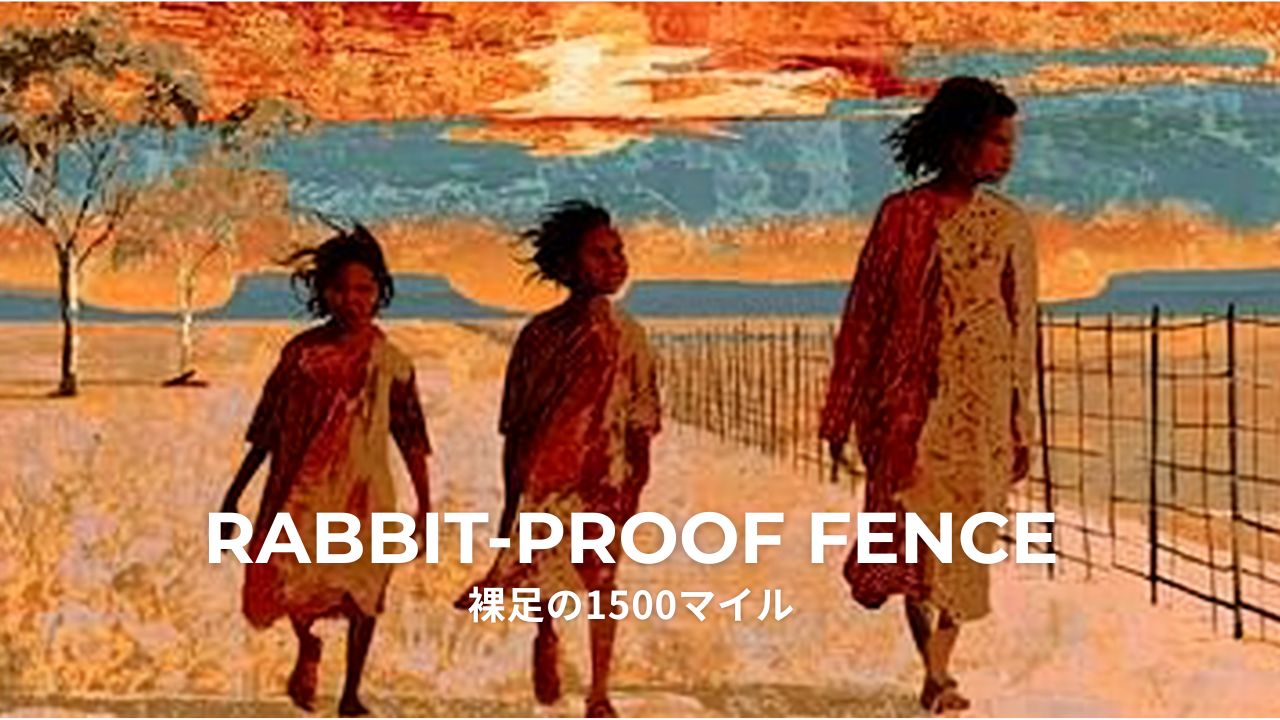
This work depicts the true story of three Aboriginal girls who, in 1931, were separated from their family by the Australian government’s assimilation policy and walked all the way across the desert to return to their mother. What they followed was the rabbit-proof fence that runs the length of the continent.
This is a work depicting the real experience of Australia’s “Stolen Generations” — the Aboriginal and Torres Strait Islander children who were forcibly separated from their families under a policy that lasted from roughly 1905 to 1970.
Basic Information & Synopsis
→ For synopsis and production information, see our Database Article
Director: Phillip Noyce
Year: 2002
Runtime: 94 minutes
Production: Rumbalara Films / Australian Film Finance Corporation
Commemorative Day: International Day of the World’s Indigenous Peoples (August 9)
Background Knowledge
On the Distance Walked
The Japanese title of this work is 1500 Miles Barefoot, but as for the distance actually walked, two figures are given depending on the source.
The original book and many sources give about 1,600 kilometers (about 990 miles). On the other hand, in commentary on the film and some sources, the figure of about 2,400 kilometers (about 1,500 miles) is also used. The Japanese title is based on the latter.
In any case, it was a journey on foot lasting nine weeks. Girls of 14, 10, and 8 crossed the desert.
What Are the “Stolen Generations”
The “Stolen Generations” refers to the Aboriginal and Torres Strait Islander children who, from roughly 1905 to 1970, were forcibly separated from their families by the policies of the Australian government and churches.
The rationale for the policy was a tangle of several ideas. The notion, based on eugenics, of thinning the “black blood” by marrying mixed-race children to whites. The doctrine of regarding Aboriginal culture as inferior and assimilating them into white culture. And the pretext of “protecting” children from a “dangerous” environment.
The method was forcible removal by police. Mixed-race children in particular were targeted, and placed in native settlements, orphanages, or white households. The use of Aboriginal languages was forbidden, and training was given as domestic servants or manual laborers.
The effects continue to this day. An estimated 100,000 or more were separated, and it remained in the forms of trauma across generations, loss of culture and identity, the severing of family bonds, and high rates of mental health problems and addiction.
In 1997, the Australian Human Rights Commission released the report Bringing Them Home and severely criticized this policy.
On February 13, 2008, Prime Minister Kevin Rudd made an official apology to the “Stolen Generations” in the federal parliament. It was a landmark moment in Australian history.
But at the time this work was released in 2002, Prime Minister John Howard was refusing to apologize. This situation made the film more controversial.
The Three Real People, and What Followed
Molly Craig (later Molly Kelly) was born around 1916 or 1917 in Jigalong. She was a Martu woman. After the 1931 escape, she married the Aboriginal stockman Toby Kelly. In 1940 she was removed again, and escaped again. In January 2004, at about 87, she died in her home region of Jigalong.
Daisy Kadibil (née Burungu) was born in 1923. She was Molly’s half-sister. She was living at the time of the film’s release, but on March 30, 2018, she died at 94 or 95 in Port Hedland.
Gracie Cross (née Fields) was sent back to Moore River and raised in an institution. She never reunited with her mother.
The Author Doris Pilkington Garimara
The author of the original book Follow the Rabbit-Proof Fence (1996) is Molly’s own daughter.
And she herself was one of the “Stolen Generations.” When her mother was removed again in 1940, she was left in an institution at the age of four, and it took more than 20 years until she reunited with her mother. And it was a further 10 years after that before she learned the story of her mother’s escape.
As an adult she investigated her family’s history, conducted interviews with relatives, and researched government records to write this book. As a trilogy, there is Caprice: A Stockman’s Daughter (1991), depicting her grandmother; this work, depicting her mother; and Under the Wintamarra Tree (2002), depicting herself.
Doris died in 2014.
Director Phillip Noyce
Director Phillip Noyce, born in 1950, is one of Australia’s representative filmmakers.
He began shooting films in Australia in the 1970s, and his early work Backroads (1977) already took Aboriginal people as its theme. From 1989 he worked in Hollywood, directing big productions such as Patriot Games, Clear and Present Danger, and The Bone Collector.
After 13 years of Hollywood life, he returned to his homeland and shot this work. It was an extremely personal project for him.
Noyce has said: “I wanted to make a film in which every Australian viewer would be deeply, emotionally involved, and would want to take on these three girls as their own children.”
Reception and Controversy
This work was released in Australia in 2002 and succeeded both critically and commercially. It won Best Film at the Australian Film Institute Awards (AFI Awards) and gained audience awards at many international film festivals. Its worldwide box-office gross was around $16 million, against a production cost of about $6 million.
At the same time, there was controversy from the start of its release.
From part of the conservative camp came criticism that the film distorted history. The argument was that the government’s policy was made in good faith, and that the children were not “stolen” but “protected.” One government figure issued a document criticizing the film’s depiction and demanded an apology from the makers.
The production team countered that the film was based on much historical testimony and on the Bringing Them Home report.
With the passage of time, the value of this work came to be widely recognized. In 2005, the British Film Institute selected it as one of the “50 films to see by the age of 14.”
What Makes It Exceptional
Telling It from the Victims’ Viewpoint
The greatest strength of this work is that it depicted a vast injustice from the viewpoint of those without power.
Many historical films take the viewpoint of leaders or the powerful. But the center of this work is three girls.
They do not discuss policy. They simply want to return to their mother. This simple, universal wish reaches the audience’s heart directly.
The Presence of Girls with No Acting Experience
The leads Everlyn Sampi, Tianna Sansbury, and Laura Monaghan were all Aboriginal girls with no acting experience. The production team auditioned several hundred across all of Australia and chose these three.
The three girls’ performances are astonishingly natural. Fear, resolve, exhaustion, hope — these are shown not as technique but as things simply there.
In Everlyn Sampi’s eyes in particular dwells an unwavering will. Her lines are few, yet her presence is overwhelming.
Critics praised their performances as “astonishingly real.”
A Neville Who Is Not One-Dimensional
Kenneth Branagh avoided playing Neville as a simple villain.
His Neville sincerely believes he is doing the right thing. He is not cruel but thinks himself “rational” and “scientific.” He means to be “protecting” the children.
This way of depicting him is more frightening. For the worst injustices are often carried out by well-meaning people, in the name of a rational system.
The Complexity of the Tracker Moodoo
Moodoo, played by David Gulpilil, is the most complex person in this work.
Though himself Aboriginal, he is in the position of pursuing the girls. He too has had a daughter taken by the institution, and has no choice but to live within the system.
In the scene where he reports that he has “lost the tracks,” there is an unstated choice. This ambiguity gives the film its depth.
Christopher Doyle’s Cinematography
The cinematographer is Christopher Doyle, who has been based in Hong Kong. A cinematographer known for Wong Kar-wai’s works (Chungking Express, In the Mood for Love, and others), he shows an entirely different style in this work.
He who made his name with urbane, densely colored imagery here captured the vastness and harshness of the Australian outback in dry light.
Peter Gabriel’s Music
The soundtrack Long Walk Home: Music from the Rabbit-Proof Fence was composed by Peter Gabriel.
It is a score fusing traditional Aboriginal sounds such as the didgeridoo with contemporary electronic sound. It gives a universal dimension to the girls’ walk.
Related Articles
- Rabbit-Proof Fence Database – Synopsis & Production Details
- Phillip Noyce – Profile
はじめに
「盗まれた世代」の少女たちが、母のもとへ歩いた道
8月9日は、「世界先住民の国際デー」(International Day of the World’s Indigenous Peoples)です。1994年12月23日、国際連合総会の決議49/214によって制定されました。この日付は、1982年8月9日にジュネーブで開かれた国連先住民作業部会の初会合を記念するものです。
世界の先住民は、推定で3億7000万から5億人。90以上の国に暮らし、世界人口の5%未満でありながら、最貧層の15%を占めています。彼らは世界に約7,000ある言語の大多数を話し、地球の陸地面積のおよそ22%を所有、占有、または利用しています。
国連は先住民を「独自の文化と、人々や環境との関わり方の継承者であり実践者」と位置づけています。しかし歴史を通じて、その権利は繰り返し侵害されてきました。
この日に観る作品として、フィリップ・ノイス監督による2002年のオーストラリア映画『裸足の1500マイル』(原題:Rabbit-Proof Fence)を推薦します。
本作は、1931年、オーストラリア政府の同化政策によって家族から引き離された3人のアボリジニの少女が、母のもとへ帰るために砂漠を歩き通した実話を描いています。彼女たちが辿ったのは、大陸を縦断するウサギ避けフェンスでした。
これは、オーストラリアの「盗まれた世代」(Stolen Generations)――およそ1905年から1970年まで続いた政策により、家族から強制的に引き離されたアボリジニとトレス海峡諸島民の子どもたち――の実体験を描いた作品です。
基本情報・あらすじ
→ あらすじや製作情報はデータベース記事へ
監督: フィリップ・ノイス
製作年: 2002年
上映時間: 94分
制作: ランバララ・フィルムズ/オーストラリア映画公社
記念日: 世界先住民の国際デー(8月9日)
予備知識
歩いた距離について
本作の邦題は『裸足の1500マイル』ですが、実際に歩いた距離については、資料によって二つの数字が示されています。
原作および多くの資料は、約1,600キロメートル(約990マイル)としています。一方、映画の解説や一部の資料では、約2,400キロメートル(約1,500マイル)という数字も使われています。邦題は後者に基づくものです。
いずれにせよ、9週間にわたる徒歩の旅でした。14歳、10歳、8歳の少女たちが、砂漠を横断したのです。
「盗まれた世代」とは何か
「盗まれた世代」とは、およそ1905年から1970年まで、オーストラリア政府と教会の政策により、家族から強制的に引き離されたアボリジニとトレス海峡諸島民の子どもたちを指します。
政策の根拠は、複数の思想が絡み合ったものでした。優生学に基づき、混血の子どもを白人と結婚させることで「黒い血」を薄めるという発想。アボリジニ文化を劣ったものと見なし、白人文化へ同化させるという主義。そして、子どもを「危険な」環境から「保護」するという建前です。
方法は、警察による強制連行でした。特に混血の子どもが標的とされ、原住民居留地、孤児院、あるいは白人家庭に配置されました。アボリジニ言語の使用は禁じられ、家事使用人や肉体労働者としての訓練が施されます。
影響は、今日まで続いています。推定10万人以上が引き離され、世代を超えたトラウマ、文化とアイデンティティの喪失、家族の絆の断絶、精神的健康問題や依存症の高率といった形で残りました。
1997年、オーストラリア人権委員会は報告書『Bringing Them Home』を発表し、この政策を厳しく批判しました。
2008年2月13日、ケビン・ラッド首相が連邦議会で「盗まれた世代」への公式謝罪を行います。オーストラリア史における画期的な瞬間でした。
しかし本作が公開された2002年当時、ジョン・ハワード首相は謝罪を拒否していました。この状況が、映画をより論争的なものにしました。
実在の三人と、その後
モリー・クレイグ(後にモリー・ケリー)は1916年か1917年頃、ジガロング生まれ。マルトゥ族の女性です。1931年の脱走の後、アボリジニの牧夫トビー・ケリーと結婚しました。1940年に再び連行され、再び脱走します。2004年1月、およそ87歳で故郷ジガロングにて死去しました。
デイジー・カディビル(旧姓ブルングー)は1923年生まれ。モリーの異母妹です。映画公開時は存命でしたが、2018年3月30日、94〜95歳でポートヘッドランドにて死去しました。
グレイシー・クロス(旧姓フィールズ)は、ムーア・リバーに送り返された後、施設で育ちました。母親と再会することはありませんでした。
原作者ドリス・ピルキントン・ガリマラ
原作『Follow the Rabbit-Proof Fence』(1996年)の著者は、モリーの実の娘です。
そして彼女自身も「盗まれた世代」の一人でした。1940年に母が再び連行された際、彼女は4歳で施設に残され、母と再会するまでに20年以上を要しました。そして母の脱走の物語を知るのは、そのさらに10年後のことです。
彼女は成人後、家族の歴史を調べ、親族に聞き取りを行い、政府の記録を調査してこの本を書きました。三部作として、祖母を描いた『Caprice: A Stockman’s Daughter』(1991年)、母を描いた本作、そして自分自身を描いた『Under the Wintamarra Tree』(2002年)があります。
ドリスは2014年に死去しました。
フィリップ・ノイス監督
監督のフィリップ・ノイスは1950年生まれ、オーストラリアを代表する映画作家の一人です。
1970年代からオーストラリアで映画を撮り始め、初期作『バックロード』(1977年)は既にアボリジニをテーマにしていました。1989年からハリウッドで活動し、『パトリオット・ゲーム』『今そこにある危機』『ボーン・コレクター』といった大作を監督します。
13年のハリウッド生活の後、彼は故郷に戻り、本作を撮りました。彼にとって極めて個人的な企画でした。
ノイスは語っています。「すべてのオーストラリア人の観客が感情的に深く関与し、この3人の少女を自分の子どものように引き受けたいと思う映画を作りたかった」
評価と論争
本作は2002年にオーストラリアで公開され、批評的にも商業的にも成功しました。オーストラリア映画協会賞(AFI賞)で最優秀作品賞を受賞し、多くの国際映画祭で観客賞を得ています。全世界の興行収入は1,600万ドル前後、製作費は約600万ドルでした。
一方で、公開当初から論争もありました。
保守派の一部からは、映画が歴史を歪めているという批判が出ました。政府の政策は善意によるものであり、子どもたちは「盗まれた」のではなく「保護」されたのだ、という主張です。ある政府関係者は、映画の描写を批判する文書を発行し、制作者に謝罪を求めました。
制作陣は、映画が多くの歴史的証言と『Bringing Them Home』報告書に基づいていると反論しています。
時間の経過とともに、本作の価値は広く認められるようになりました。2005年、英国映画協会は本作を「14歳までに観るべき50本」の一つに選んでいます。
優れている点
被害者の視点から語ること
本作の最大の優れた点は、権力を持たない側の視点から、巨大な不正義を描いたことです。
多くの歴史映画は、指導者や権力者の視点を取ります。しかし本作の中心は、3人の少女です。
彼女たちは政策を論じません。ただ、母のもとに帰りたいだけです。この単純で普遍的な願いが、観客の心に直接届きます。
演技経験のない少女たちの存在感
主演のエヴァリン・サンピ、ティアンナ・サンズベリー、ローラ・モナハンは、いずれも演技経験のないアボリジニの少女でした。制作陣はオーストラリア全土で数百人をオーディションし、この3人を選んでいます。
3人の演技は、驚くほど自然です。恐怖、決意、疲労、希望――それらが技巧としてではなく、そこにあるものとして映ります。
特にエヴァリン・サンピの目には、揺るぎない意志が宿っています。台詞は少なく、しかし存在感は圧倒的です。
批評家は彼女たちの演技を「驚くほど本物」と評しました。
一面的でないネヴィル
ケネス・ブラナーは、ネヴィルを単純な悪役として演じることを避けました。
彼のネヴィルは、自分が正しいことをしていると本気で信じています。残酷なのではなく、「合理的」で「科学的」だと考えている。彼は子どもたちを「保護」しているつもりなのです。
この描き方は、より恐ろしいものです。最悪の不正義は、しばしば善意の人々によって、合理的なシステムの名の下に行われるからです。
追跡者ムードゥの複雑さ
デヴィッド・ガルピリル演じるムードゥは、本作で最も複雑な人物です。
彼はアボリジニでありながら、少女たちを追う立場にあります。彼自身も施設に娘を取られた身であり、システムの中で生きるほかありません。
彼が「足跡を見失った」と報告する場面には、明示されない選択があります。この曖昧さが、映画に深みを与えています。
クリストファー・ドイルの撮影
撮影監督は、香港を拠点に活動してきたクリストファー・ドイルです。ウォン・カーウァイ作品(『恋する惑星』『花様年華』など)で知られる撮影監督ですが、本作ではまったく異なる作風を見せています。
都会的で色彩の濃密な映像で名を成した彼が、ここではオーストラリアのアウトバックの広大さと過酷さを、乾いた光で捉えました。
ピーター・ガブリエルの音楽
サウンドトラック『Long Walk Home: Music from the Rabbit-Proof Fence』は、ピーター・ガブリエルが作曲しました。
ディジュリドゥなどアボリジニの伝統的な音を、現代的な電子音と融合させたスコアです。少女たちの歩みに、普遍的な次元を与えています。
関連記事
- 裸足の1500マイル データベース – あらすじ・製作情報
- フィリップ・ノイス – プロフィール